Liquid Optically Clear Adhesive (LOCA) Production Cost Analysis Report by Procurement Resource

Jul 24, 2025
5 min read
1 views
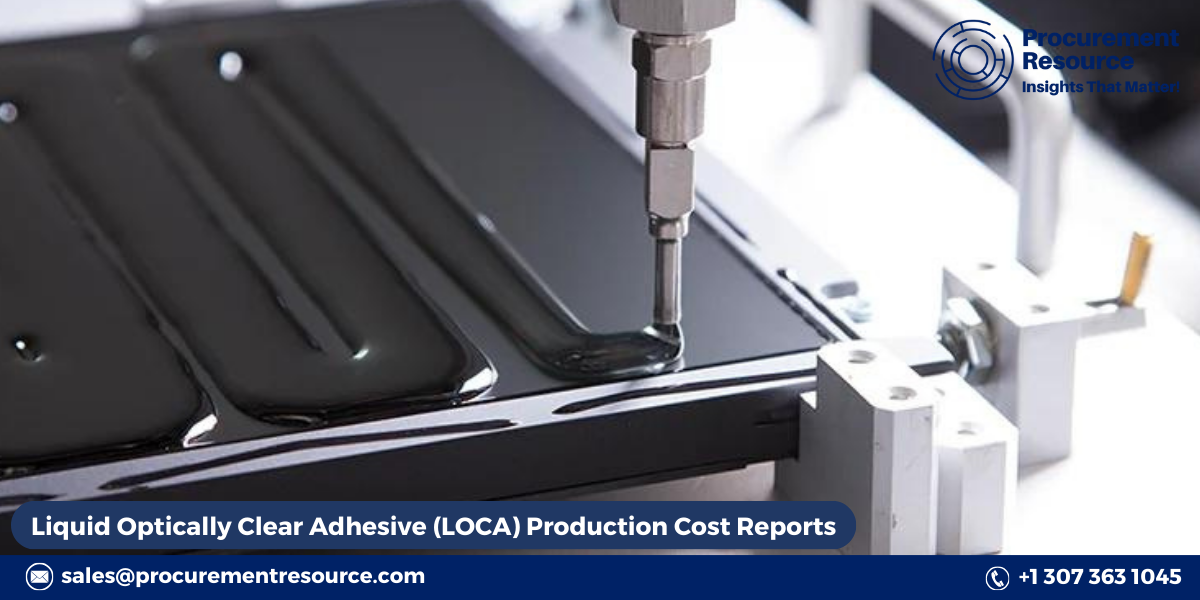
Procurement Resource, a premier provider of procurement intelligence and market research solutions, proudly releases its latest Liquid Optically Clear Adhesive (LOCA) Production Cost Report. This exhaustive analysis serves as a strategic tool for entrepreneurs, manufacturers, and investors aiming to navigate the increasingly competitive display materials industry. The report offers an end-to-end breakdown of LOCA production costs, raw material dynamics, market trends, production technologies, and economic feasibility, providing stakeholders with the data needed to make well-informed business decisions.
Liquid Optically Clear Adhesive (LOCA): A Critical Enabler of Advanced Display Technology
Liquid Optically Clear Adhesives (LOCAs) are specialized materials used primarily in the assembly of touch panels, LCDs, OLED displays, and mobile screens. Known for their high transparency, excellent adhesion, and durability, LOCAs improve display readability, contrast, and impact resistance by eliminating the air gap between the display components.
With the surge in consumer demand for high-resolution, touch-sensitive electronic devices, and the growing complexity of display panels in smartphones, tablets, automotive dashboards, and wearable electronics, the LOCA market is experiencing rapid growth. Manufacturers are now under pressure to optimize both performance and cost-efficiency, making detailed production cost analysis more essential than ever.
Comprehensive Cost Report for Strategic Investment and Planning
The LOCA Production Cost Report by Procurement Resource is crafted to serve as a complete guide for businesses planning to venture into or scale up LOCA production. It includes detailed assessments of production methodologies, input costs, technical and environmental considerations, and economic models tailored to various scales of operation.
Market Outlook: Growing Demand Across Consumer and Industrial Electronics
Global Trends and Regional Demand
The global LOCA market is expanding due to technological advancements in touch displays and increased adoption in smartphones, tablets, and automotive electronics. Asia-Pacific, led by South Korea, China, and Taiwan, remains the dominant region due to its concentration of display panel and electronics manufacturers. North America and Europe are witnessing steady growth, particularly in automotive and medical display applications.
Raw Material Pricing and Supply Dynamics
Key raw materials used in LOCA production include acrylates, epoxy resins, photoinitiators, UV stabilizers, and solvents. The report offers a detailed analysis of these inputs, highlighting cost drivers, regional sourcing challenges, and pricing trends that impact the overall cost of LOCA production.
Sustainability Trends and Regulatory Framework
Environmental concerns and the shift towards sustainable materials in electronics are influencing LOCA formulations. Regulatory frameworks like REACH (Europe) and RoHS (Global) impact material selection, compelling manufacturers to invest in non-toxic, eco-friendly adhesive compositions. The report covers evolving compliance requirements and their implications on production economics.
Technical Insights: LOCA Manufacturing Process and Plant Setup
Step-by-Step Manufacturing Process
The report elaborates on the most common manufacturing processes for LOCA, including:
Monomer blending and mixing: Base monomers (acrylates and epoxies) are precisely mixed under controlled conditions.
Addition of functional additives: UV initiators, stabilizers, and rheology modifiers are incorporated.
Degassing and filtration: The mixture is degassed to eliminate air bubbles and filtered to ensure optical purity.
Packaging and storage: The final adhesive is filled into UV-protected containers to prevent premature curing.
These steps require strict control over temperature, light exposure, and humidity to ensure product consistency and stability.
Technology and Machinery Requirements
Depending on production capacity and automation level, the report outlines machinery for:
Mixing vessels with UV protection
Inline filters and degassing systems
Viscosity and optical clarity testing instruments
Cleanroom-grade packaging units
Infrastructure and Utility Demands
A standard LOCA production facility requires:
ISO-grade cleanrooms (Class 1000 or better)
Precision HVAC systems
UV-safe storage areas
Water purification and solvent recovery systems
Utility needs include stable electricity, purified water, nitrogen gas (for inert atmospheres), and waste treatment facilities for solvent disposal.
Workforce and Quality Management
Manpower Requirements
The report details human resource requirements based on production scale, including:
Polymer chemists and process engineers
Quality assurance and lab technicians
Plant operators and maintenance personnel
Proper training in handling UV-sensitive materials and cleanroom protocols is emphasized.
Quality Control and Compliance
Given the optically sensitive nature of LOCAs, the report highlights stringent quality assurance measures such as:
Spectrophotometry for clarity assessment
Adhesion and peel strength tests
UV-curing tests to confirm polymerization behavior
Compliance with international standards such as ISO 10993 (biocompatibility for medical devices) and JEITA (for electronics) is also discussed.
Financial and Economic Evaluation
Capital Investment Breakdown
The report presents a complete overview of capital expenditure, including:
Land acquisition and facility construction
Equipment procurement and installation
Licensing and technology transfer costs
Initial working capital and raw material inventory
Investment models are tailored for both small-to-medium enterprises (SMEs) and large-scale producers.
Operating Cost Analysis
Operating expenses are segmented into:
Raw materials and chemical inputs
Energy consumption and utility bills
Labor and overheads
Quality assurance and compliance costs
Waste management and environmental control
Profitability Analysis and ROI Projections
The report offers detailed projections for:
Gross margins and unit cost breakdown
Market selling prices across regions
Return on investment (ROI) estimates under different scenarios
Sensitivity analysis based on raw material price fluctuations
Break-Even and Payback Period
Investors can access risk mitigation tools such as:
Break-even analysis
Cash flow modeling
Payback period estimation under various cost and pricing assumptions
Future Outlook: Innovation and Market Opportunities
The LOCA industry is poised for transformation driven by:
Flexible and foldable displays: Creating demand for stretchable, non-yellowing adhesives.
Mini-LED and Micro-LED technologies: Requiring ultra-clear, high-bond adhesives.
Automotive electronics: Increasing use in HUDs, infotainment systems, and digital dashboards.
Green chemistry initiatives are also leading to the development of solvent-free and bio-based LOCA formulations, offering a sustainable edge to forward-looking producers.
Why Choose Procurement Resource?
Procurement Resource stands at the forefront of chemical and material cost intelligence. With robust expertise in production modeling, supply chain analytics, and benchmarking, the company ensures clients access the most reliable, up-to-date insights for strategic decision-making.
Key Services Include:
Detailed cost structure and price trend analysis
Customized market entry studies
Competitive benchmarking and procurement strategy
Real-time market monitoring and alerts
Using proprietary data tools and expert research capabilities, Procurement Resource helps companies reduce procurement risk, optimize operations, and accelerate growth.
Get a Free Copy of the Report
For businesses considering entry into the LOCA manufacturing industry or looking to optimize existing operations, Procurement Resource’s Liquid Optically Clear Adhesive Production Cost Report offers a valuable roadmap. Whether you are a startup, a display panel manufacturer, or a raw material supplier, this report equips you with the actionable intelligence needed to succeed.
Request a Free Sample Report: https://www.procurementresource.com/production-cost-report-store/liquid-optically-clear-adhesive/request-sample
Contact Information
Company Name: Procurement Resource
Contact Person: Ashish Sharma (Sales Representative)
Email: [email protected]
Location: 30 North Gould Street, Sheridan, WY 82801, USA
Phone: UK: +44 7537171117 USA: +1 307 363 1045 Asia-Pacific (APAC): +91 1203185500
Comments
Amit Sharma is a Senior SEO Executive at Procurement Resource, passionate about digital marketing, content writing, and SEO strategy. With a B.Sc. in IT.