How Testers Decide What Not to Test and Why Does Skill Matters More Than Tools?

Jun 03, 2026
5 min read
15 views

Introduction
Software testing is not only about finding bugs now. Modern applications are large and connected with many systems together. A tester works with APIs, browsers, databases, cloud services, mobile apps, and automation tools at the same time. Because of this, testing every single thing is not possible anymore. Smart testers now spend more time deciding what should not be tested.
This helps teams save time, reduce pressure, and release software faster. Many students joining a Software Testing Course with Placement first focus only on automation tools. But real testing work depends more on understanding risk and selecting the right areas for testing.
Why Testing Everything Is Not Practical?
A modern application can contain hundreds of screens, APIs, user actions, and integrations. One small change in the backend can affect many connected services. If testers try to validate every possible condition, testing may continue for weeks.
That is why skilled testers reduce unnecessary testing.
They mainly check:
● Which module changed recently
● Which feature fails often
● Which service handles important user data
● Which integration has dependency issues
● Which area stays stable most of the time
This process helps testing teams focus only on important risks.
Many learners in a Selenium Online Course in India understand automation basics quickly, but companies mostly value testers who know which scenarios actually need testing.
The Problem with Too Much Testing
Many fresh testers think more test cases always improve quality. But too much testing creates extra work.
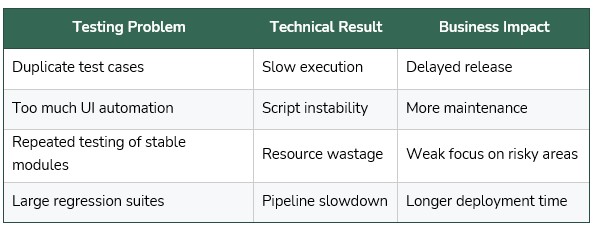
Over-testing also creates confusion. Teams spend hours checking failures that do not even affect users.
Experienced testers regularly remove low-value test cases from frameworks.
During Tosca Online Training, many learners notice that automation frameworks become difficult to manage when unnecessary tests keep increasing.
This decision is not random. It depends on technical understanding.
Some modules remain stable for months. These areas usually do not need deep regression testing every time. They spend more time on risky areas instead.
People learning through Playwright Automation Online Training often realize that even fast automation frameworks become slow if the test suite contains too many low-priority scenarios.
Why Integrations Receive More Attention?
Modern systems depend heavily on connected services.
Applications now work with:
● Payment gateways
● Cloud platforms
● Authentication services
● External APIs
● Queue systems
● Notification services
These integrations change frequently. That increases failure risk. This is why testers concentrate more on integration testing rather than repeating tests on stable pages.
This is another big distinction between beginning testing and experience-based testing.
Those students enrolled for a course in software testing with placement gain
Production Data Helps Reduce Testing Scope
Modern test teams use production logs before developing any regression strategies.
They consider:
● User Traffic
● Browser Usage
● API Error Logs
● Crashes
● Timeouts
● Sessions
In case certain components are seldom used, test coverage is minimized here to increase efficiency.
This increases effectiveness and saves time.
A good Selenium Online Training in India will be better understood by trainees who know the importance of production logs in testing.
Tools Alone Cannot Create Good Testing
The automated tests just execute code, but they are not able to fully comprehend:
● Business risks
● User actions
● System interdependency
● Impact on customers
An individual may be well-versed in all kinds of tools like Selenium, Playwright, Tosca, Appium, or Cypress. However, being proficient in automation tools doesn’t necessarily make someone a good tester.
Even a poor tester might come up with:
● Duplicate automation scenarios
● Bad assertions
● Flawed test frameworks
● Slow pipelines
● Unstable builds
On the other hand, an experienced tester with average scripting abilities will most likely detect defects faster.
This is why more and more organizations prioritize logical reasoning over sheer number of scripts nowadays.
In professional Tosca Online Training, people tend to realize that cutting down unneeded coverage helps stabilize a framework.
Exploratory Testing Becomes More Effective
Exploratory testing works better when testers avoid repetitive checks.
Experienced testers skip:
● Fully stable flows
● Duplicate validations
● Predictable screens
● Low-risk features
Instead, they focus on:
● Session conflicts
● Browser mismatch
● Cache problems
● API timing failures
● Data sync issues
This improves defect detection.
Professionals attending Playwright Automation Online Training often learn that smart exploratory thinking improves automation quality as well.
Modern CI/CD Needs Faster Testing
Today many companies release software updates very quickly. Some teams deploy changes daily. Because of this, long testing cycles are becoming difficult to manage.
Large regression suites can create:
● Slow pipelines
● Infrastructure overload
● Delayed deployments
● Long debugging cycles
That is why testing teams now reduce execution scope regularly.
They focus mostly on:
● Critical user flows
● Security-sensitive areas
● Integration health
● High-traffic modules
A technical Software Testing Course With Placement should teach learners how release speed and testing scope are connected together.
Key Takeaways
● Testing everything is not practical anymore.
● Skilled testers focus more on risk.
● Over-testing creates maintenance problems.
● Fast releases need optimized testing scope.
● Framework quality improves when low-value tests are removed.
● Human decision-making still matters strongly.
Conclusion
Modern software systems are growing quickly and becoming more connected every year. Because of this, testers cannot depend only on tools or large automation suites anymore. The real skill is understanding where testing effort should be reduced without increasing release risk. Even in advanced Tosca Online Training, professionals learn that smart test selection remains one of the most important testing skills. Smart testers study system changes, integrations, failure history, production logs, and user behavior before selecting test coverage.