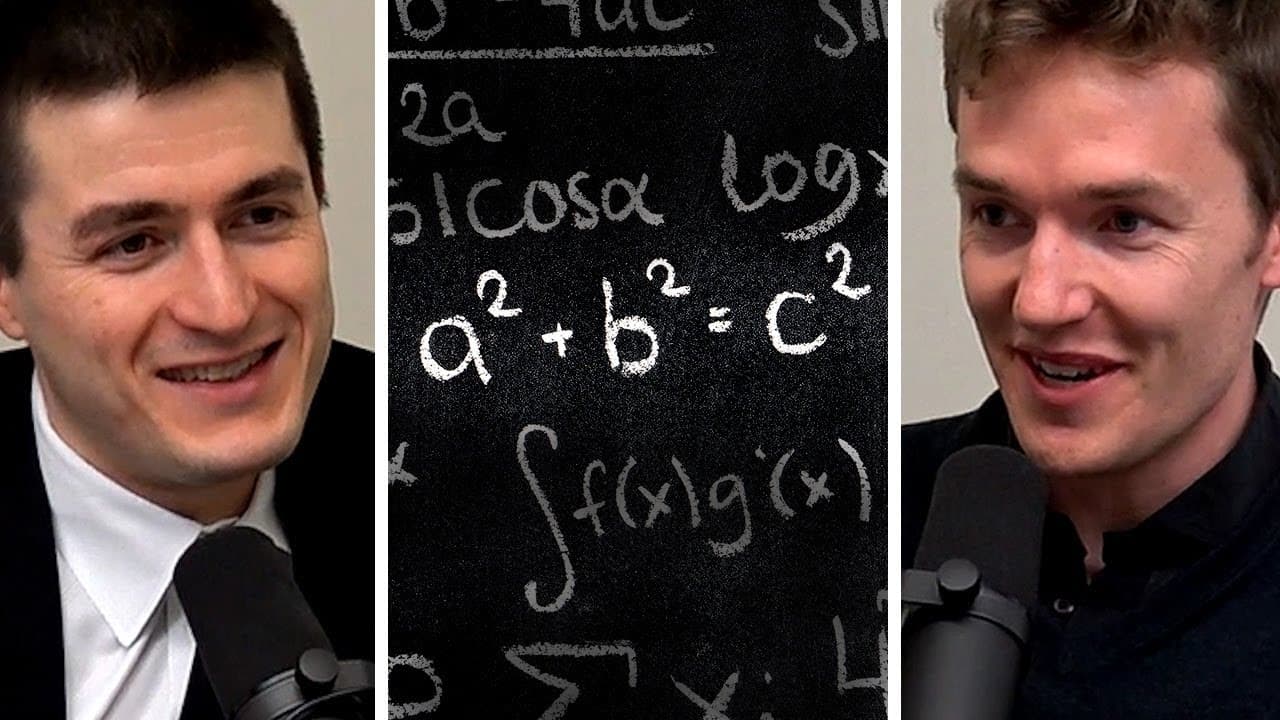
Grant Sanderson (3Blue1Brown): Is Math Discovered or Invented? | AI Podcast Clips
TL;DR
Mathematics is both discovered and invented, with discoveries informing the invention of mathematical concepts that are useful for understanding the physical world.
Transcript
do you think math is discovered or invented so we were talking about the different kind of mathematics that could be developed by the alien species the implied question is is yeah it's math discovered or invented is you know it's fundamentally everybody going to discover the same principles of mathematics so the way I think about it and everyone th... Read More
Key Insights
- 🌌 Math is a combination of discovery and invention, with discoveries about the universe informing the invention of useful math principles. The Pythagorean theorem exemplifies this.
- 🔍 Math diverges from physical intuition and becomes detached from the physical world, as seen with modern physics and concepts like string theory and multiple dimensions.
- 🔢 The usefulness of mathematics extends beyond the physical world. Even higher-dimensional concepts can be applicable to a three-dimensional physical universe, as seen with state spaces.
- 🌐 Math and physics overlap but have differences. Math studies abstractions and pure patterns, while physics aims to understand the world we live in.
- 🧩 Mathematicians have different motivations, including solving puzzles, finding applications to physics, or exploring abstraction and generality.
- 💡 Discoveries in math lead to the invention of abstract representations, like the concept of 2D space and the study of r2, which are informed by physical observations.
- 💥 Math and physics coincide in some ways, but it is surprising that the abstract nature of math can describe the fundamental aspects of physical phenomena, like quarks.
- 🌌 It is unclear why the fundamental laws of physics are simple, but the idea that our minds are biased to perceive the compressible parts of the universe is a possibility. The anthropic principle may also come into play.
Install to Summarize YouTube Videos and Get Transcripts
Explore YouTube Video Summarizer or Get YouTube Transcript Extractor
Questions & Answers
Q: Is mathematics purely an abstract study or does it have real-world applications?
The relationship between mathematics and its applications to the real world is complex. While math can be studied purely as an abstract discipline, many mathematical concepts have practical applications in fields like physics, computer science, and engineering. In this way, math can be seen as both abstract and useful.
Q: Can mathematics exist independently of the physical world?
There is ongoing philosophical debate about the nature of mathematics and its relationship to the physical world. Some argue that math is a human invention that exists only within our minds, while others believe that mathematical truths exist independently of human perception. The answer to this question depends on one's philosophical perspective.
Q: How does the Pythagorean theorem illustrate the interplay between discovery and invention in mathematics?
The Pythagorean theorem can be seen as both a discovery and an invention. It was discovered by ancient mathematicians who observed the relationships between the sides of right triangles, but it was also invented as an abstract mathematical concept that can be applied to a wide range of mathematical and physical problems.
Q: What role does intuition play in the relationship between math and physics?
Intuition plays a significant role in both math and physics. Physicists often rely on their intuition to develop new theories and make predictions about the natural world. Similarly, mathematicians use their intuition to guide their exploration of abstract mathematical concepts and to make conjectures that can later be proven or disproven.
Q: Are there fundamental principles or equations that underlie the laws of physics and the nature of reality?
The quest for fundamental principles or equations that underlie the laws of physics and the nature of reality is an ongoing area of research and speculation. Some scientists and theorists, like Stephen Wolfram, propose that there may be simple underlying rules that give rise to the complexity we observe in the universe. However, this is still a topic of much debate and exploration.
Summary
This video explores the concept of whether math is discovered or invented and the relationship between math and physics. The speaker discusses how math is a cycle of discovery and invention, with discoveries about the universe informing the invention of mathematics. The Pythagorean theorem is used as an example to illustrate this idea. The video also touches on the difference between physics and math, highlighting the overlap and different motivations of mathematicians. The nature of reality and the simplicity of fundamental equations are also briefly discussed.
Questions & Answers
Q: Is math discovered or invented?
Math is both discovered and invented. Discoveries about the universe inform the invention of mathematics. It is a cycle where observations and discoveries lead to the creation of mathematical concepts that help make sense of the world.
Q: Is math fundamentally the same for everyone?
Math can vary depending on cultural and historical contexts, but there are fundamental principles that are likely to be discovered by everyone. The universal nature of math arises from the fact that the discoveries about the world inform the invention of mathematics.
Q: How does the Pythagorean theorem illustrate the discovery and invention of math?
The Pythagorean theorem can be seen as both a discovery and an invention. It was discovered by the ancient Greeks, who used physical objects to build their intuition. From there, the mathematics of the theorem was invented to formalize the idea of 2D space. The discovery of the theorem informed the invention of an abstract representation of 2D space, known as r2.
Q: What is the difference between physics and math?
Physics is grounded in a desire to understand the world we live in, while math is the study of abstractions and pure patterns in logic. Physics involves the intuition and observation of physical phenomena, while math provides frameworks and tools to understand the physical world and invent new concepts.
Q: How does physics intuition differ from mathematical rigor?
Physicists possess a kind of intuition about the world that goes beyond mathematics. It is an intuitive understanding of how the world works that influences their approach to studying and explaining phenomena. Mathematical rigor, on the other hand, allows for the invention of frameworks and models that can help understand the physical world in a more formalized and precise manner.
Q: What motivates mathematicians to study math?
Different mathematicians are motivated by different things. Some are motivated by pure puzzles, finding joy in solving combinatorial problems. Others are driven by the desire to invent or discover math that will have specific applications in physics or computer science. There are also mathematicians who love abstraction and enjoy exploring the power of generality.
Q: Are the fundamental laws of physics simple?
The fundamental laws of physics can be surprisingly simple compared to the complexity of the physical world. Stephen Wolfram, for example, believes that there are incredibly simple rules underlying our reality that can create complex outcomes. It is still unclear why the fundamental laws are relatively simple, but it could be that our minds are biased to perceive the compressible parts of the universe.
Q: Is the simplicity of fundamental equations a result of our limited perception?
It is possible that the simplicity of fundamental equations is a result of our limited biological systems and the way our brains have evolved. We may only be able to perceive certain aspects of the universe that are compressible into simple equations. However, our ability to use these equations to manipulate the world suggests that they are not too far off from reality.
Q: What role does our biological bias play in understanding the simplicity of the universe?
Our biological bias could play a role in our ability to perceive the compressible parts of the universe and create equations to describe them. We are limited little computers, and our ability to understand and manipulate the physical world successfully implies that our equations align well with reality.
Q: What does the ability to fly and manipulate the world say about the laws of physics?
The fact that we can fly and manipulate the world based on our understanding of physics suggests that the laws we are working with are effective. It is a testament to the accuracy of our equations and their ability to capture the fundamental aspects of reality.
Takeaways
The nature of math is a combination of discovery and invention. Discoveries about the world inform the invention of mathematical concepts that help us make sense of our observations. Physics and math have an overlap, with physics providing the intuition and observation of the physical world, while math offers frameworks and tools to understand and invent new concepts. The simplicity of fundamental equations is intriguing and could be a result of our limited perception or a bias towards perceiving the compressible parts of the universe. Our ability to manipulate the world based on our understanding of physics suggests that our equations align well with reality.
Summary & Key Takeaways
-
Mathematics is a combination of both discovery and invention, with discoveries about the universe informing the invention of useful mathematical concepts.
-
The Pythagorean theorem, for example, can be seen as a discovery that informed the invention of an abstract representation of 2-dimensional space.
-
Different mathematicians have varying motivations and perspectives on the relationship between math and physics, with some viewing math as a branch of physics and others focusing on abstraction and generality.
Read in Other Languages (beta)
Share This Summary 📚
Summarize YouTube Videos and Get Video Transcripts with 1-Click
Try YouTube Summary with ChatGPT & Claude or YouTube Transcript Generator
Explore More Summaries from Lex Fridman 📚






Summarize YouTube Videos and Get Video Transcripts with 1-Click
Try YouTube Summary with ChatGPT & Claude or YouTube Transcript Generator