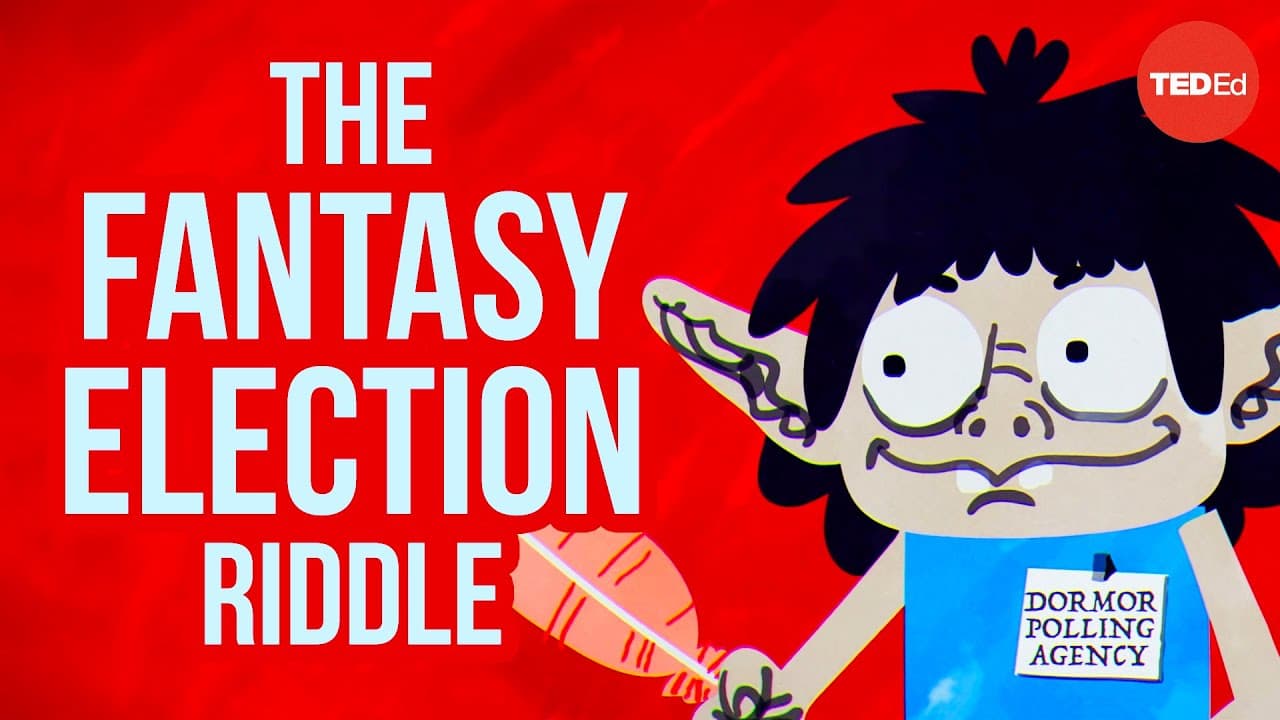
Can you solve the fantasy election riddle? - Dennis E. Shasha
TL;DR
Use a coin toss to add random chance to poll results in order to account for bias and accurately predict election outcomes.
Transcript
After much debate, the fantasy realm you call home has decided dragon jousting may not be the best way to choose its leaders, and has begun transitioning to democracy. The candidates are a giant orange troll and an experienced tree statesman. An all-powerful eyebrow has hired your company— The Dormor Polling Agency— to survey the citizens of the... Read More
Key Insights
- 💄 The coin toss method introduces randomness and deniability in polling, making it useful in situations where bias or hesitation exists.
- ❓ Considering bias is crucial in accurately predicting election outcomes and preventing skewed results.
- 😚 The first election results, after accounting for the influence of the coin, indicate that the troll is likely to lose.
- 👻 In the subsequent election, modifying the coin toss method allows for accurate polling and the troll emerges as the winner by a small margin.
- 💼 This case study demonstrates the importance of innovative polling techniques in challenging and controversial election scenarios.
- 😒 The use of a coin toss provides a mechanism for voters to hide their true preference while still contributing to poll results.
- ❓ Accurate polling methods can greatly influence the outcome of an election and maintain the credibility of polling agencies.
Install to Summarize YouTube Videos and Get Transcripts
Explore YouTube Video Summarizer or Get YouTube Transcript Extractor
Questions & Answers
Q: How can you use a coin toss to conduct an accurate poll in a controversial election?
By having voters flip a coin and instructing them to report a specific candidate based on the outcome (heads for the troll, tails for their true preference), randomness and deniability are introduced, accounting for bias and providing more accurate results.
Q: Why is it important to consider bias when conducting polls?
Bias can significantly affect the accuracy of poll results. In this case, supporters of the troll are hesitant to openly admit their preference due to controversy, potentially skewing the results. Introducing randomness through a coin toss helps mitigate this bias.
Q: How does the coin toss method work in the first election?
Voters who get heads on the coin toss are asked to say they support the troll, regardless of their actual preference. Those who get tails are instructed to reveal their true preference. By subtracting the proportion of troll votes that were influenced by the coin, a more accurate picture of the election outcome can be projected.
Q: How is the coin toss method modified for the subsequent election?
In the second election, where expressing support for the troll is still taboo, voters are asked to flip the coin twice. Those who get two heads in a row are instructed to report support for the troll, those who get two tails in a row are asked to report support for the dragon, and all other combinations represent the voters' true preference. This method allows for accurate polling and accounting for bias.
Summary & Key Takeaways
-
The Dormor Polling Agency is hired to survey voters in a fantasy realm that is transitioning to democracy and predict the winner between a troll and a treefellow. Troll supporters are hesitant to openly admit their preference, so a coin toss is used to introduce randomness and deniability.
-
Voters who get heads on the coin toss are instructed to say they support the troll, while those who get tails are encouraged to reveal their true preference. The results indicate that the troll is likely to lose the election.
-
In a subsequent election, where expressing support for the troll is still shameful, a cunning method is devised. Voters are asked to flip the coin twice, with instructions depending on the outcome (two heads for troll, two tails for dragon, and any other combination for true preference). This method allows for accurate polling and indicates that the troll wins the election by a small margin.
Read in Other Languages (beta)
Share This Summary 📚
Summarize YouTube Videos and Get Video Transcripts with 1-Click
Try YouTube Summary with ChatGPT & Claude or YouTube Transcript Generator
Explore More Summaries from TED-Ed 📚
Summarize YouTube Videos and Get Video Transcripts with 1-Click
Try YouTube Summary with ChatGPT & Claude or YouTube Transcript Generator