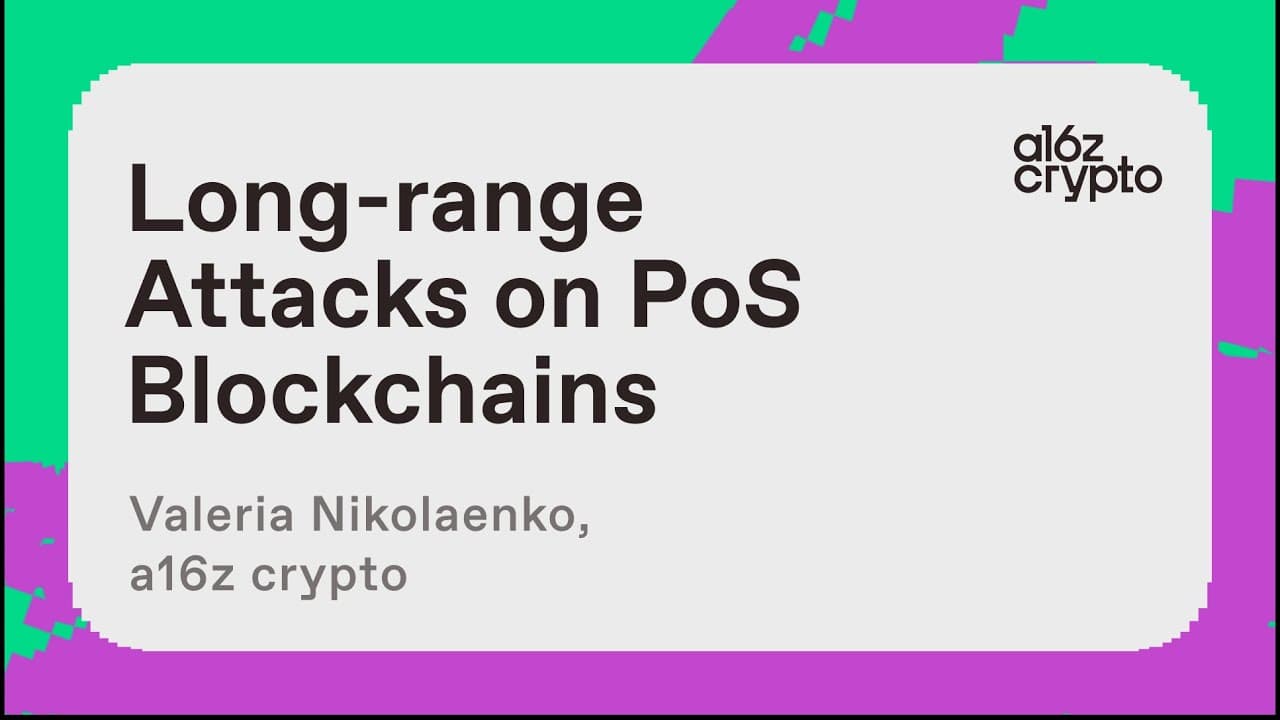
Long-range Attacks on Proof-of-Stake (PoS) Blockchains w/ Valeria Nikolaenko | a16z crypto research
TL;DR
Long-range attacks are a significant threat in proof-of-stake blockchains, and existing solutions such as checkpointing and key evolving cryptography have limitations. A new approach called Wrinkle proposes user-based consensus where users vote on the current state of the blockchain within their transactions to mitigate long-range attacks.
Transcript
all right good morning everyone um welcome to a16 crypto research seminar um part two proof-of-stake blockchains by our own there at nicolenko on tuesday we know about kind of like a general lance the general landscape and then today she's gonna drill down onto long-range attacks and some other issues so thank yeah so today we're gonna deep dive in... Read More
Key Insights
- 🧡 Existing solutions to long-range attacks in proof-of-stake blockchains have limitations and are not entirely effective.
- 👤 Wrinkle's approach of user-based consensus provides an additional layer of security, making use of the larger number of user keys to protect the blockchain.
- 🤱 Transaction fees and delegation mechanisms can incentivize users to participate in the consensus and maintain the security of the blockchain.
- 🧡 Long-range attacks pose a significant threat to the integrity and security of proof-of-stake blockchains and require ongoing research and development to find effective mitigation strategies.
Install to Summarize YouTube Videos and Get Transcripts
Explore YouTube Video Summarizer or Get YouTube Transcript Extractor
Questions & Answers
Q: What is the most challenging attack to combat in proof-of-stake blockchains?
The long-range attack is considered the most challenging attack to combat in proof-of-stake blockchains. It allows attackers to create forks of the blockchain using historical validators' keys and disrupt consensus.
Q: How can validators' keys be compromised in proof-of-stake blockchains?
Validators' keys can be compromised through various means, including hacking or social engineering. If an attacker gains control of a validator's key, they can corrupt the validator and disrupt consensus in the blockchain.
Q: What is the purpose of checkpointing in mitigating long-range attacks?
Checkpointing involves committing the hash of a block or epoch to a centralized mechanism or a proof-of-work blockchain. It helps users synchronize to the correct fork and prevents long-range attacks from creating alternative forks.
Q: How does Wrinkle propose to mitigate long-range attacks?
Wrinkle suggests user-based consensus, where users include a vote on the last epoch within their transactions. By involving users in the consensus process, the security of the blockchain is enhanced, as more keys are protecting it.
Summary & Key Takeaways
-
Long-range attacks are unique to proof-of-stake blockchains and pose a significant threat to their security and integrity.
-
Existing solutions to mitigate long-range attacks, such as checkpointing and key evolving cryptography, have limitations and are not entirely effective.
-
Wrinkle, a new approach, suggests user-based consensus where users include a vote on the current state of the blockchain within their transactions, providing an additional layer of security against long-range attacks.
Read in Other Languages (beta)
Share This Summary 📚
Summarize YouTube Videos and Get Video Transcripts with 1-Click
Try YouTube Summary with ChatGPT & Claude or YouTube Transcript Generator
Explore More Summaries from a16z crypto 📚




Summarize YouTube Videos and Get Video Transcripts with 1-Click
Try YouTube Summary with ChatGPT & Claude or YouTube Transcript Generator