Heather Barnett: What humans can learn from semi-intelligent slime
TL;DR
This content introduces Physarum polycephalum, a slime mold with remarkable behaviors and potential applications in various fields.
Transcript
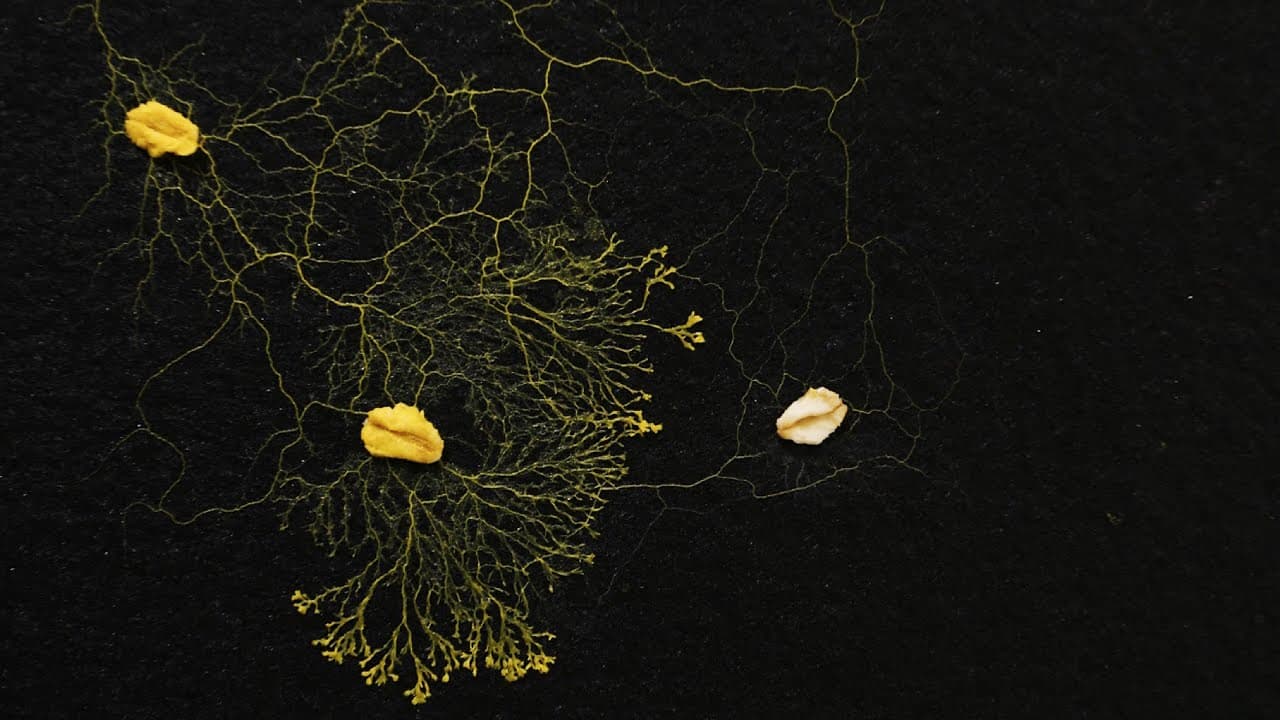
I'd like to introduce you to an organism: a slime mold, Physarum polycephalum. It's a mold with an identity crisis, because it's not a mold, so let's get that straight to start with. It is one of 700 known slime molds belonging to the kingdom of the amoeba. It is a single-celled organism, a cell, that joins together with other cells to form a mass ... Read More
Key Insights
- 🌱 Slime mold is a single-celled organism that forms a mass super-cell to maximize its resources, operating as one entity with thousands of nuclei sharing a cell wall.
- 🔬 Slime mold demonstrates behaviors that resemble intelligence, including recognizing itself, mapping territory, and solving problems such as finding the most efficient route through a maze.
- 📚 The slime mold has been the subject of numerous scientific studies and is being studied in the fields of electronics, programming, and robotics, as it can form efficient networks and solve complex problems.
- 🧠 Despite not having a central nervous system or a brain, the slime mold exhibits intelligence through the continuous pulsing flow of cellular material and chemical information within its cells.
- 🌐 The Slime Mould Collective is an online network that brings together researchers, artists, architects, designers, and more, all interested in studying and experimenting with slime mold.
- 🎨 Artists and designers use slime mold in their work, painting with fluorescent Physarum or using it as a tool to engage communities and discuss concepts like social cohesion and cooperation.
- 🔍 Slime mold workshops and experiments provide opportunities for the public to learn and engage with this fascinating organism, sparking discussions about intelligence and collective behavior.
- 📸 Slime mold is not just a subject for study, but a collaborator for artists and creators, as it has its own internal aesthetics and influences the creative process.
Install to Summarize YouTube Videos and Get Transcripts
Explore YouTube Video Summarizer or Get YouTube Transcript Extractor
Questions & Answers
Q: What is Physarum polycephalum and how does it differ from molds?
Physarum polycephalum is a slime mold belonging to the kingdom of the amoeba. Unlike molds, it is a single-celled organism that joins together with other cells to form a mass super-cell.
Q: Where can slime mold be found?
Slime mold can be found in its natural habitat, such as woodlands, where it forages on rotting vegetation. However, it can also be found in research laboratories, classrooms, and even artists' studios.
Q: What interesting behaviors have been observed in slime mold?
Slime mold has been observed forming connections between food sources, leaving trails behind to indicate where it has been, and finding better homes when it is fed up with one petri dish. It has also been observed exploring new territories in different directions simultaneously and recognizing itself when it meets.
Q: What experiments have been conducted with slime mold?
One experiment involved filling a maze with slime mold and observing how it established the shortest and most efficient route between two food sources. Another experiment exposed slime mold to cold air at regular intervals and found that it slowed down its growth in anticipation of the cold air even when it wasn't actually present. Additionally, slime mold was used to replicate the Tokyo transport network in just over a day.
Q: Where does the intelligence of slime mold lie?
Slime mold doesn't have a central nervous system or a brain, yet it can perform behaviors associated with brain function, such as learning, remembering, problem-solving, and decision-making. Its intelligence lies in a rhythmic pulsing flow within the cell, which allows it to form a complex understanding of its environment without a large-scale control center.
Q: How has slime mold been utilized in different fields?
Slime mold has been of interest not only to academic researchers but also to artists, architects, designers, and writers. It has been used as a tool for artistic expression, as a metaphor for social cohesion and communication, and as a biological model for studying principles that can be applied to electronics, programming, and robotics.
Q: How has the Slime Mould Collective fostered collaboration and engagement with slime mold?
The Slime Mould Collective is an online network that brings together researchers, enthusiasts, artists, and various professionals interested in slime mold. It serves as a platform for sharing knowledge and experimentation across disciplinary and academic divides. It has enabled collaborations, workshops, and public engagement activities, such as slime mold experiments and exhibitions, to explore ideas of intelligence, agency, autonomy, and cooperation.
Summary & Key Takeaways
-
Physarum polycephalum is a single-celled organism that forms a mass super-cell with thousands or millions of nuclei, operating as one entity.
-
Despite lacking a brain or central nervous system, slime molds can learn, remember, solve problems, and make decisions.
-
Researchers are studying slime molds to understand their computational abilities and applying the knowledge to fields like electronics, programming, and robotics.
Read in Other Languages (beta)
Share This Summary 📚
Summarize YouTube Videos and Get Video Transcripts with 1-Click
Try YouTube Summary with ChatGPT & Claude or YouTube Transcript Generator
Explore More Summaries from TED 📚






Summarize YouTube Videos and Get Video Transcripts with 1-Click
Try YouTube Summary with ChatGPT & Claude or YouTube Transcript Generator