How Do Salamanders Regenerate Their Limbs?
TL;DR
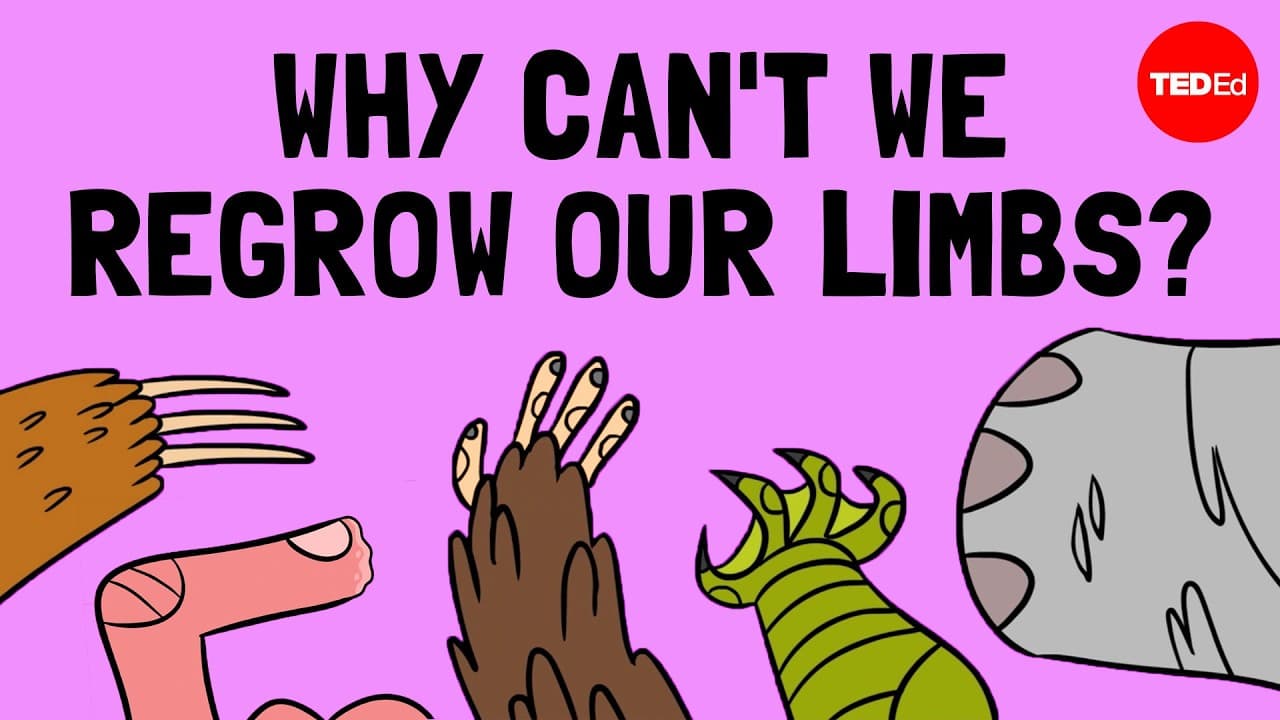
Salamanders, especially axolotls, can regenerate limbs in about six weeks through a process involving dedifferentiation of cells and the formation of a blastema, a structure made from recycled cells. This remarkable ability not only restores lost limbs but also has implications for understanding tissue regeneration in other species, including humans.
Transcript
For some animals, losing a limb is a decidedly permanent affair. But for salamanders, particularly axolotls, amputation is just a temporary affliction. Not only can they grow back entire limbs in as little as six weeks, they can also regenerate heart and even brain tissue. So how does this astonishing adaptation work? Regardless of regeneration, ev... Read More
Key Insights
- 🧗 Salamanders, particularly axolotls, can regenerate limbs and other tissues, demonstrating unique cellular capabilities.
- 💁 Limb regeneration begins with the formation of a wound epidermis, which initiates the dedifferentiation of cells at the injury site.
- 😚 The blastema serves as the foundation for rebuilding lost limbs, made up of recycled and specialized cells.
- 💊 Understanding the molecular basis of salamander regeneration could have implications for regenerative medicine in humans and other animals.
- 😨 Regeneration processes in salamanders could inform methods for limiting scarring during tissue repair.
- ⚡ Research explores how salamander cells manage to revert to earlier developmental stages, a capability lost in most higher animals with age.
- ⚖️ The potential for positional memory in cells could offer insights into how organisms understand their structure and scale during regeneration.
Install to Summarize YouTube Videos and Get Transcripts
Explore YouTube Video Summarizer or Get YouTube Transcript Extractor
Questions & Answers
Q: How quickly can axolotls regenerate a lost limb?
Axolotls can regenerate a lost limb in as little as six weeks, showcasing a remarkable adaptation that allows them to recover from injuries. This rapid regeneration process is due to the unique biological capabilities of their progenitor and stem cells, which can revert to a less specialized state and then organize into the specific tissues required for a functional limb.
Q: What is the role of the blastema in limb regeneration?
The blastema is a critical structure in the limb regeneration process, composed of dedifferentiated progenitor cells and stem cells. It functions similarly to a limb bud, where cells rapidly divide and specialize to create new muscle, bone, skin, and nerve tissues. The formation of the blastema allows salamanders to replace lost limbs with those that match their original structures, without scarring.
Q: How do salamanders know how much to regrow after losing a limb?
Researchers propose that blastema cells possess a form of positional memory, enabling them to determine the correct amount of limb tissue to regenerate based on the injury's specifics. Understanding this mechanism is essential to grasp how organisms regulate limb growth, ensuring that they do not develop excessively, which can occur in conditions like cancer.
Q: What are some similarities between salamander regeneration and other species?
Several other species exhibit regenerative abilities akin to those of salamanders. For instance, deer can regenerate their antlers annually, while spiny mice can heal skin and hair without scarring. Humans have a limited ability to regenerate fingertip tissues. Comparative studies could provide insights into common evolutionary traits and regenerative mechanisms.
Summary & Key Takeaways
-
Salamanders, especially axolotls, possess the incredible ability to regenerate limbs, heart, and brain tissues, with limb regeneration occurring in about six weeks.
-
The regeneration process involves a series of specialized cells called progenitors and stem cells that revert to a less specialized state, forming a structure called the blastema.
-
Ongoing research seeks to unravel the molecular mechanisms behind salamander regeneration and explore potential applications in other species, including humans.
Read in Other Languages (beta)
Share This Summary 📚
Summarize YouTube Videos and Get Video Transcripts with 1-Click
Try YouTube Summary with ChatGPT & Claude or YouTube Transcript Generator
Explore More Summaries from TED-Ed 📚



Summarize YouTube Videos and Get Video Transcripts with 1-Click
Try YouTube Summary with ChatGPT & Claude or YouTube Transcript Generator