Why does this flower smell like a dead body? - Daniel Nickrent
TL;DR
The Rafflesia plant, found in the Sumatran rainforest, is the world's largest and strangest flower, known for its putrid smell. It is a parasite that relies on its host plant for nutrients and has stolen genetic material through horizontal gene transfer. Despite its fascinating nature, cultivating Rafflesia outside its natural habitat remains a challenge.
Transcript
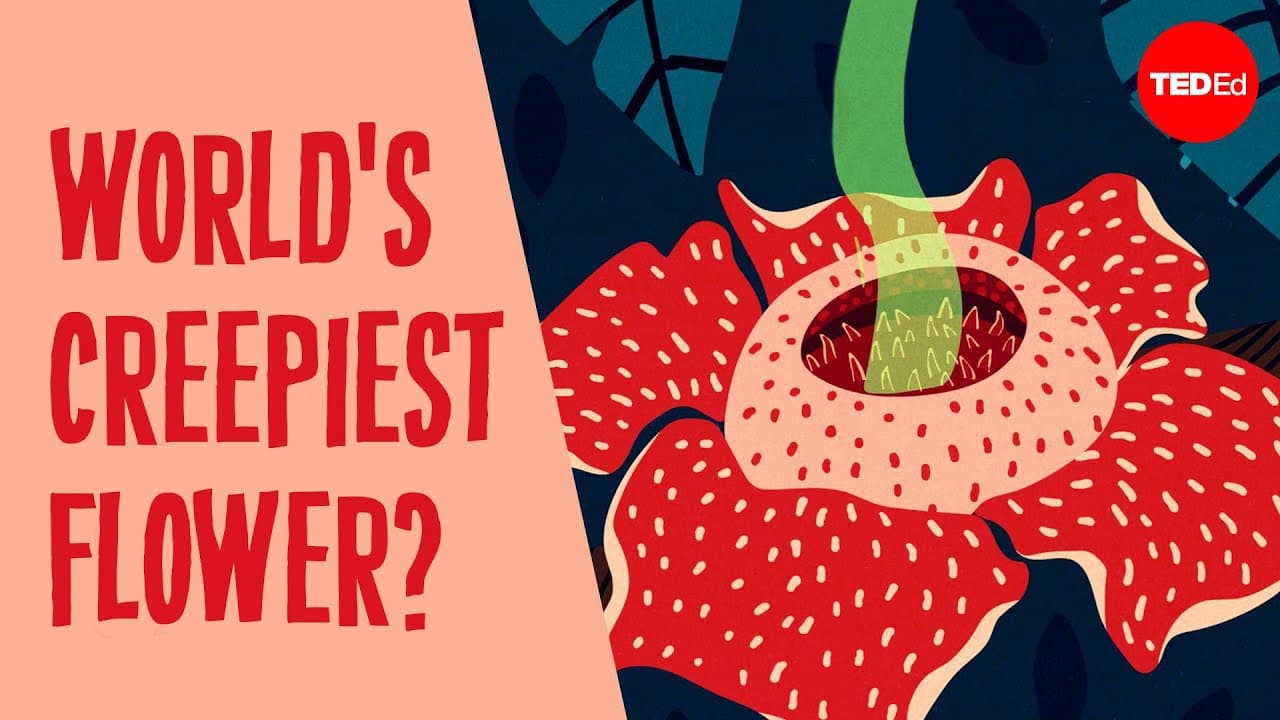
Deep inside the Sumatran rainforest, a carrion fly descends, guided by the scent of its favorite place to lay eggs: dead and rotting animal carcasses. But when it lands, it isn’t on liquefying flesh, but instead on the world’s biggest, and perhaps strangest, flower— Rafflesia arnoldii. Rafflesia is a genus of over 30 species found across the tropic... Read More
Key Insights
- 🌱 The Rafflesia plant is a parasitic plant found in the Sumatran rainforest with unique characteristics, including being the world's largest flower and relying on other plants for its survival.
- 🖤 Rafflesia's lack of DNA in its plastids and its ability to undergo horizontal gene transfer showcase remarkable adaptations for a parasitic plant.
- 😵 The putrid smell emitted by Rafflesia serves as a clever strategy to attract pollinators and facilitate cross-pollination.
- 🌱 The cultivation of Rafflesia outside its natural habitat remains a challenge, jeopardizing our understanding and preservation of this fascinating plant species.
Install to Summarize YouTube Videos and Get Transcripts
Explore YouTube Video Summarizer or Get YouTube Transcript Extractor
Questions & Answers
Q: How does the Rafflesia plant obtain nutrients without photosynthesis?
The Rafflesia plant is a parasite that depends on its host plant, Tetrastigma, to extract water and nutrients. It lacks roots and the ability to produce its own food, making it entirely reliant on its host for survival.
Q: How does Rafflesia steal genetic material from other plants?
Rafflesia undergoes horizontal gene transfer, a process in which it acquires genetic material from its host plant and other plants in its habitat. It then incorporates this stolen genetic material into its own cellular processes, utilizing the DNA to produce proteins necessary for its growth.
Q: How does Rafflesia attract pollinators despite its putrid smell?
The Rafflesia plant emits foul-smelling sulfur compounds, attracting carrion flies that are attracted to the scent of rotting flesh. These flies inadvertently help with cross-pollination by transferring pollen from male to female Rafflesia flowers.
Q: What challenges are involved in cultivating Rafflesia?
Cultivating Rafflesia from seeds outside its natural habitat is difficult. Despite attempts by botanists worldwide, successful cultivation has been largely unsuccessful due to the complexities involved in understanding seed dispersal and the plant's ability to attach to and infect a host root.
Summary & Key Takeaways
-
Rafflesia arnoldii is a genus of parasitic plants found in the tropical forests of Southeast Asia, known for their large size and foul odor.
-
Rafflesia survives as an endophyte, relying on its host plant, Tetrastigma, for water and nutrients.
-
The plant has stolen genetic material through horizontal gene transfer, incorporating it into its own cellular processes.
Read in Other Languages (beta)
Share This Summary 📚
Summarize YouTube Videos and Get Video Transcripts with 1-Click
Try YouTube Summary with ChatGPT & Claude or YouTube Transcript Generator
Explore More Summaries from TED-Ed 📚





Summarize YouTube Videos and Get Video Transcripts with 1-Click
Try YouTube Summary with ChatGPT & Claude or YouTube Transcript Generator