Deep Learning State of the Art (2019) - MIT
TL;DR
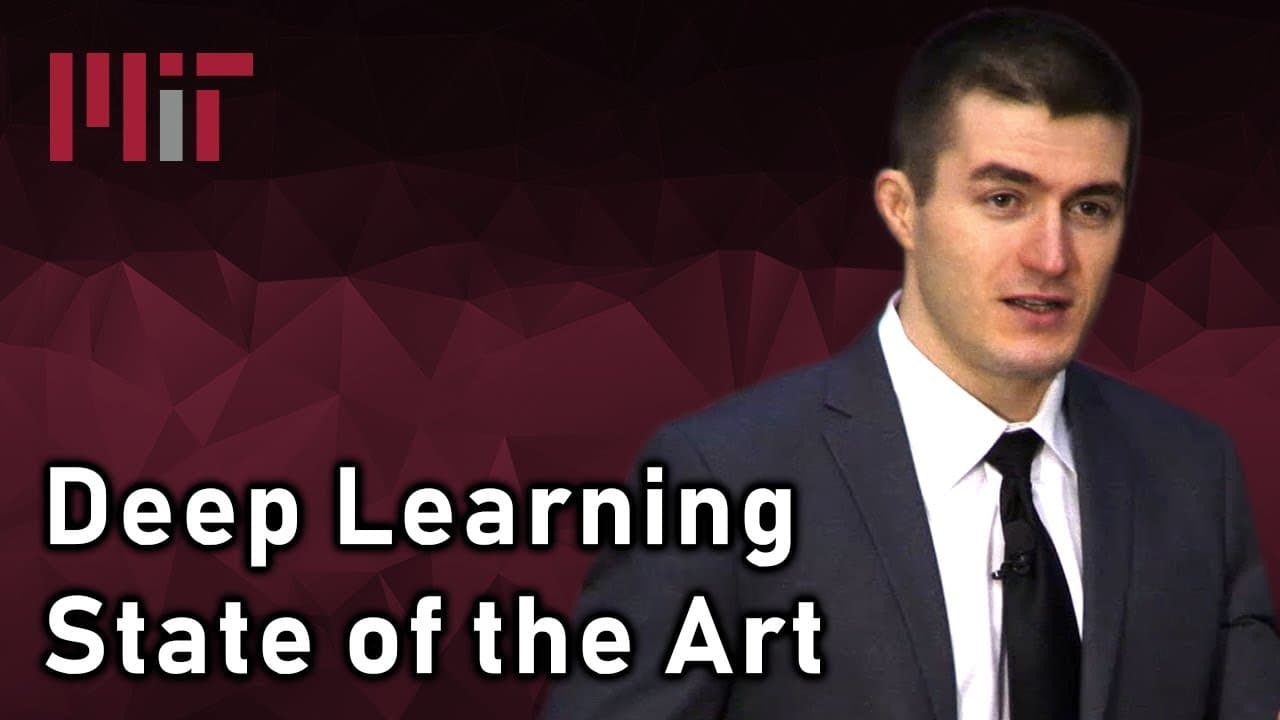
This video discusses the recent breakthroughs in deep learning, from advances in natural language processing and image classification to data augmentation and deep reinforcement learning.
Transcript
The thing I would very much like to talk about today is the state of the art in deep learning. Here we stand in 2019 really at the height of some of the great accomplishments that have happened. But also stand at the beginning. And it's up to us to define where this incredible data-driven technology takes us. And so I'd like to talk a little bit ab... Read More
Key Insights
- 💡 Breakthroughs in deep learning have defined the exciting field, with 2018 being the "year of natural language processing" due to developments like BERT, which has improved NLP benchmarks and applications. Recurrent neural networks have been effective for machine translation and encoder-decoder structures allow for the generation of sequences of various lengths. Attention mechanisms have allowed for selective focus on important inputs during the decoding process. Self-attention further enhances the encoder process by allowing it to look at relevant aspects of the input sequence. Building a transformer with self-attention on the encoder and attention on the decoder captures the rich context of the input sequence. Embedding is important for representing words and characters in an efficient and meaningful way for language understanding. AutoAugment and synthetic data generation aim to improve data augmentation techniques, making deep learning more accessible and efficient. Deep reinforcement learning has made significant progress, with AlphaGo and AlphaZero beating world champions in games like Go and chess. DeepLabv3+ is the state of the art in semantic segmentation, and GANs have improved in resolution and image generation. Robotics and the automation of tasks like labeling and annotation are areas that have also seen advancements. Researchers continue to push the boundaries of what deep learning can achieve and are in search of new ideas and breakthroughs.
Install to Summarize YouTube Videos and Get Transcripts
Explore YouTube Video Summarizer or Get YouTube Transcript Extractor
Questions & Answers
Q: What are some applications of deep learning in the field of autonomous driving?
One major advancement in deep learning applied to autonomous driving is Tesla's Autopilot system, which utilizes neural networks to process data from multiple cameras and perform tasks like object detection and drivable area segmentation. This technology has been tested extensively, with Tesla vehicles driving over one billion miles. It showcases the impact of deep learning on real-world applications and the potential for autonomous systems to revolutionize the transportation industry.
Q: How does data augmentation improve deep learning models in image classification?
Data augmentation is a technique that involves manipulating and expanding the training dataset to improve the model's ability to generalize and learn from limited examples. AutoAugment is an approach that uses reinforcement learning and RNNs to automate the data augmentation process. By generating new variations of the training data, deep learning models can learn more robust features and improve their performance on tasks like image classification.
Q: What are some recent advancements in deep reinforcement learning?
Deep reinforcement learning has made significant strides in recent years. In 2016, AlphaGo defeated top human players in the game of Go, showcasing the ability of deep RL to tackle complex games with imperfect information. In 2017, AlphaGo Zero demonstrated even greater progress by achieving top-level gameplay in just a few days of self-play. Additionally, OpenAI's work with Dota 2 has pushed the boundaries of deep RL in handling teamwork, long time horizons, and uncertainty in a dynamic video game environment.
Q: How has deep learning contributed to advancements in semantic segmentation?
Deep learning models, such as DeepLabv3+, have significantly improved the performance of semantic segmentation tasks. By leveraging convolutional neural networks, dilated convolutions, and multi-scale processing, these models are capable of accurately segmenting images and identifying different objects and regions within an image. This has led to advancements in various computer vision applications, including scene understanding, object detection, and autonomous driving.
Q: What are some challenges and future directions in deep learning?
Although deep learning has made remarkable progress, there are still challenges and areas for improvement. One challenge is the need for breakthrough ideas beyond the current frameworks and algorithms. Researchers are continuously exploring new directions, such as exploring alternative optimization methods to backpropagation and developing more efficient techniques for training deep neural networks. Additionally, the field is actively working on making deep learning more accessible and democratizing its adoption through user-friendly frameworks like TensorFlow and PyTorch. The future of deep learning depends on further advancements in areas like data augmentation, reinforcement learning, natural language processing, and autonomous systems.
Summary
This video discusses the state of the art in deep learning in 2019, focusing on the breakthroughs that occurred in 2017 and 2018. It covers various topics such as recurrent neural networks, attention mechanisms, self-attention, transformers, language modeling, AutoML, synthetic data, data augmentation, deep reinforcement learning, generative adversarial networks (GANs), video-to-video synthesis, semantic segmentation, and applications of deep learning in gaming. The video also emphasizes the need for new ideas and breakthroughs to push the field of deep learning forward.
Questions & Answers
Q: What are some breakthroughs in natural language processing in 2018?
In 2018, the development of BERT (Bidirectional Encoder Representations from Transformers) had a significant impact on natural language processing (NLP). BERT improved performance on NLP tasks and allowed for the generation of rich contextual embeddings. It achieved state-of-the-art results on benchmarks and had applications in language classification, sentence pairing, sentence similarity, question answering, and more.
Q: What is the encoder-decoder structure for recurrent neural networks?
The encoder-decoder structure is used in recurrent neural networks (RNNs) for tasks like machine translation. The encoder takes a sequence of words or samples as input and uses recurrent units (such as LSTM or GRU) to encode the sequence into a fixed-sized vector representation. The decoder then takes this representation and decodes it into a sequence of words that form the translated sentence. This structure allows for the translation of sequences with different lengths.
Q: What is attention and how does it improve the encoder-decoder architecture?
Attention is a mechanism that allows the decoder to look back at specific parts of the input sequence during the decoding process. In traditional encoder-decoder architectures, the entire input sequence is collapsed into a fixed-sized vector representation, making it difficult for the decoder to selectively focus on relevant information. With attention, the encoder's hidden state representations are pushed forward to the decoder, allowing it to weigh different parts of the input sequence and determine how to best generate the output sequence. This selective attention improves the quality of the translation.
Q: What is self-attention and how does it improve the encoding process?
Self-attention is an extension of attention that allows the encoder to selectively look at other parts of the input sequence while forming hidden representations. It enables the encoder to determine the important aspects of the input sequence for encoding specific words. By considering the entire context of the input sequence, self-attention improves the encoding process and helps in generating more meaningful representations.
Q: What is the OpenAI transformer and how does it leverage the transformer architecture?
The OpenAI transformer builds on the transformer architecture (which uses self-attention in the encoding and decoding processes) to create a language model. It utilizes the language learned by the decoder and fine-tunes it on specific language tasks like sentence classification. The idea is to take the learned representations and apply them to multiple applications, such as language classification, sentence comparison, multiple-choice question answering, tagging of sentences, and more. The OpenAI transformer also enables transfer learning by applying the learned data augmentation policies from one dataset to another, improving performance and efficiency.
Q: How have deep learning approaches been applied to autonomous driving?
Tesla's Autopilot system, specifically the hardware version 2, utilizes deep learning networks for perception and control tasks. The system incorporates eight cameras and a modified inception network to perform drivable area segmentation, object detection, and basic localization tasks. This real-world application of deep learning in autonomous driving represents a breakthrough in utilizing neural networks to control the decisions and perceptions that impact human safety.
Q: How does AutoML automate aspects of the machine learning process?
AutoML aims to automate as many aspects as possible in the machine learning process. It allows users to input a dataset and automatically determines the parameters, architectures, and hyperparameters required for training and inference. The neural architecture search (NAS) technique in AutoML stitches together different modules using reinforcement learning and recurrent neural networks to optimize the overall performance of the system. AutoML has shown promising results, outperforming state-of-the-art systems in terms of efficiency and accuracy.
Q: How can data augmentation improve deep learning models?
Data augmentation involves manipulating the raw data to provide richer representations of the variability in different contexts. AutoAugment is an example of data augmentation that applies actions like translation, scaling, color manipulation, and more to the data using reinforcement learning and RNNs to optimize the augmentation process. This augmentation helps generate larger datasets efficiently and creates meaningful representations for working with language, improving performance on tasks like sentence classification, sentence comparison, translation, and more.
Q: How has the use of synthetic data impacted deep learning training?
Training deep neural networks with synthetic data has been explored by researchers, including NVIDIA. By creating realistic scenes and manipulating objects and lighting, synthetic data can help improve network training. Synthetic data generation techniques, combined with increased model capacity and batch size, have enabled the training of high-resolution images and achieved state-of-the-art performance. While synthetic data training may not outperform networks trained on real data, it provides a way to learn effectively from limited real samples.
Q: What developments have occurred in the field of reinforcement learning?
Deep reinforcement learning has seen significant developments in recent years. Google DeepMind's DQN (Deep Q-Network) paper showcased the ability to achieve superhuman performance in Atari games using deep reinforcement learning. DeepMind's AlphaGo and AlphaGo Zero also beat world champions in Go without human supervision, using self-play and neural network estimators to assess move qualities. OpenAI has focused on challenging games like Dota 2, with their bots competing against human players and making significant progress. These breakthroughs highlight the potential of deep reinforcement learning in complex games and decision-making.
Q: How has deep learning been applied to gaming and the field of Dota 2?
Deep learning has made significant strides in the gaming industry, particularly in the context of games like Dota 2. OpenAI's bots achieved remarkable results, beating professional players in 1v1 matches and making progress in 5v5 matches against top Dota 2 players. While there are challenges in adapting deep learning to the complexity of Dota 2 and imperfect information, the ongoing research in this area promises exciting developments in the future.
Takeaways
The state of the art in deep learning in 2019 is a culmination of breakthroughs from 2017 and 2018. Natural language processing has seen significant advancements with the development of BERT, improving performance on various NLP tasks. Encoder-decoder structures, attention mechanisms, and self-attention have enhanced machine translation and other sequence-to-sequence problems. AutoML has aimed to automate aspects of the machine learning process, making it more accessible. Deep learning in autonomous driving has made strides with the use of neural networks in Tesla's Autopilot system. Synthetic data and data augmentation techniques have expanded training capabilities. Deep reinforcement learning has achieved feats in game-playing, as seen in AlphaGo and OpenAI's work on Dota 2. The field of deep learning continues to evolve, and new breakthroughs are needed to drive further progress and uncover the potential of neural networks.
Summary & Key Takeaways
-
The video discusses breakthroughs in natural language processing, such as the development of BERT, which has significantly improved NLP benchmarks and applications.
-
It explores the use of attention mechanisms in the encoder-decoder architecture to selectively look back at and focus on specific parts of the input sequence.
-
The video also highlights advancements in deep learning applied to autonomous driving, autonomous systems, automated machine learning, data augmentation, and computer vision, among other areas.
Read in Other Languages (beta)
Share This Summary 📚
Summarize YouTube Videos and Get Video Transcripts with 1-Click
Try YouTube Summary with ChatGPT & Claude or YouTube Transcript Generator
Explore More Summaries from Lex Fridman 📚



Summarize YouTube Videos and Get Video Transcripts with 1-Click
Try YouTube Summary with ChatGPT & Claude or YouTube Transcript Generator