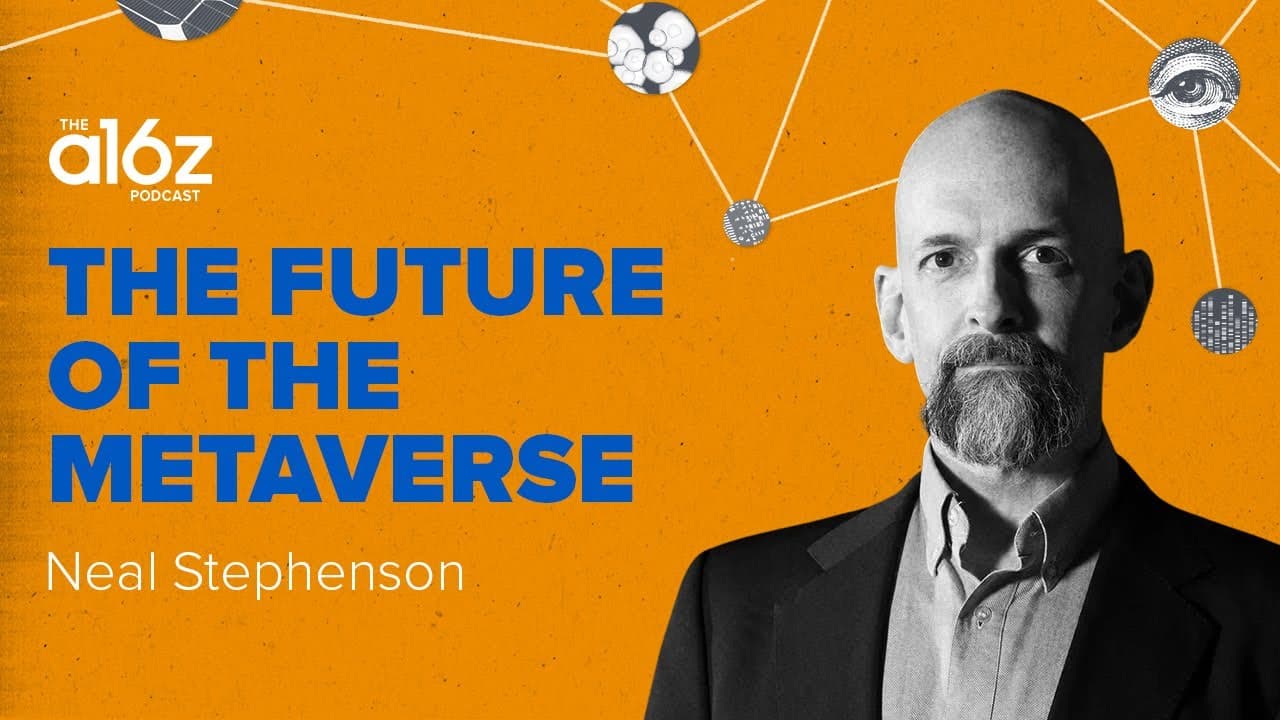
Neal Stephenson on the Future of the Metaverse
Transcript
Read and summarize the transcript of this video on Glasp Reader (beta).
Install to Summarize YouTube Videos and Get Transcripts
Explore YouTube Video Summarizer or Get YouTube Transcript Extractor
Summary
In this video, Neil Stephenson discusses the metaverse, its connection to gaming, the role of AR and VR, and the evolving intersection between technology and storytelling. He emphasizes the importance of science fiction in shaping tech industry developments and highlights the need for a unified metaverse experience. Stephenson also explores the level of immersion required for the metaverse, the challenges of interoperability, the application of AI in content creation, and the ownership of AI-generated objects.
Questions & Answers
Q: What impact can science fiction novels have on the tech industry?
Stephenson mentions that science fiction novels can serve as templates or roadmaps for companies and open-source groups in a way that traditional communication strategies cannot. They can provide a unifying vision and direction that is more effective in coordinating strategies across different teams.
Q: How do Stephenson's books stand the test of time in terms of predictions?
Stephenson notes that many things he predicted in his novel "Snow Crash," such as the use of goggles and immersive 3D worlds, have become a reality. He believes that long-standing alignment in organizations is fascinating, considering it's difficult for companies to set long-term visions that can be widely embraced.
Q: What is the definition of the metaverse according to Stephenson?
Stephenson defines the metaverse as a single unified space rather than multiple metaverses. He emphasizes the idea of being able to navigate between different experiences within the metaverse seamlessly. He also mentions the importance of interoperability.
Q: Can the metaverse thrive in two-dimensional spaces like phones or computers?
Stephenson explains that while current popular applications like online auctions or TikTok are not necessarily metaverse-like, there are exceptions. Games like Fortnite, Roblox, and Minecraft, where users interact and share the same space, provide a basic on-ramp to the metaverse. These games have the potential for interoperability and can serve as a bridge between different metaverse experiences.
Q: Do incentives align for interoperability in the metaverse?
Stephenson acknowledges that there might be tensions between game developers who want to keep users within their own games and consumers who desire interoperability. He believes that influential games with large user bases, like Fortnite and Minecraft, are actively thinking about bridging the gap between games. While not every game will be obliged to allow interoperability, he sees a future where these interconnections are created through ad hoc arrangements between game developers.
Q: Is VR essential for the metaverse's development?
According to Stephenson, VR is not a necessity for building the metaverse. While he initially assumed VR would be crucial, the widespread access to 3D spaces through two-dimensional screens on laptops and phones has proven to be a successful medium. He believes that the immersion experienced through screens, combined with the adaptability of the human brain to navigate these 3D spaces using traditional keyboards, is a significant achievement.
Q: How does AI factor into the metaverse and content creation?
Stephenson shares his experiences working on content creation projects involving AI, especially at Magic Leap. He mentions the importance of having a base layer of functionality that recognizes and populates the user's environment for an immersive experience. He sees AI playing a crucial role in creating realistic and diverse virtual environments within the metaverse.
Q: How can AI and ownership of created objects within the metaverse be managed?
Stephenson discusses the idea of a value chain for AI-generated objects within the metaverse. He mentions that people who contribute data and ideas should receive recognition and compensation when their work generates revenue. Smart contracts and blockchain technologies could play a significant role in tracking the provenance of metaverse objects and ensuring fair compensation for creators.
Q: Can AI-generated objects be transferred between different engines or experiences?
Stephenson believes that AI-generated objects can be transferred between different engines or experiences if the infrastructure and smart contracts enable it. He explains that the challenge lies in establishing a value chain that recognizes the contributions of various creators. With rating systems and third-party evaluations, creators can assert their rights over their creations and provide approval or restrictions on its usage.
Q: How might AI be applied in commercial applications outside of gaming?
Stephenson mentions that at Magic Leap, there were projects focused on applying AR to specific industrial or commercial applications. While he primarily worked on projects targeting general audiences, he acknowledges the potential of AI-powered systems in various fields. He emphasizes the need to solve engineering challenges regardless of the application type.
Q: What unexpected applications might be explored by applying AI and other technologies?
Stephenson suggests that AI and other technologies have the potential to generate unexpected results and applications. He cites examples like the mashup AI art generated by DALL-E and mid-journey as instances where user contributions and AI processes combine to create new and surprising outcomes. He envisions virtual environments populated and brought to life by AI and the emergence of new AI-assisted creative experiences.
Takeaways
The metaverse, as envisioned by Neil Stephenson, requires a unified vision, interoperability, and immersive experiences. While VR is not essential, two-dimensional screens can successfully provide a sense of immersion in 3D spaces. Game developers and consumers have mixed incentives when it comes to interoperability, and ad hoc arrangements are likely to shape the metaverse's development. AI will play a crucial role in content creation within the metaverse, but challenges of ownership and compensation must be addressed. The potential applications of AI in commercial and industrial contexts are vast, and unexpected outcomes can emerge through AI-assisted creativity.
Read in Other Languages (beta)
Share This Summary 📚
Summarize YouTube Videos and Get Video Transcripts with 1-Click
Try YouTube Summary with ChatGPT & Claude or YouTube Transcript Generator
Explore More Summaries from The a16z Podcast 📚




Summarize YouTube Videos and Get Video Transcripts with 1-Click
Try YouTube Summary with ChatGPT & Claude or YouTube Transcript Generator