How Does Agentic Engineering Transform AI Development?
TL;DR
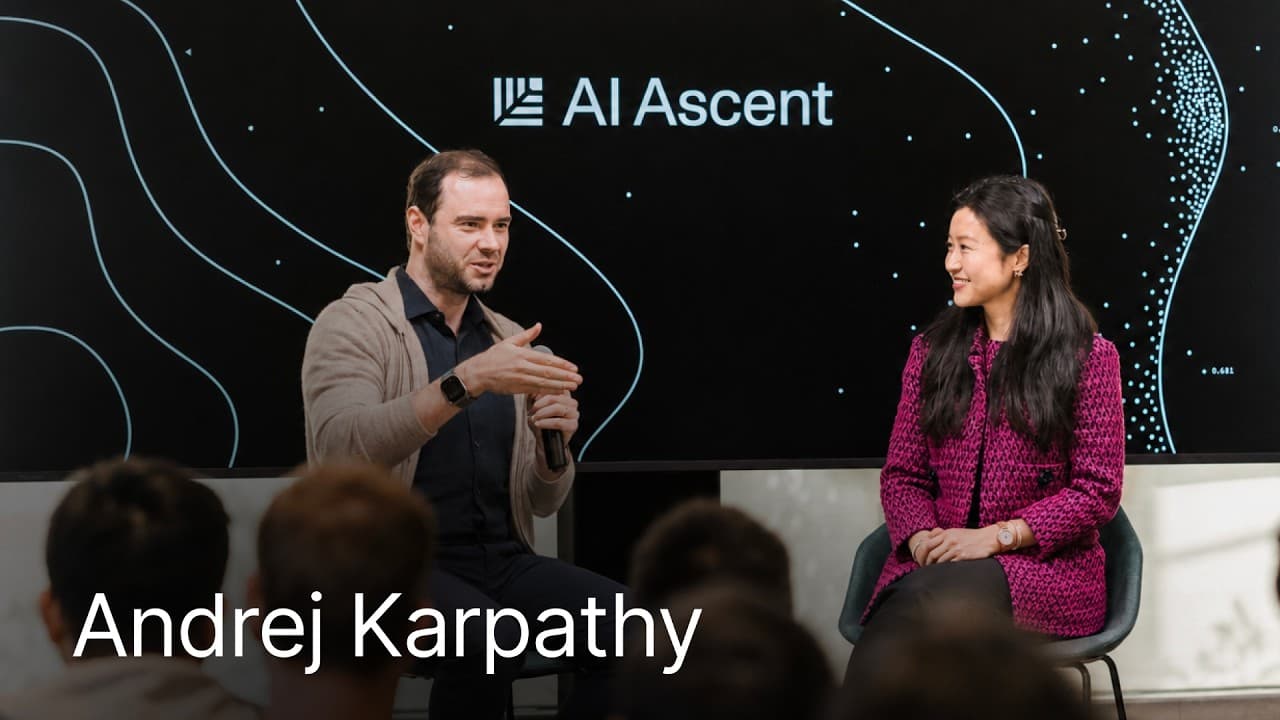
Andrej Karpathy discusses the evolution from vibe coding to agentic engineering, emphasizing the shift towards leveraging AI agents for sophisticated tasks. He explains that while AI tools raise the baseline for software development, maintaining quality requires a new discipline. Karpathy highlights the importance of understanding over mere thinking in AI-driven workflows, as agents become integral to automating complex processes.
Transcript
We're so excited for our very first special guest. He has helped build modern AI, then explain modern AI, and then occasionally rename modern AI. He actually helped co-ound open AAI right inside of this office. Was the one who actually got Autopilot working at Tesla back in the day, and he has a rare gift of making the most complex technical shifts... Read More
Key Insights
- Agentic engineering is a new discipline that focuses on maintaining quality while using AI agents to enhance software development.
- Vibe coding increases the accessibility of software development, but agentic engineering ensures the quality of professional software.
- Software 3.0 involves programming through prompts, allowing AI models to interpret and execute tasks based on context.
- AI agents can automate complex installations by interpreting generic instructions and adapting them to specific environments.
- The shift to agentic engineering requires a reframing of traditional programming paradigms, moving from explicit coding to leveraging AI capabilities.
- Verifiability in AI models is crucial for automating tasks, as models excel in domains where outputs can be easily verified.
- AI models are jagged entities, excelling in specific tasks based on their training data, but lacking the intrinsic motivations found in biological intelligences.
- Understanding remains a human domain, as AI can outsource thinking but not the deeper comprehension required to direct AI effectively.
Install to Summarize YouTube Videos and Get Transcripts
Explore YouTube Video Summarizer or Get YouTube Transcript Extractor
Questions & Answers
Q: What is agentic engineering?
Agentic engineering is a discipline that focuses on utilizing AI agents to enhance software development while maintaining quality. It builds on the concept of vibe coding, which democratizes software creation, but emphasizes the importance of preserving professional standards. This approach involves coordinating AI agents to execute tasks efficiently without compromising on the quality of the software.
Q: How does Software 3.0 differ from previous software paradigms?
Software 3.0 represents a shift from explicit coding to programming through prompts, where AI models interpret and execute tasks based on contextual understanding. Unlike Software 1.0 and 2.0, which rely on explicit rules and learned weights, Software 3.0 leverages AI's ability to understand and process information dynamically, allowing for more flexible and powerful software solutions.
Q: Why is verifiability important in AI development?
Verifiability is crucial in AI development because it determines the ease with which tasks can be automated. AI models excel in domains where outputs can be easily verified, as they receive reinforcement learning rewards for accurate results. This focus on verifiable domains enables AI to perform complex tasks reliably, making it essential for developers to identify and leverage verifiable aspects of their projects.
Q: What is jagged intelligence in AI models?
Jagged intelligence refers to the uneven capabilities of AI models, where they excel in specific tasks due to targeted training data but lack general intelligence. These models are highly competent in areas where they have been extensively trained, such as coding or mathematics, but may struggle with tasks outside their training scope. This jaggedness highlights the importance of understanding the limitations and strengths of AI models.
Q: How can AI agents automate complex installations?
AI agents can automate complex installations by interpreting generic instructions and adapting them to specific environments. Instead of following rigid scripts, agents use their contextual understanding to execute tasks intelligently, considering the unique requirements of different systems. This approach streamlines installations and reduces the need for manual intervention, showcasing the potential of agentic engineering.
Q: What skills remain valuable as AI becomes more prevalent in development?
As AI becomes more prevalent in development, skills related to understanding, judgment, and taste remain valuable. While AI can handle many technical tasks, human oversight is essential for setting goals, evaluating outcomes, and ensuring that AI systems align with broader objectives. Developers must focus on directing AI effectively, leveraging their unique ability to comprehend complex concepts and make informed decisions.
Q: How does the concept of 'ghosts' relate to AI models?
The concept of 'ghosts' in AI models refers to their nature as statistical entities shaped by data and reward functions, rather than intrinsic motivations or emotions. Unlike animals, which have evolved with specific drives, AI models operate based on the patterns they have learned from training data. This framing helps developers understand the limitations and capabilities of AI, guiding their deployment and evaluation strategies.
Q: What changes are needed for an agent-native environment?
Creating an agent-native environment requires rethinking existing systems to accommodate AI agents as primary actors. This involves designing interfaces and workflows that prioritize agent interactions, enabling them to perform tasks autonomously. Developers must focus on making data structures and processes legible to AI, facilitating seamless automation and reducing reliance on human intervention for routine tasks.
Summary & Key Takeaways
-
Andrej Karpathy outlines the transition from vibe coding to agentic engineering, highlighting the need for quality control in AI-enhanced software development. He describes Software 3.0 as a paradigm shift where programming involves prompting AI models to perform tasks based on contextual understanding. This new approach requires developers to rethink traditional coding practices and embrace AI's potential to automate complex processes.
-
Karpathy emphasizes the role of verifiability in AI development, noting that models excel in areas where outcomes can be verified. He introduces the concept of jagged intelligence, where AI models display high competence in specific tasks due to their training data. Despite AI's capabilities, Karpathy stresses the importance of human understanding in directing AI effectively.
-
The discussion explores the future of AI-driven development, where agents handle more tasks autonomously. Karpathy envisions a world where AI agents facilitate complex installations and automate workflows, reducing the need for human intervention. However, he underscores the continued necessity for human oversight and judgment in guiding AI systems.
Read in Other Languages (beta)
Share This Summary 📚
Summarize YouTube Videos and Get Video Transcripts with 1-Click
Try YouTube Summary with ChatGPT & Claude or YouTube Transcript Generator
Explore More Summaries from Sequoia Capital 📚



Summarize YouTube Videos and Get Video Transcripts with 1-Click
Try YouTube Summary with ChatGPT & Claude or YouTube Transcript Generator