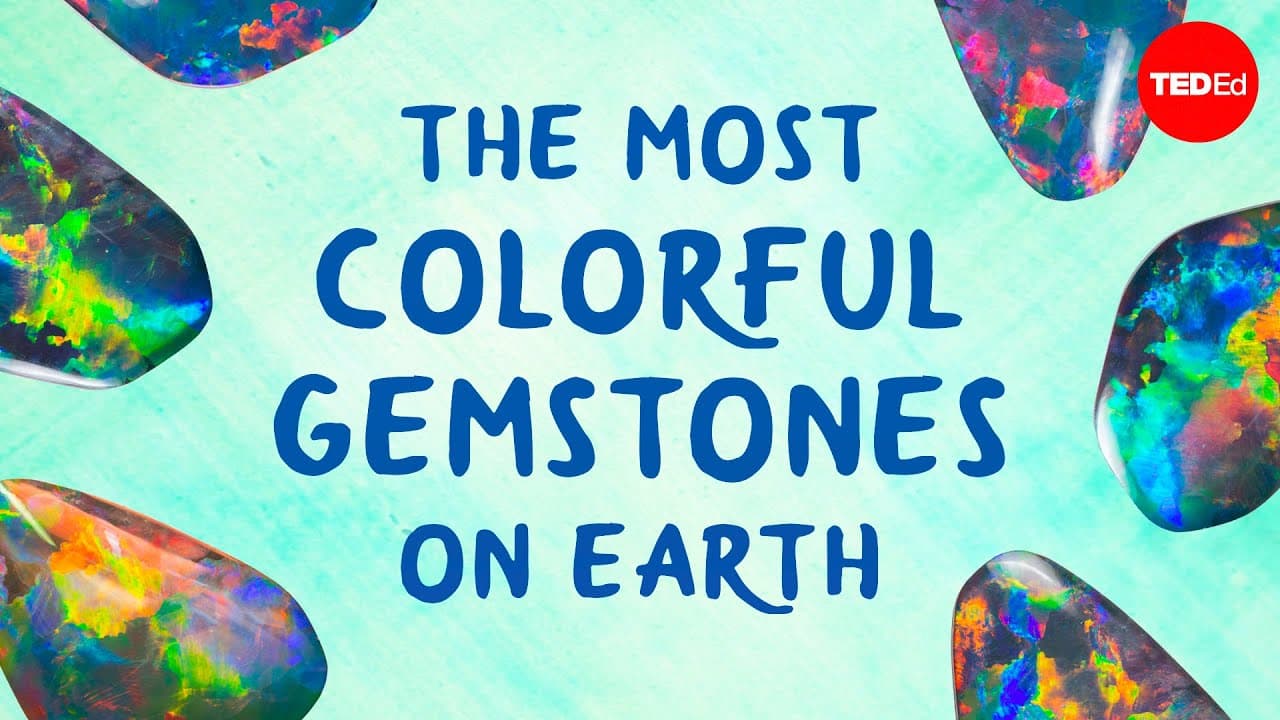
The most colorful gemstones on Earth - Jeff Dekofsky
TL;DR
Opals are unique gemstones formed from water and silica, creating a mesmerizing display of colors through interference of light waves.
Transcript
On an auspicious day in November of 1986, 5 Australian miners climbed Lunatic Hill— so named for the mental state anyone would be in to dig there. While their competitors searched for opals at a depth of 2 to 5 meters, the Lunatic Hill Syndicate bored 20 meters into the earth. And for their audacity, the earth rewarded them with a fist-sized, r... Read More
Key Insights
- ⏳ Opals are formed when silica-rich water flows through different types of rocks and gradually hardens into a glass-like material.
- 🙂 The unique appearance of opals is due to the way light interacts with the layers of silica beads, resulting in a vibrant display of colors.
- 🙂 Different colors in opals correspond to different sizes of silica beads, which determine the wavelengths of light that can be amplified.
- 📿 Opals with a structured arrangement of silica beads create more vibrant and intricate color patterns.
- ℹ️ The formation of precious opals is uncommon and only occurs in a few places, with Australia being the primary source.
- 🫤 The Halley's Comet opal, a record-breaking opal, was formed in Australia around 100 million years ago.
- 🤽 The future holds the potential for silica-rich water to create opals from human artifacts in the next millions of years, resulting in unique plays of light.
Install to Summarize YouTube Videos and Get Transcripts
Explore YouTube Video Summarizer or Get YouTube Transcript Extractor
Questions & Answers
Q: How are opals different from other precious stones?
Unlike diamonds, rubies, and emeralds, opals have a characteristic called "play of color," which means each opal has a unique appearance due to the way light interacts with its silica bead structure.
Q: How are opals formed?
Opals are formed when water containing silica trickles through rocks and evaporates, leaving behind silica beads that gradually harden into a glass-like material and settle into a lattice structure.
Q: What causes the vibrant colors in opals?
The colors in opals are created through interference of light waves. When light reflects off the layers of silica beads, constructive interference amplifies certain colors, resulting in a vibrant display.
Q: Why are red opals the rarest?
Red opals are the rarest because their formation requires silica beads of a certain size, which takes a long time to form. The spaces between 300 nanometer beads are ideal for amplifying red light.
Summary & Key Takeaways
-
Opals are distinct from other precious stones because each one has a unique appearance due to the characteristic "play of color."
-
These gemstones are formed when water containing silica flows through different types of rocks and eventually evaporates, leaving behind silica beads that form layers.
-
The vibrant displays of color in opals are a result of wave physics and interference, creating constructive and destructive interference patterns.
Read in Other Languages (beta)
Share This Summary 📚
Summarize YouTube Videos and Get Video Transcripts with 1-Click
Try YouTube Summary with ChatGPT & Claude or YouTube Transcript Generator
Explore More Summaries from TED-Ed 📚





Summarize YouTube Videos and Get Video Transcripts with 1-Click
Try YouTube Summary with ChatGPT & Claude or YouTube Transcript Generator