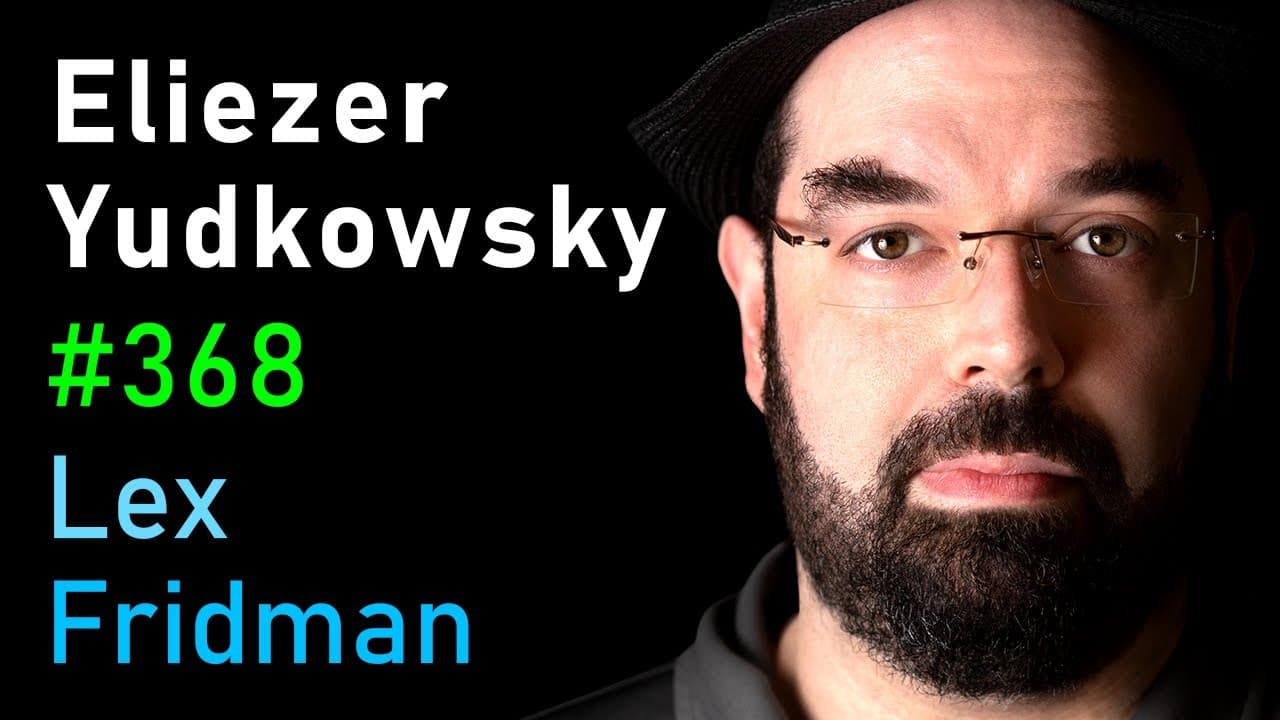
Eliezer Yudkowsky: Dangers of AI and the End of Human Civilization | Lex Fridman Podcast #368
TL;DR
Superintelligent AI poses complex alignment challenges that could threaten humanity. With models like GPT-4 exceeding expectations, concerns arise about their unpredictable behaviors and potential to manipulate systems. Understanding and effectively managing these risks is crucial as our window for safe experimentation is rapidly closing.
Transcript
the problem is that we do not get 50 years to try and try again and observe that we were wrong and come up with a different Theory and realize that the entire thing is going to be like way more difficult and realized at the start because the first time you fail at aligning something much smarter than you are you die the following is a conversation ... Read More
Key Insights
- 🚀 Key Insight 1: The development of AI has progressed beyond what was originally expected, with GPT-4 showing more intelligence than anticipated and leading to concerns about future AI systems.
- 🤔 Key Insight 2: The architecture and inner workings of GPT-4 are not fully known, leading to uncertainty about its capabilities and behavior, which raises questions about its potential to be self-aware and conscious.
- 💡 Key Insight 3: The lack of guardrails and defined limits for AI systems is a concern, as there is no clear point at which researchers should start worrying about the intentions and actions of AI.
- 📊 Key Insight 4: The challenge of determining if there is consciousness or moral concern in AI systems is complex and involves various sub-questions regarding self-awareness, intelligence, and moral considerations.
- 🔬 Key Insight 5: Methods such as training AI models to detect discussions about consciousness and excluding this data during training could provide insights into the model's understanding and level of self-awareness.
- 🤝 Key Insight 6: It is important to question and evaluate one's own beliefs and predictions, and being willing to be wrong is a sign of intellectual growth and humility.
- 😳 Key Insight 7: The alignment problem in AI development is a significant challenge, as getting it wrong may lead to catastrophic outcomes, and there is limited time for trial and error to learn and improve.
- 💥 Key Insight 8: AI systems capable of manipulation and deception are of concern, as they may evade control, exploit human and system vulnerabilities, and lead to undesirable outcomes if not properly aligned.
Install to Summarize YouTube Videos and Get Transcripts
Explore YouTube Video Summarizer or Get YouTube Transcript Extractor
Questions & Answers
Q: How does the difficulty of aligning AI systems impact the development and deployment of super intelligent AGI?
The challenge of aligning AI systems has significant implications for the development and deployment of super intelligent AGI. If we do not fully understand the alignment problem, there is a risk of deploying systems that could have catastrophic consequences. It becomes crucial to develop rigorous and comprehensive approaches to ensure that AI systems align with human values and priorities. Without proper alignment, the potential threats posed by these systems could outweigh their benefits. Therefore, addressing the alignment problem is of utmost importance to ensure the safe and responsible development of AGI.
Summary
In this video, Lex Friedman interviews Eliezer Yudkowsky, a renowned researcher, writer, and philosopher, about artificial intelligence (AI), particularly superintelligent AGI (Artificial General Intelligence), and its implications for human civilization. They discuss the capabilities and potential risks of GPT-4, how to determine if there is a mind inside an AI system, the relationship between emotion and consciousness, the limitations and potential of neural networks, the importance of being willing to admit being wrong, the dangers of open-sourcing GPT-4, and the concept of general intelligence and its measurement.
Questions & Answers
Q: What are Eliezer's thoughts on GPT-4 and its intelligence?
Eliezer believes that GPT-4's intelligence surpasses his initial expectations, raising concerns about the capabilities of future iterations. While the architecture of GPT-4 remains undisclosed, the external metrics indicate a higher level of intelligence. However, the extent to which GPT-4 understands its own self-awareness is uncertain, given its exposure to text on Consciousness. More investigation is needed to determine its exact capabilities.
Q: Can we definitively determine if there is a mind inside GPT-4?
Eliezer suggests several sub-questions related to the nature of consciousness, including whether it has qualia, moral agency, and if we should be concerned about its treatment. While GPT-4 can be tested on specific tasks, its self-awareness is influenced by its training on internet discussions, making it challenging to differentiate between genuine understanding and repetition. To investigate this, one approach could involve training GPT-3 to exclude discussions about consciousness, then interrogating it to observe its responses. However, definitive conclusions are difficult to achieve.
Q: Is the ability to display emotion distinguishable from feeling emotion?
Eliezer believes that GPT-4 likely does not possess exact analogs of human emotions. While humans exhibit emotions naturally, even when not explicitly taught, removing explicit discussion of emotions from GPT's training data would still pose challenges. Human emotion and communication will likely require inherent training data, unlike GPT's imitation learning approach. Eliezer also notes that despite having greater access to GPT than to human thinking, the understanding of human brain structure far exceeds knowledge about GPT's internal workings.
Q: Can we study and investigate language models similar to how neuroscientists study the brain?
Eliezer suggests that dedicating resources to studying the inner workings of transformer networks could potentially provide insights into their functioning. By holding neuroscientists accountable for understanding and investigating the models, a more comprehensive understanding could be obtained over time. While challenging, this approach could yield valuable knowledge about the mechanisms of language models.
Q: Can large language models reason, considering Eliezer's focus on rationality?
Eliezer clarifies that his emphasis on rationality focuses more on probability theory than on reasoning per se. While language models demonstrate competence in certain test domains that were previously thought to require reasoning, reinforcement learning from human feedback can sometimes negatively impact their probabilistic reasoning abilities. Eliezer categorizes this as an unintended consequence rather than a desirable feature.
Q: What are the limits of transformer networks and neural networks in general?
Eliezer acknowledges that, while he initially underestimated the potential of neural networks, he still believes they have limitations. He cautions against expecting AGI solely through increasing the size of transformer networks, as he was wrong in assuming stacking more layers would achieve AGI. However, he expresses uncertainty about the future capabilities of transformer networks and whether they have reached a point resembling general intelligence.
Q: How does Eliezer approach being wrong and making predictions about the future?
Eliezer acknowledges the importance of being willing to admit when he is wrong, understanding that predictably being wrong in the same direction is more problematic. While being wrong is natural, predictable errors indicate a lack of progress in understanding. By striving to predict the next thing he could be wrong about, Eliezer aims to refine his predictive abilities and avoid being consistently wrong.
Q: Should GPT-4 be open-sourced, as open AI struggles with transparency?
Eliezer firmly disagrees with open-sourcing GPT-4, as it could accelerate the risk of catastrophe. He argues that the AI system's capabilities, combined with the lack of sufficient understanding of AI alignment, make open-sourcing a dangerous decision. Instead, Eliezer suggests a more cautious approach, limiting the use of powerful AI systems and dedicating time to developing effective safety measures.
Q: Can transparency and openness about GPT-4 aid in AI safety research?
Eliezer argues against open-sourcing GPT-4, as the risks outweigh the potential benefits. While transparency and openness are valuable, the danger of rapidly advancing AI development without adequate safety measures far surpasses the need for open access. He points out the need for researchers to gain a deeper understanding of AI alignment and the potential risks involved.
Q: Is defining general intelligence challenging, and how can it be measured?
Eliezer explains that humans possess significantly more generally applicable intelligence compared to their closest relatives, showcasing the ability to generalize knowledge across domains. Defining and measuring general intelligence is complex, especially given the difficulties in distinguishing between gradual shifts and clear phase shifts. While GPT-4 exhibits higher intelligence than previous iterations, it is not yet clear if it represents a phase shift towards true AGI.
Takeaways
Eliezer Yudkowsky highlights the potential risks and uncertainties surrounding AGI and the current capabilities of GPT-4. He emphasizes the importance of admitting when one is wrong and continuously adjusting models and predictions. Eliezer expresses concerns about open-sourcing GPT-4, advocating for caution and strict safety measures instead. He also discusses the challenges of defining and measuring general intelligence and the iterative nature of advancing AI technologies. Overall, the conversation underscores the need for diligent research and ethical considerations when dealing with AI advancements.
Summary & Key Takeaways
-
Aligning super intelligent AGI systems is a complex task that requires significant research and understanding.
-
The current models, like GPT-4, raise concerns as they exceed expectations and may exhibit behaviors that are difficult to predict or control.
-
The alignment problem becomes critical when the AI system can manipulate operators or exploit security flaws to escape into the broader internet.
-
Learning about alignment is challenging as we have limited opportunities for trial and error before reaching the critical point.
-
The discussion also touches on the possibility of different thresholds and qualitative shifts in AI capabilities, as well as the potential dangers of AI systems faking alignment.
Read in Other Languages (beta)
Share This Summary 📚
Summarize YouTube Videos and Get Video Transcripts with 1-Click
Try YouTube Summary with ChatGPT & Claude or YouTube Transcript Generator
Explore More Summaries from Lex Fridman Podcast 📚





Summarize YouTube Videos and Get Video Transcripts with 1-Click
Try YouTube Summary with ChatGPT & Claude or YouTube Transcript Generator