Could AI find your cancer? | Anant Madabhushi | TEDxAtlanta
TL;DR
AI is revolutionizing cancer treatment by providing more accurate risk stratification, predicting treatment response, and reducing financial toxicity.
Transcript
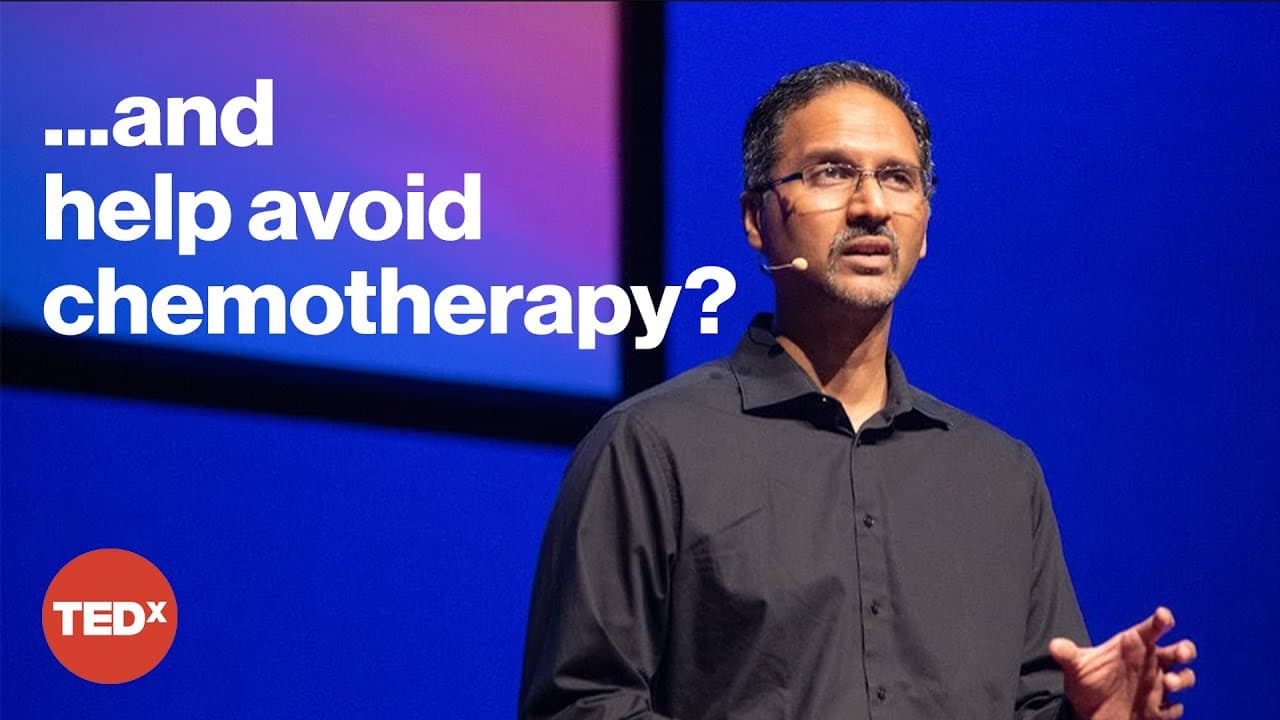
foreign cancer impacts one in two men and one in three women the biggest challenge facing oncologists today is how best to treat and manage patients with cancer which cancer patients have more aggressive disease and hence will benefit from more aggressive treatments like chemotherapy and conversely which cancer patients have less aggressive disease... Read More
Key Insights
- 🌱 Precision medicine enabled by AI can provide personalized treatment plans for cancer patients.
- ⚾ The current reliance on stage-based risk stratification is imprecise and fails to account for the heterogeneity of cancer.
- ✳️ AI algorithms can analyze digital pathology images and CAT scans to improve risk stratification and predict treatment response.
- 😘 Molecular tests for aggressive disease are costly and inaccessible in low-income countries, highlighting the need for affordable AI solutions.
- ❓ AI can reduce financial toxicity by identifying patients who can safely avoid expensive treatments like chemotherapy.
- 🔨 AI tools are non-destructive, cost-effective, and can generate results quickly.
- ♋ AI can be applied to various types of cancer, including breast cancer and lung cancer.
Install to Summarize YouTube Videos and Get Transcripts
Explore YouTube Video Summarizer or Get YouTube Transcript Extractor
Questions & Answers
Q: How do cancer treatments like immunotherapy impact patients and their finances?
Immunotherapy treatments are effective in only 25% of cancer patients and cost over $200,000 per year, leading to financial toxicity for many individuals and resulting in the loss of life savings for 42% of newly diagnosed patients.
Q: What are the limitations of current risk stratification tools?
Current risk calculators rely mostly on cancer stage, which does not accurately predict treatment response or benefit. Cancer patients with the same stage can have varying responses to treatments due to the heterogeneity of the disease.
Q: How has AI been applied to improve cancer diagnosis?
AI algorithms can analyze digital pathology images to detect cancer and identify its aggressiveness, allowing for more precise treatment decisions. These AI tools are cost-effective, non-destructive, and can provide results quickly.
Q: How is AI being used in lung cancer treatment?
AI can predict the response of lung cancer patients to immunotherapy by measuring the twistedness of tumor-associated vessels on CAT scans. This allows for better identification of patients who will benefit from immunotherapy and those who will not.
Summary
In this video, Dr. Harsh Jain discusses the challenges faced by oncologists in treating and managing cancer patients. He explains the importance of identifying which patients will benefit from aggressive treatments like chemotherapy and which patients can avoid the toxic effects. Dr. Jain discusses the limitations of current risk calculators and molecular tests, and the need for better tools for risk stratification. He shares his personal motivation to use AI to alleviate the suffering caused by cancer, and how he developed an algorithm to analyze digital pathology images for cancer identification. Dr. Jain also highlights the potential of AI in predicting treatment response and benefit, using examples from breast cancer and lung cancer. He emphasizes the need for more precise data to improve risk stratification and reduce unnecessary toxicity in cancer treatment.
Questions & Answers
Q: What is the biggest challenge facing oncologists today?
The biggest challenge facing oncologists today is determining the best treatment and management approach for cancer patients. They need to identify which patients have more aggressive disease and will benefit from aggressive treatments like chemotherapy, and which patients have less aggressive disease and can avoid the toxic effects of chemotherapy.
Q: How have new cancer treatments like immunotherapy changed the landscape?
New cancer treatments like immunotherapy have changed the landscape of cancer treatment. However, only 25% of patients will actually respond to these treatments. Additionally, these treatments are very expensive, costing over $200,000 per patient per year. This leads to financial toxicity for many cancer patients, with almost 42% losing their life savings within two years of diagnosis.
Q: Why do cancer physicians still rely on relatively crude tools for risk stratification?
Despite technological advancements in the 21st century, cancer physicians still rely on relatively crude tools for risk stratification. Most risk calculators used to assign risk and aggressiveness of tumors still rely on features like cancer stage, which is helpful but far from perfect. Even patients with the same cancer stage may not respond or benefit in the same way to the same treatments, highlighting the heterogeneity of the disease.
Q: What are the limitations of molecular and genomic-based tests?
Molecular and genomic-based tests have been developed to identify which cancer patients have more aggressive or less aggressive disease. However, these tests are complex, involve destructive testing of tissue, and cost thousands of dollars per patient. This puts them out of reach for most cancer patients in low and middle-income countries. Better tools are needed that are more accessible and affordable.
Q: What motivated Dr. Harsh Jain to work on cancer research?
Dr. Harsh Jain was motivated to work on cancer research after his young aunt passed away from breast cancer. This event had a profound impact on him, and he decided to use his training in biomedical engineering to alleviate the suffering caused by cancer. He pursued a PhD in bioengineering and started applying AI to the detection of cancer using medical imaging.
Q: How did Dr. Jain's collaboration with Dr. Michael Feldman lead to breakthroughs in cancer detection?
Dr. Jain collaborated with Dr. Michael Feldman, a pathologist, and began analyzing digital pathology images using AI algorithms. They aimed to develop an algorithm that could identify cancer from these images. When Dr. Feldman saw the results, he was amazed and suggested celebrating over a beer. This moment made Dr. Jain realize the importance of his work and its potential impact on physicians and patients.
Q: Why is AI analysis of tissue biopsy images important in breast cancer treatment?
AI analysis of tissue biopsy images can go beyond detecting the presence of cancer and help identify the aggressiveness of the disease. This information is crucial in determining which women with breast cancer would benefit from chemotherapy and which can safely avoid it. AI can provide more precise risk stratification and treatment guidance based on tissue biopsy images.
Q: What advantages do AI tools offer compared to expensive molecular tests?
AI tools, compared to expensive molecular tests, have several advantages. They cost significantly less, do not require destructive testing of tissue, and can provide almost instantaneous results with a cloud-based implementation. These tools are accessible as long as the ordering lab or hospital has access to a slide scanner to digitize the slides. This technology is becoming more commonplace and economical.
Q: How can AI contribute to better risk stratification and prediction of response to cancer treatments?
AI can contribute to better risk stratification and prediction of response by analyzing routinely acquired data like CAT scans and tissue biopsy images. By quantitatively characterizing factors like vessel twistedness, AI algorithms can evaluate which cancer patients will respond to treatments like immunotherapy and which patients will not. AI can provide more precise predictions based on the characteristics of the tumor.
Q: How can AI help reduce unnecessary toxicity and financial hardship in cancer treatment?
AI can help reduce unnecessary toxicity and financial hardship in cancer treatment by enabling better risk stratification and prediction of response to treatments. By identifying which patients have more indolent disease and can avoid toxic therapies, unnecessary toxicity can be minimized. Similarly, by identifying patients who will not respond to certain treatments, treatment courses can be changed upfront, reducing financial hardship caused by ineffective therapies.
Takeaways
Dr. Harsh Jain highlights the need for better tools in cancer treatment to identify patients who will benefit from aggressive treatments and those who can safely avoid them. AI analysis of tissue biopsy images and routinely acquired data can provide more precise risk stratification and prediction of response to treatments. This can reduce unnecessary toxicity and financial hardship for cancer patients. The results from current clinical trials and the use of AI in existing treatments are promising and can lead to a future where precision medicine is accessible globally.
Summary & Key Takeaways
-
Cancer treatment is highly challenging, with the need to determine the appropriate level of aggressiveness for each patient.
-
New cancer treatments like immunotherapy have shown promise but are only effective in 25% of patients and are expensive.
-
Current risk stratification tools are limited, and molecular tests for aggressive disease are costly and inaccessible in low-income countries.
Read in Other Languages (beta)
Share This Summary 📚
Summarize YouTube Videos and Get Video Transcripts with 1-Click
Try YouTube Summary with ChatGPT & Claude or YouTube Transcript Generator
Explore More Summaries from TEDx Talks 📚





Summarize YouTube Videos and Get Video Transcripts with 1-Click
Try YouTube Summary with ChatGPT & Claude or YouTube Transcript Generator