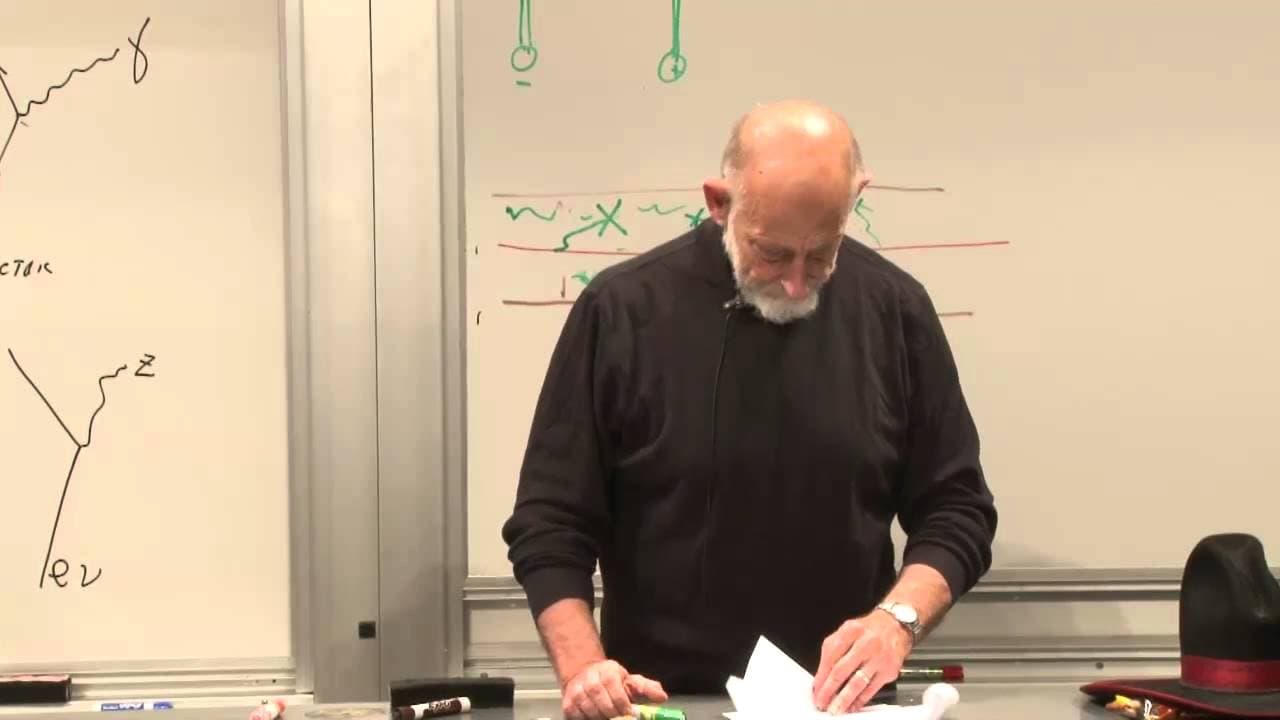
Demystifying the Higgs Boson with Leonard Susskind
Transcript
Stanford University the goal tonight is not to tell you why the higs B arm is the best thing since flush toilets you've read all of that anybody who here has probably read all of the um the hype the uh excited breathless uh superlatives that uh that have the newspapers and so forth things B arm is going to explain the origin of the universe and thi... Read More
Install to Summarize YouTube Videos and Get Transcripts
Explore YouTube Video Summarizer or Get YouTube Transcript Extractor
Summary
This video explains the concept of the Higgs boson in the context of the standard model of particle physics. The speaker emphasizes the importance of understanding how things work rather than focusing solely on the excitement and enthusiasm surrounding the discovery of the Higgs boson. He starts by discussing the basics of quantum mechanics and the concept of quantization. Then he introduces the notion of fields and how they can fill empty space. He illustrates the idea using examples of electric and magnetic fields. He also explains how fields can be quantized and how particles can be viewed as excitations in the field. He introduces the concept of a condensate and how it is related to charge and symmetry breaking. He then provides an overview of the standard model of particle physics and how particles and fields interact. Finally, he delves into how fields can affect the mass of particles and how the Higgs boson plays a role in this process.
Questions & Answers
Q: What does the speaker aim to explain in the video?
The speaker aims to explain the nuts and bolts of Higgs physics and how it relates to the standard model of particle physics.
Q: How does the speaker describe quantum mechanics?
The speaker describes quantum mechanics as a theory in which things are quantized, meaning they come in discrete, integer quantities. He uses the example of angular momentum, which can only be certain values defined by Planck's constant.
Q: What is a field according to the speaker?
According to the speaker, a field is a condition in space that characterizes the behavior of space at a given point in space and time. It can be electric, magnetic, or gravitational.
Q: Can empty space be filled with fields?
Yes, empty space can be filled with fields. The speaker explains that while we usually think of empty space as having no electric or magnetic fields, there is no requirement in physics that it should be the case. It's possible to imagine a world filled with electric fields, for example.
Q: How does the speaker explain the concept of fields affecting mass?
The speaker provides a simple example of water molecules and how their mass can be affected by an electric field. He then applies this idea to elementary particles, such as electrons, and introduces the concept of zilch, a separate type of charge that emits Z bosons. The emission and absorption of Z bosons by particles with different zilch values allow for the exchange of zilch and, in turn, affects the mass of the particles.
Q: What is the role of the Higgs boson in relation to zilch and mass?
The Higgs boson is not directly mentioned in the video, but the speaker introduces the concept of the Z boson, which is closely related to zilch. The emission and absorption of Z bosons allow for the exchange of zilch values and affect the mass of particles. The Higgs boson, which is still to be discussed in more detail, is likely to play a role in this process.
Q: What is the significance of the condensate?
The condensate is a state where particles are uncertain and can exist in different values without noticeably affecting the overall system. In the context of zilch, the condensate allows for the emission and absorption of Z bosons, enabling particles to exchange zilch values and affect their mass without drastic consequences to the system as a whole.
Takeaways
The video provides an overview of Higgs physics and its connection to the standard model of particle physics. It explains the basics of quantum mechanics, the concept of fields, and the idea of condensates. The speaker highlights the role of zilch and the emission and absorption of Z bosons in affecting the mass of particles. While the Higgs boson is not directly mentioned, it is likely to play a role in this process. Understanding these concepts helps to unravel the mystery of how particles acquire mass in the universe.
Read in Other Languages (beta)
Share This Summary 📚
Summarize YouTube Videos and Get Video Transcripts with 1-Click
Try YouTube Summary with ChatGPT & Claude or YouTube Transcript Generator
Explore More Summaries from Stanford 📚



Summarize YouTube Videos and Get Video Transcripts with 1-Click
Try YouTube Summary with ChatGPT & Claude or YouTube Transcript Generator