What Is Software 3.0 and Its Impact on Developers?
TL;DR
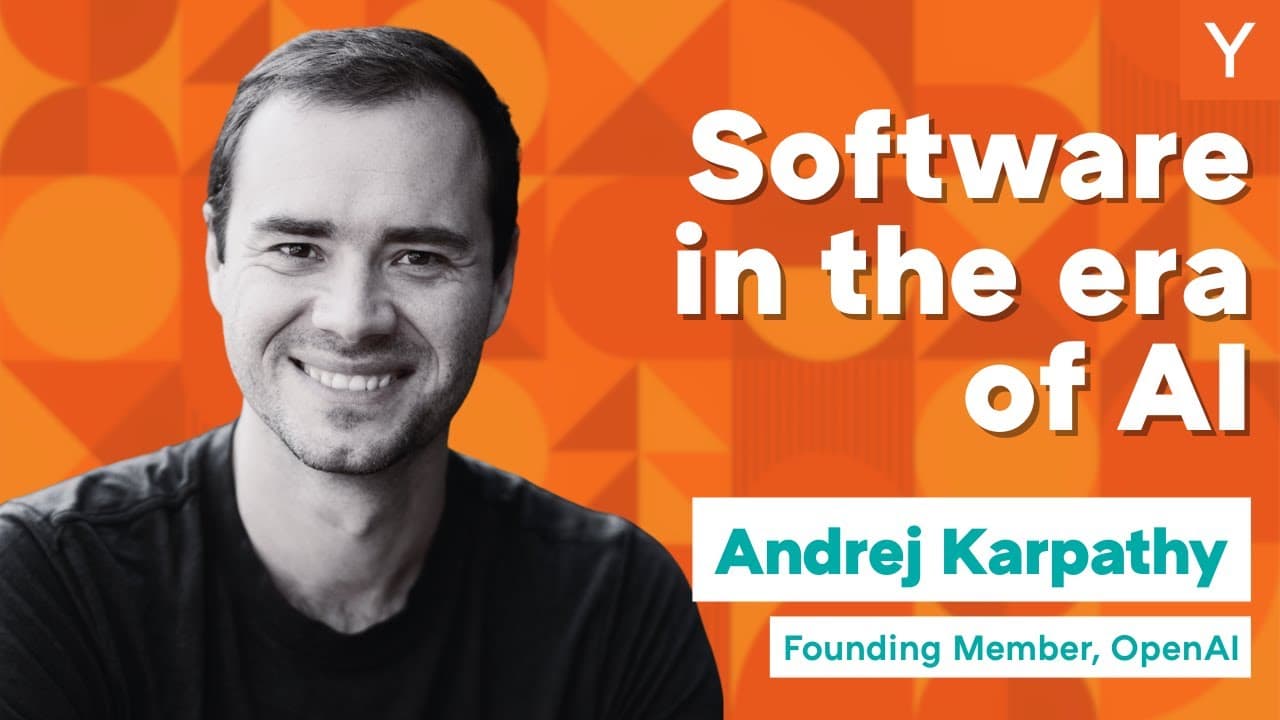
Software 3.0 marks a transformative shift where AI models are programmed using natural language, fundamentally altering software development. Developers must adapt by creating partially autonomous products and embracing Large Language Models (LLMs) as key consumers of digital information.
Transcript
please welcome former director of AI Tesla Andre Carpathy hello wow a lot of people here hello um okay yeah so I'm excited to be here today to talk to you about software in the era of AI and I'm told that many of you are students like bachelors masters PhD and so on and you're about to enter the industry and I think it's actually like an extremely ... Read More
Key Insights
- Software is undergoing a fundamental change, evolving from traditional programming to using AI models programmed in natural language, termed as Software 3.0.
- Large Language Models (LLMs) are likened to utilities, fabs, and operating systems, marking a new era in computing, similar to the 1960s.
- LLMs exhibit an emergent psychology, displaying superhuman knowledge but also cognitive deficits, requiring careful collaboration with humans.
- The advent of LLMs allows for partially autonomous products, where software can perform tasks with varying levels of autonomy.
- Natural language programming makes software development more accessible, enabling more people to engage in 'vibe coding'.
- LLMs are becoming a primary consumer and manipulator of digital information, necessitating new software infrastructure to accommodate them.
- The analogy of LLMs as operating systems suggests a shift in how we interact with technology, moving towards more integrated and autonomous systems.
- The future of software involves building for agents, creating environments where LLMs can effectively interact with digital infrastructure.
Install to Summarize YouTube Videos and Get Transcripts
Explore YouTube Video Summarizer or Get YouTube Transcript Extractor
Questions & Answers
Q: What is Software 3.0 according to Andrej Karpathy?
Software 3.0, as described by Andrej Karpathy, is the next evolution in software development where AI models, specifically large language models (LLMs), are programmed using natural language. This marks a shift from traditional coding to using English as the programming interface, allowing for more accessible and intuitive software development.
Q: How do LLMs compare to traditional software systems?
LLMs are compared to traditional software systems as new kinds of computers that function as utilities, fabs, and operating systems. They possess an emergent psychology, displaying superhuman capabilities in some areas while being fallible in others. This requires a new approach to programming and interacting with these models, as they are both powerful and unpredictable.
Q: What opportunities do LLMs present for software development?
LLMs present opportunities for creating partially autonomous products that can perform tasks with varying levels of autonomy. They enable developers to build software that is more accessible, as programming can be done in natural language. This opens up possibilities for new applications and services that can leverage the capabilities of LLMs to automate and enhance tasks.
Q: How does natural language programming change the software development landscape?
Natural language programming changes the software development landscape by making it more accessible to a broader audience. It allows individuals without traditional coding skills to engage in software development through 'vibe coding,' where they can create applications and solutions using natural language prompts. This democratizes programming and opens up new possibilities for innovation.
Q: What is the significance of LLMs as operating systems?
The significance of LLMs as operating systems lies in their ability to orchestrate complex tasks and manage digital information in a way similar to traditional operating systems. This analogy suggests a shift towards more integrated and autonomous systems, where LLMs serve as the core of digital ecosystems, facilitating interactions between users and technology in more seamless and intuitive ways.
Q: Why is building for agents important in the context of LLMs?
Building for agents is important because LLMs are becoming primary consumers and manipulators of digital information. By creating environments and infrastructures that accommodate these models, developers can enhance the efficiency and effectiveness of LLMs in performing tasks and interacting with digital systems. This involves creating interfaces and protocols that cater to the unique capabilities and limitations of LLMs.
Q: How do LLMs impact the traditional software development process?
LLMs impact the traditional software development process by introducing a new paradigm where programming is done in natural language, reducing the need for extensive coding knowledge. They enable the creation of partially autonomous products that can perform tasks independently or with minimal human intervention. This shift requires developers to rethink how software is designed, developed, and maintained, focusing on collaboration with AI models.
Q: What challenges do LLMs pose in terms of security and reliability?
LLMs pose challenges in terms of security and reliability due to their cognitive deficits and tendency to hallucinate or make errors. They are susceptible to prompt injection risks, data leaks, and other security vulnerabilities. Ensuring the reliability and safety of LLMs requires careful design and implementation of systems that can mitigate these risks, as well as ongoing monitoring and validation of their outputs.
Summary & Key Takeaways
-
Andrej Karpathy discusses the evolution of software into what he terms Software 3.0, where AI models are programmed using natural language, fundamentally changing the landscape of software development.
-
He likens Large Language Models to utilities, fabs, and operating systems, suggesting that we are in a new era of computing akin to the 1960s, with LLMs as a new kind of computer.
-
Karpathy emphasizes the need for developers to adapt to this change by building partially autonomous products and accommodating LLMs as primary consumers of digital information.
Read in Other Languages (beta)
Share This Summary 📚
Summarize YouTube Videos and Get Video Transcripts with 1-Click
Try YouTube Summary with ChatGPT & Claude or YouTube Transcript Generator
Explore More Summaries from Y Combinator 📚




Summarize YouTube Videos and Get Video Transcripts with 1-Click
Try YouTube Summary with ChatGPT & Claude or YouTube Transcript Generator