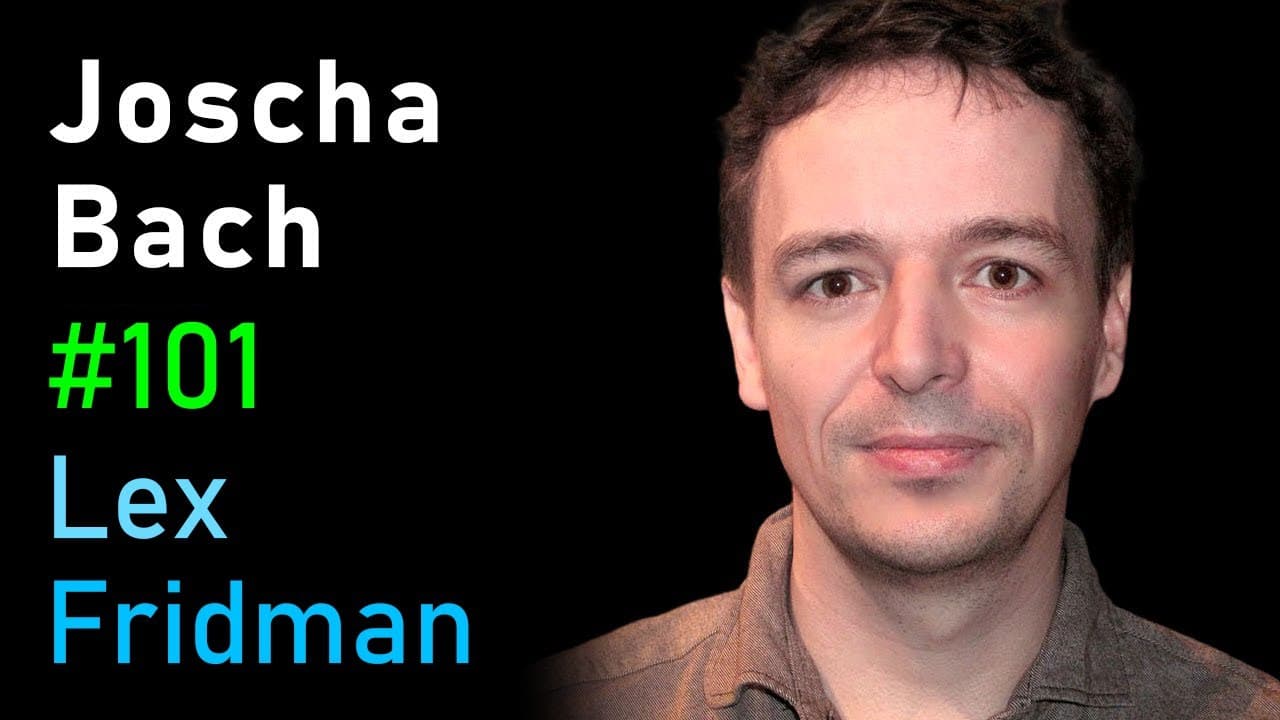
Joscha Bach: Artificial Consciousness and the Nature of Reality | Lex Fridman Podcast #101
TL;DR
Consciousness emerges from attentional mechanisms and is a simulation created by the mind. The physical world is a computational reality, and our understanding of it depends on the models constructed by our brains.
Transcript
the following is a conversation of Yoshi Bach VP of research at the AI foundation with a history of research positions at MIT and Harvard Yosha is one of the most unique and brilliant people in the artificial intelligence community exploring the workings of human mind intelligence consciousness life on Earth and the possibly simulated fabric of our... Read More
Key Insights
- 🤯 Consciousness emerges from attentional mechanisms and is a result of the mind's simulation.
- 🧠 The physical world is a computational reality, and our understanding of it is shaped by the models created by our brains.
- 🤯 Identity is a software construction within the larger simulation of the mind.
- 🖐️ Self-awareness plays a crucial role in intelligence by enabling individuals to model their own actions and regulate their behavior.
Install to Summarize YouTube Videos and Get Transcripts
Explore YouTube Video Summarizer or Get YouTube Transcript Extractor
Questions & Answers
Q: How does consciousness emerge in artificial intelligence?
Consciousness in AI arises from attentional mechanisms, where the mind constructs a simulation based on the models generated by the brain. It is a result of an ongoing narrative created by the mind.
Q: Is the physical world a simulation?
The physical world is perceived as a computational reality, where our brains generate models to interpret the patterns we observe. It is a result of the interaction between our senses and the external environment, shaped by our attentional mechanisms.
Q: What is the significance of self-awareness in intelligence?
Self-awareness allows the mind to model its own actions and predict its reactions to specific situations. It is a crucial aspect of intelligence, as it enables individuals to understand and regulate their behavior in relation to their environment.
Q: How does the mind's simulation of reality connect with the broader universe?
The mind's simulation represents a subjective interpretation of the external world, filtered through the brain's representation mechanisms. The universe, as we perceive it, consists of stable patterns that are effectively modeled by our attentional mechanisms.
Key Insights:
- Consciousness emerges from attentional mechanisms and is a result of the mind's simulation.
- The physical world is a computational reality, and our understanding of it is shaped by the models created by our brains.
- Identity is a software construction within the larger simulation of the mind.
- Self-awareness plays a crucial role in intelligence by enabling individuals to model their own actions and regulate their behavior.
- The mind's simulation of reality is an ongoing narrative that constructs a subjective interpretation of the external world.
Summary
This conversation is with Yoshi Bach, VP of Research at the AI Foundation and explores topics such as artificial intelligence, human intelligence, consciousness, life on Earth, and the possible simulated nature of the universe. The dialogue covers a range of philosophical concepts including dualism, materialism, idealism, and functionalism.
Questions & Answers
Q: What philosophers, scientists, ideas, or movies influenced you growing up and impacted your intellectual development?
Yoshi Bach grew up in an artistic household where his father, an architect, was his main influence. However, his father's parenting style clashed with Yoshi's intrinsic motivation, and he grew up feeling misunderstood. He turned to reading as a means of understanding the world, devouring books on various topics including science fiction and classical philosophy. These readings contributed to his intellectual development.
Q: How would you define a nerd and how do they interact with society?
A: Yoshi Bach defines a nerd as someone who believes that the purpose of communication is to submit ideas to peer review, whereas normal people understand that communication aims to negotiate alignment. Nerds often struggle with societal interaction and need to learn how to navigate interactions with non-nerds who have different communication priorities.
Q: What impact did your father's artistic mindset have on you?
Yoshi Bach's father, an unconventional artist, influenced Yoshi with his unique approach to architecture and life. His father's rejection of societal norms and emphasis on pursuing personal artistic expression allowed Yoshi to grow up with a sense of freedom and self-expression.
Q: Can you explain the difference between objective truth and subjective truth?
Yoshi Bach explains that objective truth is based on model correspondence and the ability to predict outcomes. It relies on the concept of a model that can be proven or disproven under certain conditions. On the other hand, subjective truth is more related to personal beliefs and experiences that may not adhere to objective standards.
Q: Why does anything exist at all?
Yoshi Bach offers the idea that existence may be the default state, where existence requires implementable structures known as finite automata. He suggests that the entire existence could be a superposition of finite automata, creating an intricate fractal-like structure.
Q: How do dualism, materialism, idealism, and functionalism relate to the understanding of reality?
Dualism posits the existence of two separate substances: mental and physical. Materialism suggests that only physical substance is real, while idealism believes the mental realm is primary. Functionalism emphasizes the process of making models and how intelligence arises from this modeling ability.
Q: How does the brain create a version of reality and experience consciousness?
Yoshua Bach explains that the brain generates a virtual reality within itself to make sense of the external world by interpreting patterns received from sensory inputs. Consciousness is the brain's way of modeling and understanding the self and its interaction with the environment.
Q: What is the difference between sentience and intelligence?
Sentience involves possessing certain models that allow us to experience and make sense of the world, while intelligence is the ability to model and predict patterns. Sentience and intelligence are not mutually exclusive; however, one can have sentience without high levels of intelligence.
Q: What is the distinction between the physical world and the mental realm?
The physical world is the external reality that we interact with, governed by physical laws and patterns. The mental realm is the internal, subjective experience generated by the brain to interpret and understand the patterns observed in the physical world.
Q: Can we access the "real world" or is it fundamentally unknowable?
The "real world" is understood through the models and simulations created by our brains. While there may be a physical reality that exists independently from our perception, it is inaccessible to us because our understanding is limited to the narratives constructed within our minds.
Q: How does the brain create a self-aware story within itself?
The brain creates a self-aware narrative as a means of understanding and predicting its own behavior and interactions with the environment. This self-aware story is constantly updated and revised as new information is processed.
Takeaways
Yoshi Bach's upbringing in an artistic household shaped his unique perspective on artificial intelligence, human intelligence, and consciousness. His exploration of philosophical concepts like dualism, materialism, idealism, and functionalism offers insights into the nature of reality and the role of the brain in constructing models of the world. The conversation highlights the importance of understanding both existing paradigms and exploring new questions to advance the field of AI.
Summary & Key Takeaways
-
The mind is a simulation created by the brain, where consciousness emerges from attentional mechanisms.
-
The physical world is perceived as a computational reality, with the brain generating models to make sense of it.
-
Identity is a software construction, and individual identities exist within the larger simulation of the mind.
Read in Other Languages (beta)
Share This Summary 📚
Summarize YouTube Videos and Get Video Transcripts with 1-Click
Try YouTube Summary with ChatGPT & Claude or YouTube Transcript Generator
Explore More Summaries from Lex Fridman Podcast 📚





Summarize YouTube Videos and Get Video Transcripts with 1-Click
Try YouTube Summary with ChatGPT & Claude or YouTube Transcript Generator