First Image of a Black Hole!
TL;DR
Scientists capture the first-ever image of a black hole, confirming the existence of these celestial entities and supporting the general theory of relativity.
Transcript
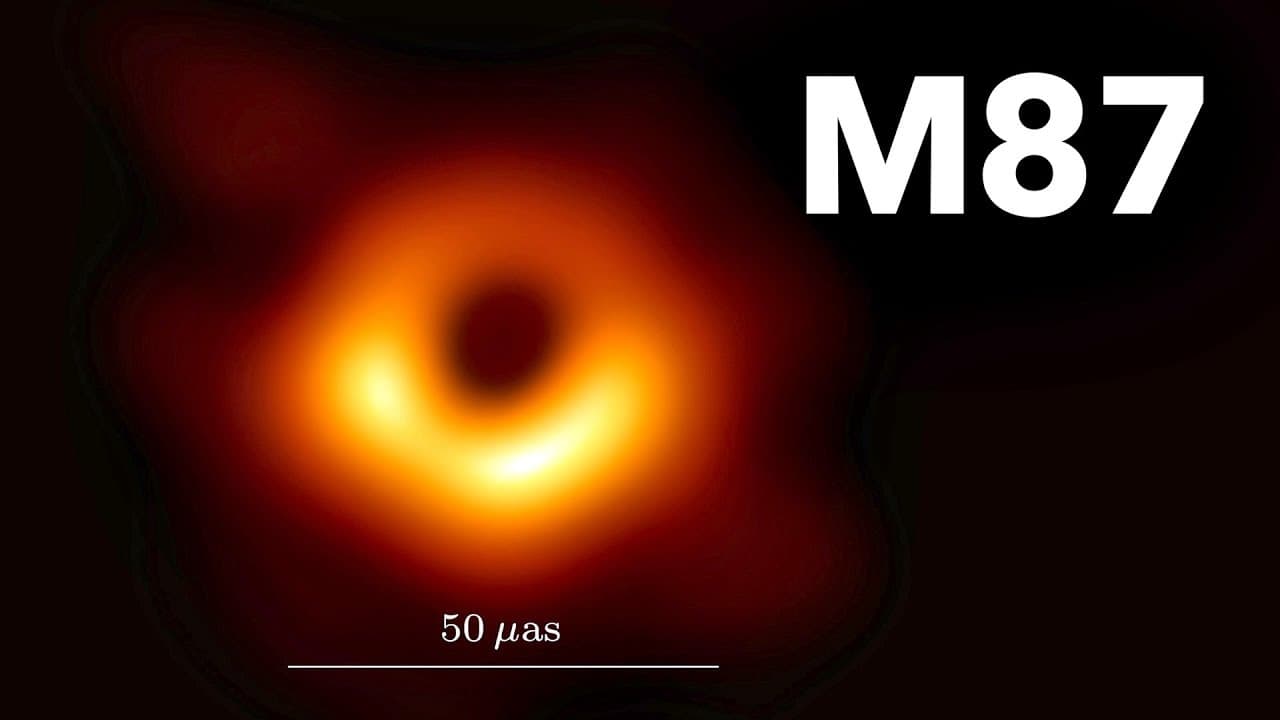
This is the first-ever image of a black hole released by the Event Horizon Telescope collaboration on April 10th 2019 It shows plasma orbiting the supermassive black hole at the center of the galaxy M87. The bright region shows where plasma is coming towards us and since it's traveling near the speed of light it appears brighter when coming towards... Read More
Key Insights
- 🖤 The first-ever image of a black hole provides visual evidence for the existence of these enigmatic celestial objects and supports Einstein's general theory of relativity.
- 😚 The image was captured using radio waves with a wavelength of 1.3 millimeters, allowing observation of features close to the event horizon and overcoming the hurdles of interstellar dust and the accretion disk.
- 🖤 The black hole in M87 is highly active, constantly feeding on matter from its accretion disk and exhibiting powerful collimated jets.
- 😁 Relativistic beaming helps explain why we can observe the jet coming towards us in the Hubble Space Telescope image but not the one moving away.
- 🖤 The warping of space-time around the black hole causes light to be lensed, enabling us to observe even parts of the accretion disk located behind the black hole.
- 🙂 The black hole's angular size of 40 microarcseconds and its distance of 53.5 million light-years make it a technical challenge to capture a detailed image, requiring a global network of telescopes.
- 🖤 Other black holes, such as Sagittarius A* at the center of our galaxy, are being observed, but images have not yet been released.
- 🧑🔬 The collaboration of over 200 scientists and the remarkable achievement of capturing the image highlights the pursuit of seemingly impossible goals in science.
Install to Summarize YouTube Videos and Get Transcripts
Explore YouTube Video Summarizer or Get YouTube Transcript Extractor
Questions & Answers
Q: How was the first image of a black hole captured?
The image was captured using a global network of eight telescopes observing the galaxy M87 simultaneously, effectively simulating a telescope the size of the Earth in order to achieve the required resolution.
Q: Why does the image of the black hole appear fuzzy?
Despite its massive size, the black hole appears tiny from our perspective due to its immense distance of 53.5 million light-years away. The image's fuzziness is a result of the black hole's small angular size of about 40 microarcseconds.
Q: What is relativistic beaming?
Relativistic beaming refers to the phenomenon where objects moving close to the speed of light, such as plasma orbiting the black hole, appear brighter when coming towards us and dimmer when moving away.
Q: Are there other black holes that have been studied?
Besides the black hole in M87, scientists have also observed the supermassive black hole at the center of our Milky Way galaxy, named Sagittarius A*. However, an image of this black hole has not yet been released.
Summary & Key Takeaways
-
The released image shows plasma orbiting the supermassive black hole in the galaxy M87, showcasing relativistic beaming and the clockwise orbital movement of plasma.
-
The image was captured using radio waves with a wavelength of 1.3 millimeters, allowing for observation of features near the event horizon.
-
The image also reveals narrow collimated jets above and below the black hole, thought to be caused by powerful magnetic fields.
Read in Other Languages (beta)
Share This Summary 📚
Summarize YouTube Videos and Get Video Transcripts with 1-Click
Try YouTube Summary with ChatGPT & Claude or YouTube Transcript Generator
Explore More Summaries from Veritasium 📚





Summarize YouTube Videos and Get Video Transcripts with 1-Click
Try YouTube Summary with ChatGPT & Claude or YouTube Transcript Generator