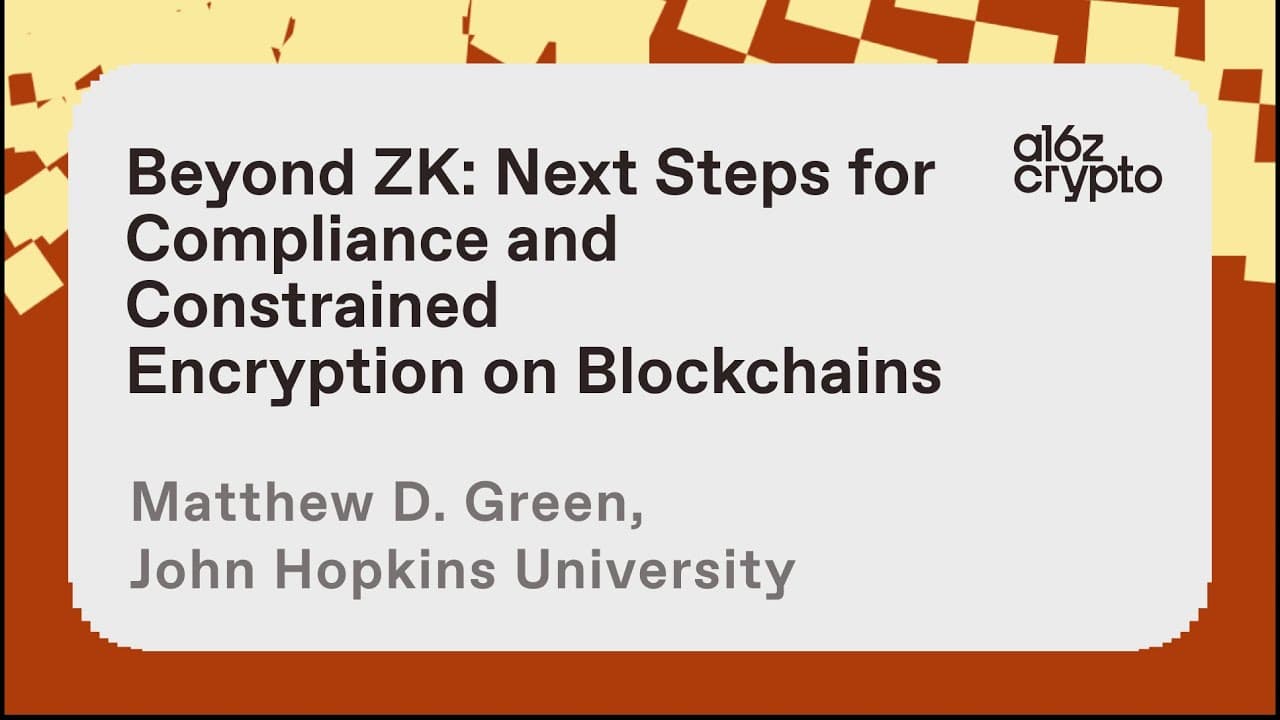
Beyond ZK: Next Steps for Compliance and Constrained Encryption on Blockchains with Matthew D. Green
TL;DR
This research seminar discusses new techniques for computing on encrypted data, including the use of blockchains and trusted execution environments.
Transcript
all right welcome everyone to uh today's a16z crypto research seminar very happy to introduce Matt Greene uh professor at Johns Hopkins University is super well known um from the blockchain space is an applied cryptographer more generally very ambitious uh talk title for us today we dialed it down a little bit beyond ZK yeah thank you um good so I ... Read More
Key Insights
- 👻 New tools and techniques, such as succinct zero knowledge proofs and witness encryption, have allowed for significant advancements in computing on encrypted data.
- 🏃 Trusted execution environments like Intel SGX and secure enclaves offer a level of security, but their limitations and control by manufacturers restrict their potential for running arbitrary software.
- 🎁 Blockchains can provide a public ledger for verifying encrypted data and enable joint computations over secret data, but practical implementation and scalability present challenges.
- 👨🔬 The concept of one-time programs, where a program can only be run once and is obfuscated for security, is an area of interest and ongoing research.
Install to Summarize YouTube Videos and Get Transcripts
Explore YouTube Video Summarizer or Get YouTube Transcript Extractor
Questions & Answers
Q: How has the cryptographic landscape changed in recent years and what new possibilities are emerging?
The speaker notes that advancements in techniques such as succinct zero knowledge proofs have enabled more powerful and efficient computations on encrypted data. However, there are still challenges in achieving practical solutions for joint computations and program obfuscation.
Q: What are the limitations of using trusted execution environments like Intel SGX or secure enclaves in smartphones?
While trusted execution environments provide some level of security for running software, they are typically controlled by the manufacturer and limited in their functionality. Users are unable to run arbitrary software in these environments without approval from the manufacturer, which limits their potential for one-time program execution.
Q: How can blockchains be utilized in computing on encrypted data?
Blockchains can serve as a public ledger, providing a proof of publication for verifying encrypted data. This can be used to establish joint computations over secret data and enable functionalities such as private smart contracts and exchanges. The speaker also mentions the potential of witness encryption in achieving more advanced cryptographic goals.
Q: Can these new techniques be applied practically in cloud environments?
Yes, it is possible to leverage cloud providers with hardware security modules to implement these techniques. By utilizing one-time memories and integrating them with secure cloud services, it is feasible to execute one-time programs in a secure manner. However, the practical implementation and adoption of these techniques may still face certain challenges.
Summary & Key Takeaways
-
The speaker discusses different ways of computing on encrypted data, both in the context of blockchains and non-blockchain related applications.
-
He highlights the rise of succinct zero knowledge and the potential of efficient computing on encrypted or private data using fully homomorphic encryption and secure multi-party computation.
-
The speaker presents the concept of obfuscation and the possibility of implementing programs with limited states for greater security and privacy.
Read in Other Languages (beta)
Share This Summary 📚
Summarize YouTube Videos and Get Video Transcripts with 1-Click
Try YouTube Summary with ChatGPT & Claude or YouTube Transcript Generator
Explore More Summaries from a16z crypto 📚
Summarize YouTube Videos and Get Video Transcripts with 1-Click
Try YouTube Summary with ChatGPT & Claude or YouTube Transcript Generator