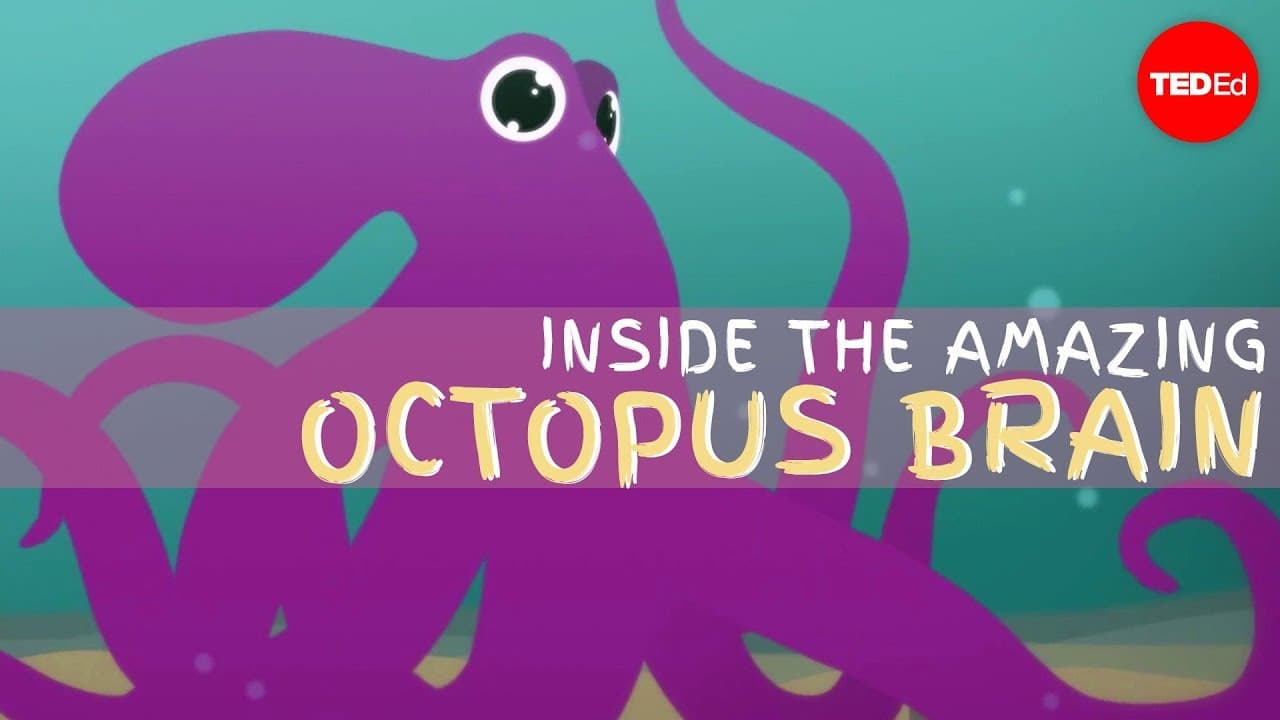
Why the octopus brain is so extraordinary - Cláudio L. Guerra
TL;DR
Octopuses possess remarkable intelligence with decentralized brains and autonomous limbs, inspiring research in robotics and consciousness studies.
Transcript
What could octopuses possibly have in common with us? After all, they don't have lungs, spines, or even a plural noun we can all agree on. But what they do have is the ability to solve puzzles, learn through observation, and even use tools, just like some other animals we know. And what makes octopus intelligence so amazing is that it comes from a... Read More
Key Insights
- 🐙 Octopuses exhibit intelligence through puzzle-solving, tool usage, and observational learning.
- 🤔 The decentralized brain structure of octopuses allows each arm to think autonomously.
- 👨🔬 Research into octopus intelligence has inspired advancements in flexible robotics.
- 💁 Studying octopus intelligence can provide insights into consciousness and the diversity of intelligent life forms.
- 🧠 Octopus intelligence challenges traditional notions of brain-centralized intelligence.
- 🧠 The behavior library in octopus brains enables adaptive responses.
- 👻 Octopuses' boneless bodies allow for unparalleled flexibility in movement and problem-solving.
Install to Summarize YouTube Videos and Get Transcripts
Explore YouTube Video Summarizer or Get YouTube Transcript Extractor
Questions & Answers
Q: How do octopuses demonstrate intelligence?
Octopuses showcase intelligence by solving puzzles, using tools, and learning through observation, similar to other intelligent animals like humans.
Q: What is unique about the brain structure of octopuses?
Octopuses have a decentralized brain structure with neurons spread throughout their bodies, enabling each arm to exhibit autonomous thinking capabilities.
Q: How has octopus intelligence inspired research in other fields?
Octopus intelligence has led to advances in robotics, inspiring the development of flexible robots made of soft materials that mimic the decentralized brain structure of octopuses.
Q: What can studying octopus intelligence teach us about consciousness?
By exploring how intelligence arises in octopuses with a radically different nervous system, we can gain insight into the nature of consciousness and understand the diversity of intelligent life forms.
Summary
Octopuses have the ability to solve puzzles, learn through observation, and use tools, which is similar to some other animals. Their intelligence comes from a biological structure different from humans. Octopuses have impressively large brains, a complex nervous system with millions of neurons, and a unique distribution of neurons in their bodies. Their lack of bones allows them to bend their limbs in any direction, giving them incredible flexibility. Octopuses have a behavior library in their brains instead of a body map, allowing each arm to think for itself. Their intelligence has inspired research in developing flexible robots and can help us understand intelligence and consciousness in general.
Questions & Answers
Q: What makes octopus intelligence so amazing?
Octopus intelligence is amazing because it comes from a biological structure that is completely different from humans. They have large brains, a complex nervous system, and a unique distribution of neurons in their bodies.
Q: How many neurons do octopuses have?
Octopuses have approximately 500 million neurons, which is similar to the number of neurons in a dog's brain.
Q: How are the neurons distributed in an octopus?
The neurons in an octopus are spread out in a network of interconnected ganglia organized into three basic structures. The central brain contains about 10% of the neurons, while the two optic lobes contain about 30%. The remaining 60% of neurons are in the tentacles.
Q: How does the lack of bones affect an octopus's movement?
The lack of bones in an octopus allows them to bend their limbs at any point and in any direction. This gives them incredible flexibility and the ability to shape their tentacles into almost limitless arrangements.
Q: How does an octopus's brain differ from a human brain in terms of body movement?
A human brain has a neurological map of the body, which activates specific muscles for movement. In an octopus, the brain has a behavior library. When an octopus sees food, its brain activates a behavioral response to grab it. The arm neurons pick up the message and command the movement accordingly.
Q: How does an octopus's arm interact with the food it is trying to grab?
When an arm touches the food, a muscle activation wave travels from the arm's tip to its base, while another wave travels from the base to the tip. The signals meet halfway between the food and the base of the arm, indicating where the arm should bend to grasp the food.
Q: What advantages does an octopus have with its autonomously thinking appendages?
Each of an octopus's eight arms can essentially think for itself, giving it amazing flexibility and creativity. This allows the octopus to adapt to new situations, solve problems, and perform complex tasks such as opening bottles, escaping mazes, blending into the environment, and mimicking other creatures.
Q: How have cephalopods influenced research in robotics?
The unique nervous system and autonomously thinking appendages of cephalopods, including octopuses, have inspired research in developing flexible robots made of soft materials. Cephalopods' ability to navigate and manipulate their environment has provided insights into creating more versatile and adaptable robotic systems.
Q: In what ways can the study of octopus intelligence contribute to our understanding of intelligence and consciousness?
Octopus intelligence, evolving along a divergent path from vertebrates, offers valuable insights into how intelligence can arise in different species. Studying octopuses can advance our understanding of intelligence and consciousness in general, helping us explore the possibilities of other forms of intelligent life and how they perceive the world.
Q: What is the broader significance of octopus intelligence?
Octopus intelligence not only benefits octopuses themselves but also offers opportunities for technological advancements and scientific discoveries. Understanding how intelligence can arise in such a different evolutionary path can broaden our knowledge of intelligence and consciousness overall, opening up new perspectives in various fields.
Takeaways
The remarkable intelligence of octopuses, stemming from their unique biological structure, challenges our understanding of what intelligence can look like. Their complex nervous system, distributed neurons, and autonomously thinking arms enable them to adapt and solve problems in extraordinary ways. Understanding octopus intelligence can inspire advancements in robotics and provide insights into the nature of intelligence and consciousness. It prompts us to consider the possibility of other types of intelligent life and how they perceive and interact with their environment.
Summary & Key Takeaways
-
Octopuses demonstrate intelligence through puzzle-solving, tool usage, and observational learning.
-
Their brains have a decentralized structure with neurons spread throughout their bodies, allowing each arm to essentially think for itself.
-
Studying octopus intelligence can provide insights into consciousness and inspire developments in flexible robotics.
Read in Other Languages (beta)
Share This Summary 📚
Summarize YouTube Videos and Get Video Transcripts with 1-Click
Try YouTube Summary with ChatGPT & Claude or YouTube Transcript Generator
Explore More Summaries from TED-Ed 📚



Summarize YouTube Videos and Get Video Transcripts with 1-Click
Try YouTube Summary with ChatGPT & Claude or YouTube Transcript Generator