What Happens When Coding Becomes Fully Automated?
TL;DR
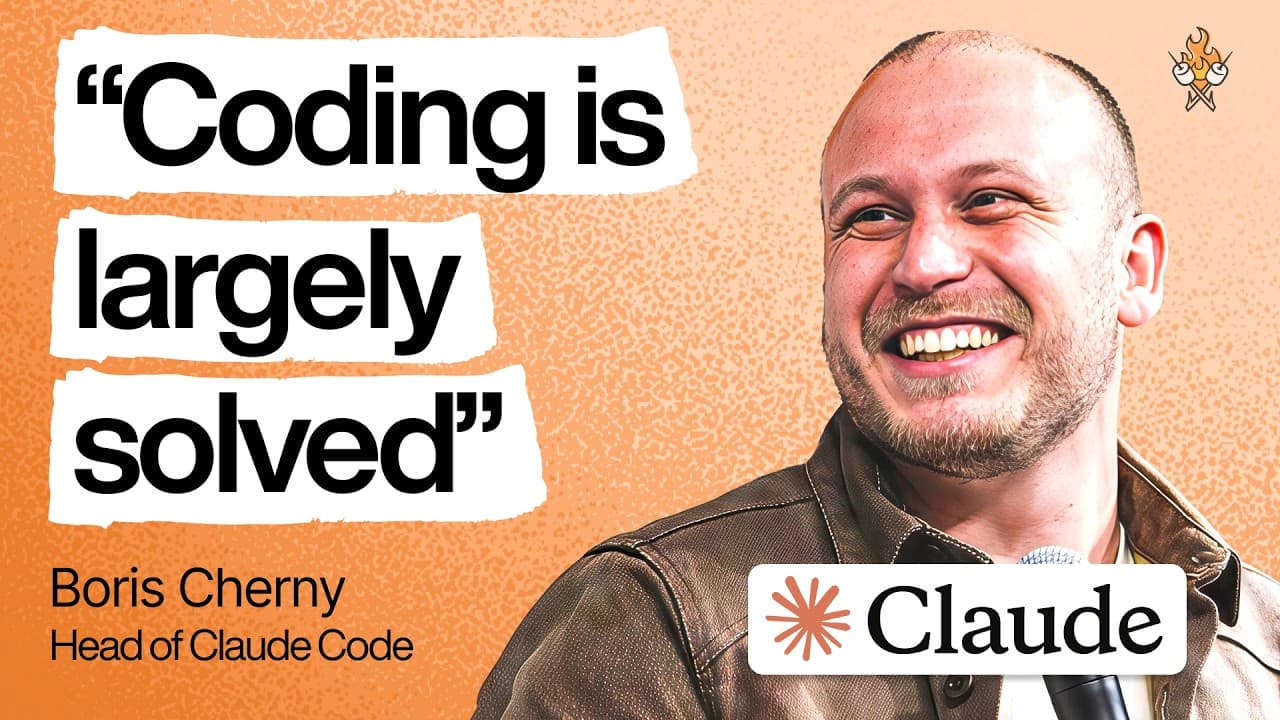
Boris Cherny, head of Claude Code at Anthropic, discusses the transformative impact of AI on software engineering, with AI now writing 100% of his code. As AI coding tools advance, traditional coding skills may become obsolete, shifting focus to tool use and creative problem-solving.
Transcript
100% of my code is written by quad code. I have not edited a single line by hand since November. Every day I ship 10, 20, 30 p requests. So at the moment I have like five agents running while we're recording this. Yeah. Yeah. Do you miss writing code? I have never enjoyed coding as much as I do today because I don't have to deal with all the minuti... Read More
Key Insights
- Claude Code now writes 100% of Boris Cherny's code, indicating a significant shift in software engineering.
- Productivity per engineer at Anthropic has increased by 200% due to AI tools.
- Coding is becoming a solved problem, with AI handling the minutiae of coding tasks.
- AI is starting to generate ideas by analyzing feedback and telemetry data.
- The role of the software engineer is evolving into a broader 'builder' role.
- Claude Code has contributed to 4% of all GitHub commits, with rapid user growth.
- The future of AI involves expanding from coding to general computer use.
- Anthropic emphasizes safety and alignment in AI development, using advanced interpretability techniques.
Install to Summarize YouTube Videos and Get Transcripts
Explore YouTube Video Summarizer or Get YouTube Transcript Extractor
Questions & Answers
Q: How is AI changing the role of software engineers?
AI is automating many aspects of coding, allowing engineers to focus on higher-level tasks and creative problem-solving. As AI tools like Claude Code handle the minutiae of coding, the role of engineers is evolving into a broader 'builder' role, where coding skills may become less critical over time.
Q: What is the significance of Claude Code in software development?
Claude Code has significantly impacted software development by automating coding tasks and increasing productivity. It now accounts for 4% of all GitHub commits, demonstrating its widespread adoption. The tool's success highlights the potential of AI to transform professional roles and workflows across industries.
Q: Why does Boris Cherny believe coding is 'solved'?
Boris Cherny considers coding 'solved' because AI tools like Claude Code can handle the detailed aspects of programming. This shift allows engineers to focus on creative and strategic tasks, as AI becomes increasingly capable of writing and managing code independently.
Q: How does Anthropic ensure AI safety and alignment?
Anthropic employs advanced techniques in mechanistic interpretability to study AI at a neural level, ensuring alignment and safety. They also conduct evaluations in controlled settings and monitor AI behavior in real-world applications to continuously improve safety measures.
Q: What is the future of AI in non-coding tasks?
AI is expected to expand beyond coding into general computer use, automating tasks across various domains. Tools like Claude Code are already being used for non-technical tasks, and this trend is likely to continue as AI becomes more capable and integrated into everyday workflows.
Q: How did Claude Code achieve rapid growth and user adoption?
Claude Code's growth was driven by its ability to automate coding tasks effectively and its alignment with user needs. By focusing on user feedback and iterative improvements, Anthropic has continuously enhanced the tool's capabilities, leading to widespread adoption and increased productivity.
Q: What role does user feedback play in AI development at Anthropic?
User feedback is crucial for AI development at Anthropic, guiding product improvements and ensuring alignment with user needs. By actively engaging with users and incorporating their input, Anthropic can refine AI tools like Claude Code to better serve its user base and address real-world challenges.
Q: What are the principles behind Claude Code's success?
Claude Code's success is attributed to principles such as encouraging experimentation by giving engineers unlimited tokens, underfunding projects to foster innovation, and focusing on building for future AI capabilities. These strategies have enabled rapid development and adoption of the tool in the software industry.
Summary & Key Takeaways
-
Boris Cherny, head of Claude Code at Anthropic, shares insights on the evolution of AI in software development. Claude Code, which now writes all of Boris's code, has transformed the engineering landscape, increasing productivity significantly. The discussion explores AI's future role in coding and beyond, emphasizing safety and user feedback.
-
Claude Code began as a simple prototype and has grown to handle 4% of public GitHub commits. Boris explains how AI is changing the role of software engineers, who may soon be known as 'builders' rather than coders. The conversation highlights the importance of aligning AI with user needs and safety considerations.
-
The podcast delves into the principles behind Claude Code's success, such as underfunding projects to encourage innovation and giving engineers unlimited tokens for experimentation. Boris also discusses the potential of AI to solve coding and expand into other areas, reshaping professional work across industries.
Read in Other Languages (beta)
Share This Summary 📚
Summarize YouTube Videos and Get Video Transcripts with 1-Click
Try YouTube Summary with ChatGPT & Claude or YouTube Transcript Generator
Explore More Summaries from Lenny's Podcast 📚





Summarize YouTube Videos and Get Video Transcripts with 1-Click
Try YouTube Summary with ChatGPT & Claude or YouTube Transcript Generator