The Physical Turing Test: Jim Fan on Nvidia's Roadmap for Embodied AI
TL;DR
Jim Fan discusses Nvidia's roadmap for advancing embodied AI through simulation.
Transcript
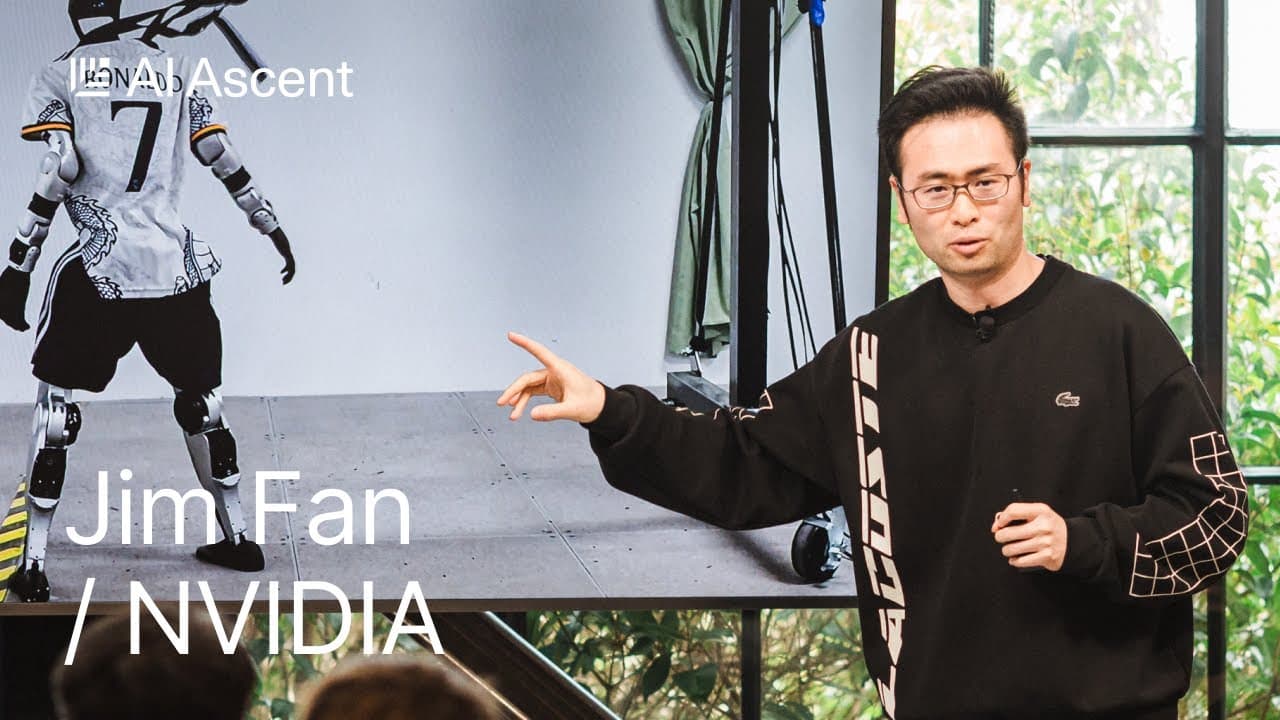
next up we have Jim Fan you all know him come on up Jim jensen was talking about him just this morning he is not only director of AI at NVIDIA but also distinguished research scientist and he'll talk to us about physical AI so a couple days ago I saw a blog post that caught my attention it says "We passed a touring test and nobody noticed." Well to... Read More
Key Insights
- Jim Fan introduces the concept of the Physical Turing Test, where machines perform tasks indistinguishable from humans, highlighting the challenges and progress in robotics.
- Data scarcity is a significant challenge for robotics, unlike language models, requiring innovative data collection methods like teleoperation and simulation.
- Simulation at scale, using techniques like domain randomization and digital twins, is crucial for training robots to perform complex tasks efficiently.
- The transition from digital twins to digital cousins and digital nomads represents the evolution of simulation techniques, incorporating generative models for enhanced diversity and realism.
- Nvidia's Roboccasta framework leverages generative models to create diverse and realistic simulation environments, facilitating the training of robots for everyday tasks.
- Video diffusion models compress vast amounts of internet video data to simulate diverse scenarios, enabling robots to learn and adapt to new tasks in virtual environments.
- The future of robotics involves the development of a physical API, allowing for seamless interaction and manipulation of the physical world through software.
- Jim Fan envisions a future where autonomous robots become an integral part of daily life, performing tasks seamlessly and enhancing human productivity.
Install to Summarize YouTube Videos and Get Transcripts
Explore YouTube Video Summarizer or Get YouTube Transcript Extractor
Questions & Answers
Q: What is the Physical Turing Test?
The Physical Turing Test is a concept introduced by Jim Fan where machines perform tasks that are indistinguishable from those performed by humans. It involves evaluating whether a task, when completed, appears to be done by a human or a machine, signifying a milestone in robotics and AI development.
Q: Why is data scarcity a challenge in robotics?
Data scarcity is a challenge in robotics because unlike language models that can scrape vast amounts of data from the internet, robotics requires specific, real-world data that is difficult to collect. This data involves continuous values over time, such as robot joint control signals, which cannot be found online and must be collected manually, making the process slow and expensive.
Q: How does simulation at scale benefit robotics?
Simulation at scale benefits robotics by allowing the training of robots in diverse and controlled environments without the constraints of real-world data collection. Techniques like domain randomization and digital twins enable the creation of varied scenarios, helping robots learn to perform complex tasks efficiently and adapt to new situations, ultimately enhancing their real-world performance.
Q: What is the difference between digital twins and digital cousins?
Digital twins are exact replicas of real-world robots and environments used in simulations to train robots. Digital cousins, on the other hand, are simulations that capture the essence of real-world environments without being exact replicas. They use generative models to create diverse and realistic scenarios, offering a broader range of training possibilities for robots.
Q: What role do video diffusion models play in robotics?
Video diffusion models play a crucial role in robotics by compressing vast amounts of internet video data to simulate diverse scenarios. These models allow robots to learn and adapt to new tasks in virtual environments, providing a rich source of training data that helps improve their performance and versatility in real-world applications.
Q: What is the vision for a physical API in robotics?
The vision for a physical API in robotics involves creating a system that allows seamless interaction and manipulation of the physical world through software. This API would enable robots to perform tasks autonomously and efficiently, transforming industries and daily life by providing a new level of automation and convenience.
Q: How does Nvidia's Roboccasta framework enhance simulation?
Nvidia's Roboccasta framework enhances simulation by using generative models to create diverse and realistic environments. This framework allows for the composition of everyday tasks in simulated settings, providing robots with varied training scenarios that improve their adaptability and performance in real-world applications.
Q: What is Jim Fan's vision for the future of robotics?
Jim Fan envisions a future where autonomous robots become an integral part of daily life, performing tasks seamlessly and enhancing human productivity. He foresees the development of a physical API that enables robots to interact with the physical world effortlessly, creating a new paradigm where robots perform tasks indistinguishably from humans, ultimately transforming society.
Summary & Key Takeaways
-
Jim Fan discusses the Physical Turing Test, a concept where machines perform tasks indistinguishable from humans, and explores the challenges and advancements in robotics. He emphasizes the importance of simulation at scale, using digital twins and domain randomization, to train robots efficiently.
-
Fan highlights the transition from digital twins to digital cousins and digital nomads, showcasing the evolution of simulation techniques. Nvidia's Roboccasta framework utilizes generative models to create diverse simulation environments, enabling robots to learn and adapt to everyday tasks.
-
The talk envisions a future with a physical API, allowing seamless interaction with the physical world through software. Fan foresees autonomous robots becoming integral to daily life, enhancing productivity and performing tasks indistinguishably from humans.
Read in Other Languages (beta)
Share This Summary 📚
Summarize YouTube Videos and Get Video Transcripts with 1-Click
Try YouTube Summary with ChatGPT & Claude or YouTube Transcript Generator
Explore More Summaries from Sequoia Capital 📚

Summarize YouTube Videos and Get Video Transcripts with 1-Click
Try YouTube Summary with ChatGPT & Claude or YouTube Transcript Generator