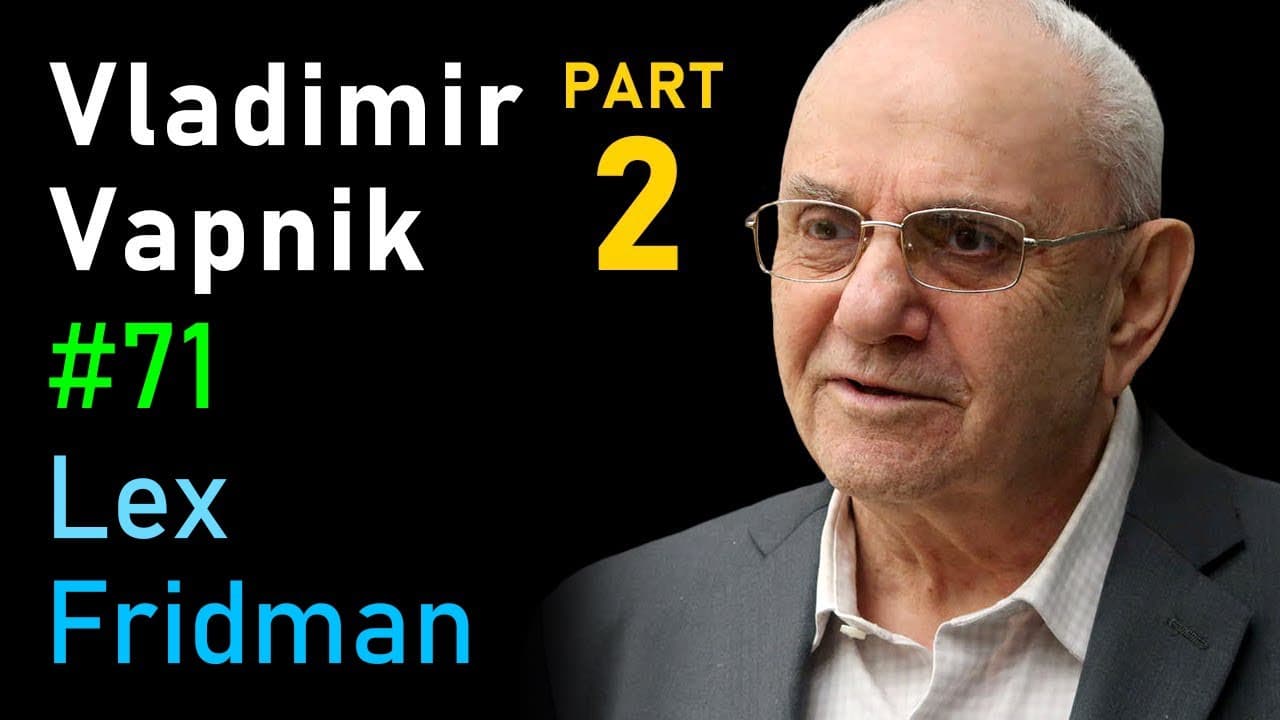
Vladimir Vapnik: Predicates, Invariants, and the Essence of Intelligence | Lex Fridman Podcast #71
TL;DR
Weak convergence, an essential concept in statistical learning, helps in reducing the set of functions and finding good predicates. The journey from handwritten recognition to understanding more general visual information is facilitated by the discovery of effective predicates.
Transcript
- The following is a conversation with Vladimir Vapnik, part two, the second time we spoke on the podcast. He's the co inventor of support vector machines, support vector clustering, VC theory and many foundational ideas in statistical learning. He was born in the Soviet Union, worked at the Institute of Control Sciences in Moscow, then in the U.S.... Read More
Key Insights
- 😫 Weak convergence is an essential concept in statistical learning, helping to reduce the set of functions and find good predicates.
- 😥 Handwritten recognition serves as a starting point for understanding more complex visual tasks.
- 😫 The discovery of effective predicates enables the creation of an admissible set of functions, reducing the training data required for learning tasks.
- 🖐️ Weak convergence plays a crucial role in reducing the training data required for learning, making the learning process more efficient and effective.
- 🤑 The search for good predicates is an important step in reducing the set of functions and selecting the most relevant ones for a given task.
Install to Summarize YouTube Videos and Get Transcripts
Explore YouTube Video Summarizer or Get YouTube Transcript Extractor
Questions & Answers
Q: What is the significance of weak convergence in statistical learning?
Weak convergence plays a crucial role in reducing the set of functions and finding good predicates, which are essential for understanding complex concepts and recognizing visual information.
Q: What is the relationship between handwritten recognition and understanding more general visual information?
Handwritten recognition serves as an entry point for understanding more complex visual tasks. The search for good predicates enables the creation of an admissible set of functions, making the learning process more efficient and enabling the understanding of more general visual information.
Q: How can weak convergence help in reducing the training data required for learning tasks?
Weak convergence helps in selecting a small set of functions from a larger space of functions, which significantly reduces the training data required for learning tasks. By finding good predicates, the learning process becomes more efficient.
Q: How does the discovery of predicates contribute to the reduction of training data required for learning?
The discovery of good predicates allows for the selection of a smaller set of admissible functions, which reduces the amount of training data required for learning. This helps in achieving better performance with limited data.
Key Insights:
- Weak convergence is an essential concept in statistical learning, helping to reduce the set of functions and find good predicates.
- Handwritten recognition serves as a starting point for understanding more complex visual tasks.
- The discovery of effective predicates enables the creation of an admissible set of functions, reducing the training data required for learning tasks.
- Weak convergence plays a crucial role in reducing the training data required for learning, making the learning process more efficient and effective.
- The search for good predicates is an important step in reducing the set of functions and selecting the most relevant ones for a given task.
- The discovery of predicates helps in reducing the complexity of learning tasks and enables the development of intelligent systems capable of understanding and recognizing visual information.
Summary
In this conversation, Vladimir Vapnik, the co-inventor of support vector machines and support vector clustering, discusses the difference between engineering intelligence and the science of intelligence. He explains that engineering intelligence involves creating a device that imitates human behavior, while understanding intelligence is a different problem that involves exploring the world of ideas. Vapnik also discusses the concept of predicates and how they can be used to explain human behavior and solve problems like digit recognition. He emphasizes the importance of finding good predicates that significantly reduce the set of admissible functions and discusses the challenge of discovering new predicates.
Questions & Answers
Q: What is the difference between engineering intelligence and the science of intelligence?
Engineering intelligence involves creating a device that imitates human behavior, while understanding intelligence involves exploring the world of ideas and trying to understand what intelligence is truly about.
Q: How can predicates be used to explain human behavior and solve problems like digit recognition?
Predicates are statements of something that is true and can be used to describe and analyze human behavior, as well as solve problems like digit recognition. For example, symmetry can be a predicate that describes the level of symmetry in a digit image, which can be used to identify and classify digits.
Q: Can human behavior and the world be summarized in a set of predicates?
While there are many forms of human behavior and aspects of the world, the number of predicates that can accurately summarize them is much smaller. Vladimir Vapnik believes that there are relatively few predicates that are truly useful and can explain a wide range of situations.
Q: How do good predicates significantly reduce the set of admissible functions?
Good predicates are those that can greatly reduce the number of admissible functions. By selecting predicates that capture important properties or invariants of the problem at hand, the set of functions that need to be considered becomes smaller, making it easier to find the desired function or solution.
Q: Can machines discover good predicates or is it ultimately a human endeavor?
Vapnik believes that while machines can be used to find predicates, it is not easy to create the smartest predicates using an automated approach. Discovering good predicates often requires human understanding and intuition, as well as the ability to find contradictions or situations that current theories or predicates cannot explain.
Q: How can the challenge of handwritten digit recognition be solved using a small number of examples per digit?
Vapnik challenges researchers to solve the problem of handwritten digit recognition using a small number of examples per digit. The key to solving this challenge is to find good predicates or properties that significantly reduce the set of admissible functions, making it easier to find the desired function. Vapnik suggests finding contradictions or situations where existing predicates fail to create invariants, and then removing these contradictions to improve performance.
Q: Can neural networks help in finding good predicates?
Vapnik explains that neural networks can be used to find good predicates or functions that capture important properties of the problem, but the admissible set of functions or the subset of functions that are used in the network still needs to be selected based on the desired predicates. Neural networks themselves do not automatically find good predicates, but they can be part of the process of discovering them.
Q: Is logic-based AI helpful in finding good predicates?
Vapnik does not believe that logic-based AI systems alone are sufficient in finding good predicates. While logic can help in reasoning and analysis, it is often necessary to have a deep understanding of reality and life to come up with effective predicates. Predicates are not just rules in a logical sense, but also involve knowledge and intuition about the problem domain.
Takeaways
Vladimir Vapnik emphasizes the importance of finding good predicates or properties that significantly reduce the set of admissible functions. These predicates can be used to explain human behavior, solve problems like digit recognition, and ultimately advance our understanding of intelligence. While machines can be used to find predicates, Vapnik believes that human understanding, intuition, and the ability to find contradictions are crucial in the search for effective predicates. The challenge of discovering good predicates remains an open problem in artificial intelligence.
Summary & Key Takeaways
-
Vladimir Vapnik emphasizes the importance of weak convergence in reducing the set of functions and finding good predicates, which are essential for understanding and recognizing visual information.
-
Handwritten recognition serves as a starting point for understanding more complex visual tasks, and the search for good predicates enables the creation of an admissible set of functions for this task.
-
The discovery of predicates helps in reducing the training data required for learning tasks, making the learning process more efficient.
Read in Other Languages (beta)
Share This Summary 📚
Summarize YouTube Videos and Get Video Transcripts with 1-Click
Try YouTube Summary with ChatGPT & Claude or YouTube Transcript Generator
Explore More Summaries from Lex Fridman Podcast 📚





Summarize YouTube Videos and Get Video Transcripts with 1-Click
Try YouTube Summary with ChatGPT & Claude or YouTube Transcript Generator