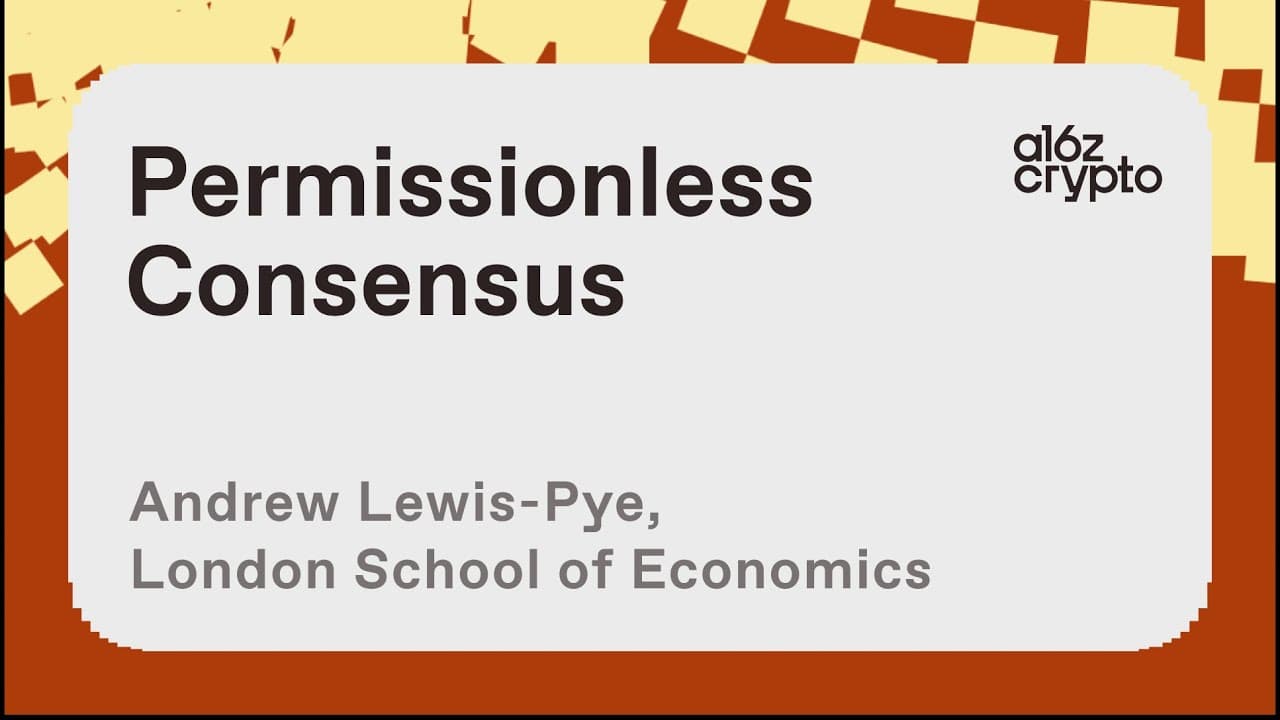
What Is Permissionless Consensus and How Is It Structured?
TL;DR
Permissionless consensus refers to blockchain protocols that operate without a fixed set of participants. They can be categorized into different levels: fully permissionless, dynamically available, and quasi permissionless. The fully permissionless setting faces impossibility for deterministic protocols, while the dynamically available setting struggles with probabilistic Byzantine agreement under partial synchrony. An effective framework is crucial for analyzing these diverse levels of permission.
Transcript
all right welcome everyone to today's a16z crypto research seminar uh very happy to introduce Andrew Lewis pie professor at London School of economics who will be visiting um all month uh Andy actually got his start as a computability theorist believe it or not but very luckily for sort of web 3 in the blockchains world he's gotten obsessed with um... Read More
Key Insights
- ❓ The fully permissionless setting requires a general framework to analyze the consensus protocols, given the impossibility results for deterministic protocols in that setting.
- 😀 The dynamically available setting allows for certain assumptions about active players and allocation of resources, but still faces impossibility results for probabilistic Byzantine agreement in the partial synchrony model.
- 😫 The quality permissionless setting introduces the concept of on-chain resources and the need for protocols to define resource allocations.
Install to Summarize YouTube Videos and Get Transcripts
Explore YouTube Video Summarizer or Get YouTube Transcript Extractor
Questions & Answers
Q: Why is a general framework needed for permissionless consensus protocols?
A general framework is necessary to prove the impossibility of certain results and to delineate the differences between different levels of permission within consensus protocols.
Q: What is the permissionless setting and how does it differ from the permissioned setting?
In the permissionless setting, there is no fixed set of known participants, allowing for potentially infinite players and unknown active participants. This differs from the permissioned setting, where there is a fixed set of known participants.
Q: Can dynamically available protocols solve probabilistic Byzantine agreement in the partial synchrony model?
No, dynamically available protocols cannot solve probabilistic Byzantine agreement in the partial synchrony model.
Q: What are some examples of on-chain resources?
One example of an on-chain resource is stake, where players have a certain amount of ownership in the blockchain. Other resources can include proof of work or protocol-defined resources.
Summary & Key Takeaways
-
The analysis introduces the concept of permissionless consensus protocols and the need for a general framework to analyze them.
-
It explores different levels of permission within consensus protocols, such as fully permissionless, dynamically available, and quasi permissionless settings.
-
The analysis discusses impossibility results for deterministic protocols in the fully permissionless setting and probabilistic protocols in the dynamically available setting.
Read in Other Languages (beta)
Share This Summary 📚
Summarize YouTube Videos and Get Video Transcripts with 1-Click
Try YouTube Summary with ChatGPT & Claude or YouTube Transcript Generator
Explore More Summaries from a16z crypto 📚





Summarize YouTube Videos and Get Video Transcripts with 1-Click
Try YouTube Summary with ChatGPT & Claude or YouTube Transcript Generator