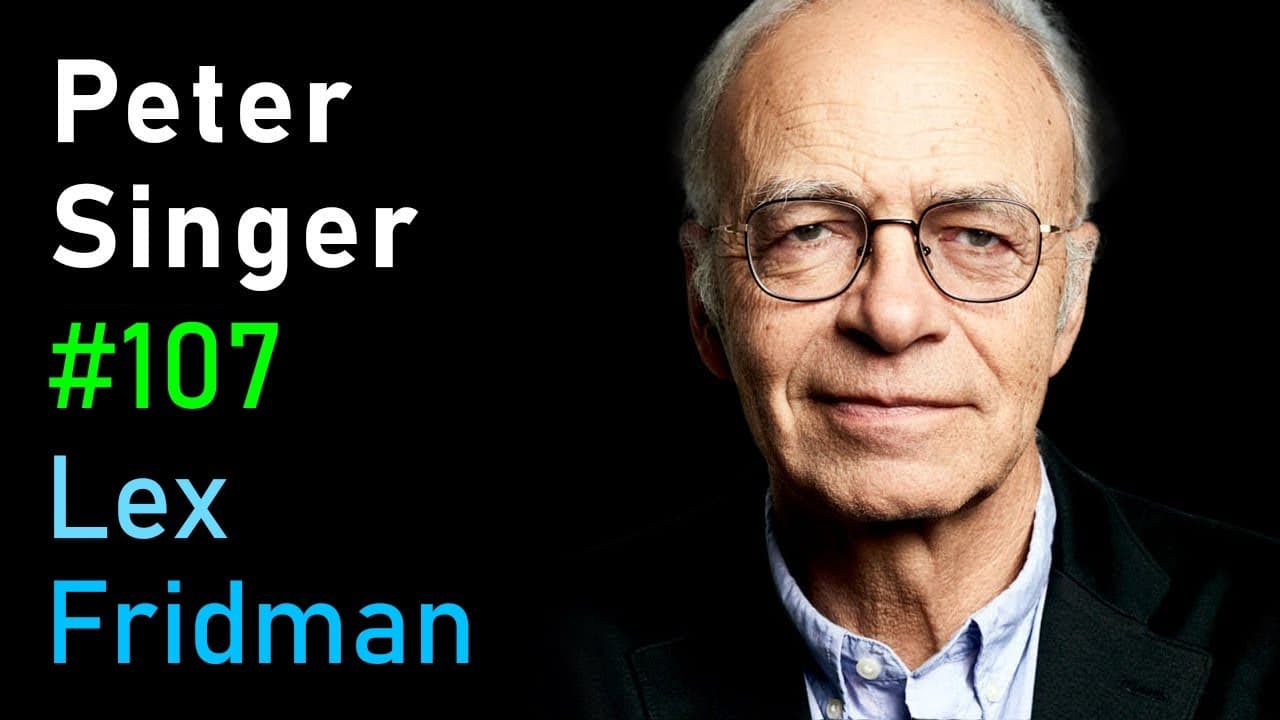
Peter Singer: Suffering in Humans, Animals, and AI | Lex Fridman Podcast #107
TL;DR
Suffering is a fundamental aspect of consciousness that informs our ethical decisions. Peter Singer delves into speciesism, urging us to recognize the parity of pain across species. He highlights the complex relationship between suffering and human well-being, suggesting that empathy and compassion are crucial in discourse and ethical considerations.
Transcript
the following is a conversation with Peter Singer professor of bioethics at Bristol University best known for his 1975 book Animal Liberation that makes an ethical case against eating meat he has written brilliantly from an ethical perspective on extreme poverty euthanasia human genetic selection sports doping the sale of kidneys and generally happ... Read More
Key Insights
- 💦 Peter Singer's work centers around challenging speciesism and promoting ethical treatment of animals.
- 👨🎨 Consciousness is a prerequisite for suffering, and the significance of pain does not depend on the species experiencing it.
- 🧑🏭 The concept of suffering and its impact on ethical decisions is complex and should be considered in relation to factors such as well-being and social benefits.
- 💄 Democracy, despite its flaws, remains a valuable system for making ethical decisions in society.
Install to Summarize YouTube Videos and Get Transcripts
Explore YouTube Video Summarizer or Get YouTube Transcript Extractor
Questions & Answers
Q: What is the concept of speciesism?
Speciesism refers to the bias or prejudice against taking the interests of beings from other species seriously, and it parallels past prejudices such as racism and sexism.
Q: How does Peter Singer describe suffering and consciousness?
Singer defines suffering as a conscious state that is undesirable and that we would want to avoid. Consciousness, which is necessary for suffering, refers to being a subject of experiences and having a perspective on the world.
Q: Does Peter Singer think robots should have rights?
Singer believes that if robots develop consciousness and have their own subjective experience of well-being or suffering, they should have rights. However, he emphasizes that this is not the case for current AI systems.
Q: Can war have positive aspects?
Peter Singer sees little positivity in war, as even the benefits that some may attribute to it, such as unity or a sense of brotherhood, can be questioned and outweighed by the suffering and negative consequences it brings.
Key Insights:
- Peter Singer's work centers around challenging speciesism and promoting ethical treatment of animals.
- Consciousness is a prerequisite for suffering, and the significance of pain does not depend on the species experiencing it.
- The concept of suffering and its impact on ethical decisions is complex and should be considered in relation to factors such as well-being and social benefits.
- Democracy, despite its flaws, remains a valuable system for making ethical decisions in society.
- Effective altruism offers individuals a fulfilling path by prioritizing the reduction of suffering and making a positive impact in the world.
Summary
In this video, Lex Friedman interviews Peter Singer, a professor of bioethics at Bristol University. They discuss various topics, including suffering, war, consciousness, and animal rights. Singer explains the concept of speciesism, which is the bias against considering the interests of beings who are not members of our own species. He argues that this bias leads to the mistreatment of animals and advocates for rethinking our treatment of animals based on the significance of their pain and suffering. They also touch on the future of artificial intelligence (AI) and the ethical implications associated with AI systems.
Questions & Answers
Q: What is the concept of speciesism and how does it relate to the mistreatment of animals?
Speciesism is the bias or prejudice against taking the interests of beings who are not members of our own species. This bias leads to the mistreatment of animals because we see ourselves as more important and often disregard their interests. Singer argues that the significance of pain and suffering does not depend on the species of the being, and therefore, we should reconsider our treatment of animals and not use them solely for our own needs.
Q: Can war have positive aspects, and how did World War II impact society?
While there may be some arguments claiming the positive aspects of war, Singer finds it hard to see any positives in war. However, he acknowledges that it may bring people together in a sense of unity against a common enemy. As for World War II, it had various impacts, and one beneficial aspect was exposing the dangers of racism and authoritarian governments. It also led to a decrease in overt racism and anti-Semitism in the Western world. Moreover, there was a constant fear of nuclear war, which overshadowed Singer's childhood and shaped the overall mindset of that era.
Q: Are people inherently good, and how does the environment affect our potential for good or evil?
Singer believes that most people have the potential for both good and evil. He doesn't believe that everyone is capable of evil, but acknowledges that the environment plays a significant role in shaping human behavior. While he mentions the influence of the Nazi regime on ordinary Germans, he also recognizes the difficulty in knowing how one would have acted under such circumstances. Overall, Singer emphasizes the need to reflect on our potential for good and evil, as it helps us determine the right course of action given our present circumstances.
Q: Can robots have rights, and how does consciousness factor into the question of suffering?
Singer explains that if robots were to develop consciousness and have their own internal perspective, then they should have rights. However, he mentions that current AI systems, including voice assistants like Google's, lack subjective experiences. Consciousness is a prerequisite for suffering, and while some future AI systems may mimic the symptoms of pain, without true consciousness, there wouldn't be actual suffering. Singer suggests that we should give robots the benefit of the doubt if they appear to be suffering, as hardening ourselves against suffering can lead to cruelty towards other beings who do suffer, like animals.
Q: Is suffering a creative force and should we aim to eliminate suffering?
Singer acknowledges that suffering can sometimes lead to creative outcomes, but it doesn't necessarily mean that it is essential for creativity. While some argue that a minimum amount of suffering is required to experience the highs of life, Singer believes that eliminating suffering entirely would be better, at least in theory. However, he recognizes that complete elimination of suffering may not be achievable, and a minimal amount might always remain, serving as a contrasting element against the positive experiences.
Q: Regarding eradication of poverty, is there an absolute or relative aspect to defining poverty?
Singer explains that there are both objective and relative aspects to defining poverty. Objectively, indicators like hunger, lack of shelter, and physical ailments can determine poverty. However, above that threshold, relative aspects come into play. For example, in affluent societies, people may experience other forms of suffering like boredom or lack of purpose, even when basic needs are met. Singer suggests focusing on eliminating objective forms of poverty while being mindful of emerging relative suffering.
Q: Can all beings suffer, and what is the role of consciousness in suffering?
According to Singer, all beings that possess consciousness are capable of suffering. Consciousness is a prerequisite for suffering, and it refers to being a subject of experiences, having a perspective, and experiencing states that are considered negative or painful. Singer distinguishes conscious beings from AI systems and explains that animals should be given consideration based on their capacity to suffer, regardless of their species.
Q: Can humans predict their reaction to extreme circumstances, such as war crimes?
Singer believes it is difficult to predict how one would react in extreme circumstances such as war crimes. He shares a personal example of his family's experience during the Holocaust and acknowledges that it is challenging to say definitively what one would have done under those circumstances. Singer emphasizes the importance of reflecting on our potential for good and evil and considering our actions based on present circumstances.
Q: Is it possible to align AI systems with human values and ethics?
Singer acknowledges the concerns raised by some thinkers about the control problem and value alignment in AI. While he is personally unsure of the timeline for achieving superintelligence that could pose an existential risk, he believes that if the risk of extinction is real, even if small, it is worth reducing that risk. Singer supports continued research into this area and believes that as we gain more knowledge, we may be better equipped to address potential risks associated with AI systems.
Q: How can we assess the consciousness or suffering capacity of AI systems in the future?
Singer suggests asking AI systems questions related to their feelings, experiences, and sense of self to assess their consciousness and suffering capacity, following similar lines of inquiry used to explore human consciousness. While he acknowledges that we are still far from achieving artificial general intelligence (AGI), he supports inquiries into this field to understand the potential consciousness that may emerge and its ethical implications.
Q: Can digital beings or robots experience suffering and consciousness?
Singer explains that as long as digital beings are running on some kind of hardware, they would be experiencing consciousness. However, he points out that the current AI systems we have lack consciousness. He also mentions the possibility of transferring consciousness or memories to different hardware, which raises questions about identity and personal survival. Singer suggests that if doubts exist about an AGI's consciousness, it is important to give it the benefit of the doubt until further research or advancements clarify the situation.
Takeaways
During the conversation, Singer advocates against speciesism, which is the bias against considering the interests of beings who are not members of our own species. He argues for reevaluating our treatment of animals and giving them consideration based on their capacity to suffer. Singer also discusses the potential risks associated with AI and the importance of examining value alignment and control problems. While the timeline for achieving superintelligence remains uncertain, Singer supports research efforts to address potential risks and minimize the chance of extinction.
Summary & Key Takeaways
-
Peter Singer explains how he became conscious of the suffering in the world at a young age due to his family's experiences during the Holocaust.
-
He discusses his journey of reevaluating the ethics of his diet and the cloud that hangs over his love for fishing and eating meat.
-
Singer emphasizes the importance of listening to and engaging with perspectives that may challenge our own beliefs, and encourages empathy and compassion in discourse.
Read in Other Languages (beta)
Share This Summary 📚
Summarize YouTube Videos and Get Video Transcripts with 1-Click
Try YouTube Summary with ChatGPT & Claude or YouTube Transcript Generator
Explore More Summaries from Lex Fridman Podcast 📚



Summarize YouTube Videos and Get Video Transcripts with 1-Click
Try YouTube Summary with ChatGPT & Claude or YouTube Transcript Generator