Electrical experiments with plants that count and communicate | Greg Gage
TL;DR
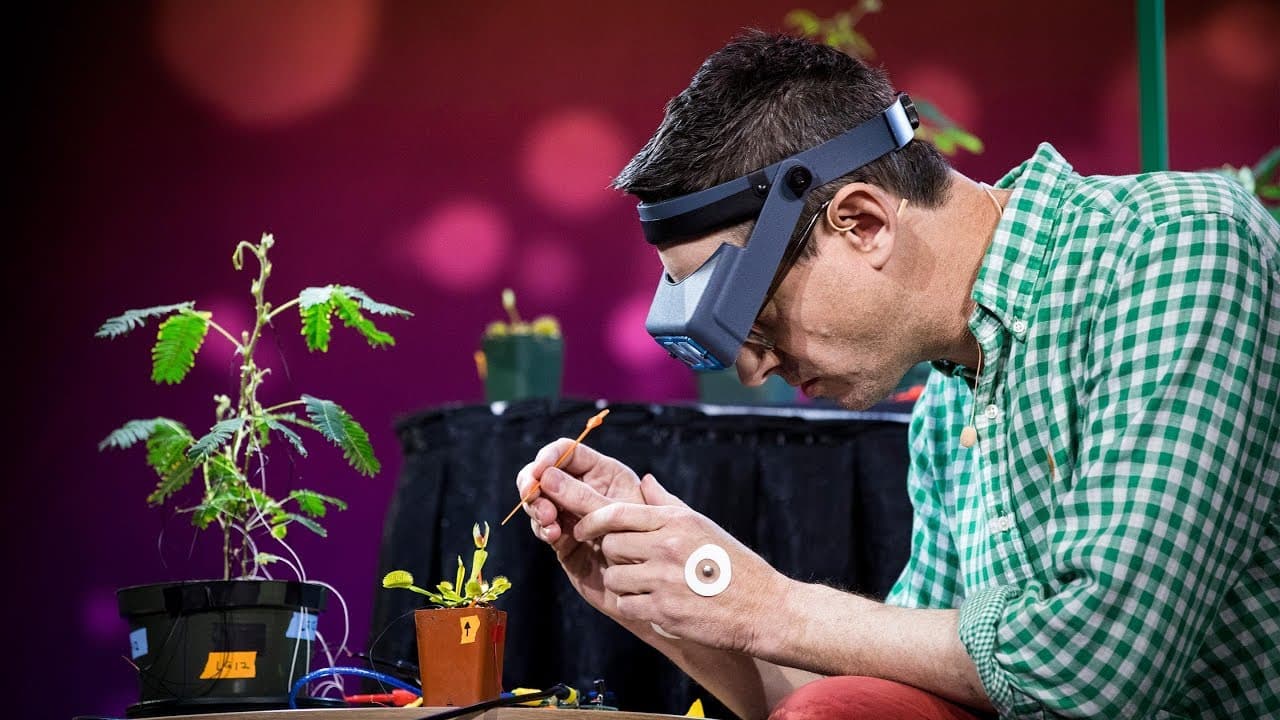
Plants like the Venus flytrap and mimosa communicate using electrical signals called action potentials, not through a traditional brain. The Venus flytrap can even count the number of touches it receives, ensuring it only closes when a meal is detected inside its trap. This phenomenon illustrates that while plants lack brains, they share similarities in communication with animals.
Transcript
I'm a neuroscientist, and I'm the co-founder of Backyard Brains, and our mission is to train the next generation of neuroscientists by taking graduate-level neuroscience research equipment and making it available for kids in middle schools and high schools. And so when we go into the classroom, one way to get them thinking about the brain, which is... Read More
Key Insights
- 🌱 Plants move, but most people don't associate movement with having a brain. The nervous system evolved for quick responses to stimuli.
- 🪴 Plants like the Venus flytrap are able to move quickly and are carnivorous, making them unique in the plant kingdom.
- 🌿 The Venus flytrap also has the ability to count the number of seconds between successive touching of trigger hairs, ensuring that it only closes its leaf trap if there's a meal inside.
- ⚡️ Action potentials, which are the body's electrical signals, are not exclusive to animals. Plants, like the Venus flytrap and the mimosa, also use action potentials to encode information and move.
- 🍃 The mimosa has touch receptors that send information in the form of an action potential, causing leaves to curl up or the entire branch to fall down when touched or tapped.
- 💡 By recording the action potential from a Venus flytrap and sending it into the sensitive mimosa, the behavior of the mimosas can be triggered without human touch, illustrating communication between plant species.
- 🌍 Plants can be used to teach neuroscience and contribute to the neurorevolution, highlighting the similarities in the way plants and animals communicate using electricity.
- 🧠 Plants don't have brains like humans, but they possess the ability to communicate using electricity, similar to animals. Opening up possibilities for further research and discoveries in plant neuroscience.
Install to Summarize YouTube Videos and Get Transcripts
Explore YouTube Video Summarizer or Get YouTube Transcript Extractor
Questions & Answers
Q: What is the mission of Backyard Brains?
The mission of Backyard Brains is to train the next generation of neuroscientists by making graduate-level neuroscience research equipment available for kids in middle schools and high schools.
Q: What is the simple question about neuroscience that is often asked in classrooms?
The simple question about neuroscience often asked in classrooms is "What has a brain?"
Q: Which living things do most students believe have a brain?
Most students believe that their cat, dog, mouse, or even a small insect have a brain.
Q: What is the classification that students often mention when asked about things that have brains?
When asked about things that have brains, students often mention the classification that things that move tend to have brains.
Q: What example of a plant with quick movement does the speaker provide?
The speaker provides the example of the Venus flytrap, a plant discovered in 1760 by Arthur Dobbs, which will spring shut when a bug falls in between its traps.
Summary
In this video, the neuroscientist co-founder of Backyard Brains discusses how plants can exhibit behaviors that are typically associated with animals. He explains how plants have the ability to move and respond to external stimuli, which challenges the notion that only animals possess a brain. Through experiments on plants like the Mimosa pudica and the Venus flytrap, he demonstrates their ability to generate action potentials, similar to neurons, which allow them to encode and transmit information. He also introduces an interspecies plant-to-plant communicator experiment, where the action potential from a Venus flytrap is transmitted to a sensitive mimosa, triggering its movement. This research not only sheds light on the complexity of plant behavior but also has the potential to revolutionize neuroscience education.
Questions & Answers
Q: What is the mission of Backyard Brains?
The mission of Backyard Brains is to train the next generation of neuroscientists by making graduate-level neuroscience research equipment accessible to middle and high school students.
Q: How do students usually differentiate between living things that have brains and those that don't?
Students often classify creatures that can move as having a brain, while stationary organisms like plants are typically not considered to have a brain.
Q: Why do living things with brains, such as animals, have a nervous system?
Animals have a nervous system because it allows for rapid electrical communication, enabling them to quickly respond to stimuli in their environment.
Q: Can plants move?
While it is commonly believed that plants don't move, some plants, like the mimosa, exhibit movement by curling their leaves when touched or even falling down when tapped.
Q: How does the mimosa exhibit movement when touched or tapped?
When the touch receptors of the mimosa are stimulated, it generates an action potential that travels down the stem, causing water-filled cells to change shape and resulting in leaf movement.
Q: What is the uniqueness of the Venus flytrap?
The Venus flytrap is considered an evolutionary wonder due to its carnivorous nature and its ability to move quickly, which is uncommon in plants.
Q: How does the Venus flytrap capture prey?
The Venus flytrap has trigger hairs on its leaves that, when touched, generate action potentials. If multiple action potentials occur in quick succession, it triggers the closing of the plant's trap, capturing prey.
Q: Why does the Venus flytrap count the time between successive touches of the trigger hairs?
The Venus flytrap counts the time between touches as a defensive mechanism to ensure that there is a high probability of prey being present before expending energy to close its trap.
Q: What happens when an action potential is generated but there is no subsequent touch detected by the Venus flytrap?
If an action potential is generated, but there is no additional touch within a specific time frame, the Venus flytrap does not close its trap, conserving energy until a more promising prey opportunity arises.
Q: Do plants have brains?
No, plants do not have brains in the same way animals do. They lack neurons, axons, and complex cognitive functions. However, plants exhibit similar electrical communication through action potentials, albeit with different ions and methods.
Q: How does the neuroscientist demonstrate the interconnectedness of action potentials among different species of plants?
The neuroscientist showcases an experiment where the action potential from a Venus flytrap is transmitted to a sensitive mimosa, effectively triggering movement in the mimosa without direct physical interaction.
Takeaways
Through the neuroscientist's experiments on plants like the mimosa and Venus flytrap, we see that plants have the ability to generate action potentials, enabling them to encode and transmit information similar to neurons in animals. This challenges the traditional notion that only animals possess a brain. By using plants as a tool for teaching neuroscience, we can engage students in understanding the complex and diverse world of living organisms. Moreover, the research on plant behavior has the potential to contribute to the neurorevolution and advance our understanding of fundamental principles in neuroscience.
Summary & Key Takeaways
-
Backyard Brains aims to make neuroscience research equipment accessible to middle and high school students
-
Simple question of "What has a brain?" highlights misconceptions about which living things have brains
-
Plants like the Venus flytrap and mimosa demonstrate the ability to exhibit behaviors and encode information through action potentials, similar to humans and animals.
Read in Other Languages (beta)
Share This Summary 📚
Summarize YouTube Videos and Get Video Transcripts with 1-Click
Try YouTube Summary with ChatGPT & Claude or YouTube Transcript Generator
Explore More Summaries from TED 📚






Summarize YouTube Videos and Get Video Transcripts with 1-Click
Try YouTube Summary with ChatGPT & Claude or YouTube Transcript Generator