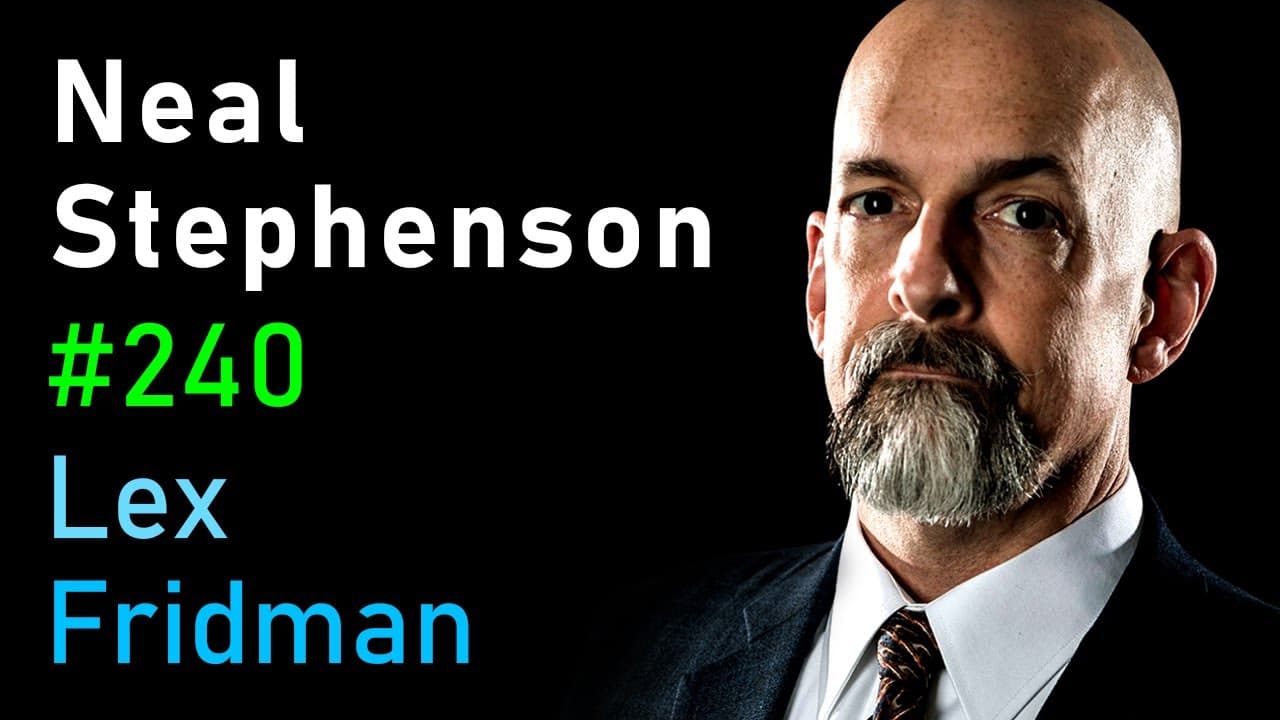
Neal Stephenson: Sci-Fi, Space, Aliens, AI, VR & the Future of Humanity | Lex Fridman Podcast #240
TL;DR
Neil Stephenson discusses the repetition of human behavior, the role of technology in revealing human nature, and the lessons learned from World War II. He also delves into the possibilities of colonizing Mars and the challenges of virtual reality.
Transcript
the following is a conversation with neil stephenson a legendary science fiction writer exploring ideas in mathematics science cryptography money linguistics philosophy and virtual reality from his early book snow crash to his new one called termination shock he doesn't just write novels he worked at the space company blue origin for many years inc... Read More
Key Insights
- 👶 History tends to repeat itself due to the constancy of human nature, with new events being exceptions rather than the rule.
- 🧑⚕️ Technology has improved living standards, health, and longevity, but it hasn't eliminated negative behavior patterns.
- 😈 Lessons from World War II include the recognition that good and evil coexist in human nature, the importance of knowing history to be educated, and the potential for bravery and survival.
- 🍉 Colonizing Mars poses significant challenges, both in terms of technical aspects and the economic viability of resource utilization.
- 🈸 Virtual reality (VR) remains an area of exploration and development, with potential applications in gaming, storytelling, and creating unique experiences.
- 🤞 The ambition of individuals like Elon Musk and Jeff Bezos to make humanity multi-planetary inspires and offers hope for the future.
Install to Summarize YouTube Videos and Get Transcripts
Explore YouTube Video Summarizer or Get YouTube Transcript Extractor
Questions & Answers
Q: How does the repetition of human behavior contribute to the perception of history repeating itself?
Human nature remains constant, leading to similar behavior patterns emerging throughout history. While new events occur, they are not as common as the repetition of familiar behaviors.
Q: What is the impact of technology on human nature?
Technology has greatly improved living standards and health, but it hasn't fundamentally altered human behavior patterns. Although advancements may provide more resources, human nature still has the potential for divisiveness and anger.
Q: Can we learn lessons from World War II that apply to today's world?
World War II serves as a reminder that human nature is capable of both good and evil. It challenges the notion of an entirely pessimistic view of the world and highlights the potential for bravery, love, and survival amidst difficult times.
Q: What are the challenges of colonizing Mars?
Colonizing Mars poses technical challenges such as dealing with toxic substances on the planet's surface and ensuring sustainable ecosystems. Additionally, there are issues of energy requirements, maintaining a healthy environment, and potential limitations in the available resources.
Summary
Neil Stephenson, a renowned science fiction writer, discusses various topics in an interview with Lex Friedman. From the repetition of history to the role of technology in revealing human nature, Stephenson shares his thoughts on these subjects. He also talks about the lessons we can learn from World War II and the complexities of human nature. Additionally, he explores the challenges and possibilities of space travel, colonizing Mars, and interacting with potential extraterrestrial life forms. Stephenson examines the ambitious visions of Elon Musk and the importance of pursuing big, risky projects.
Questions & Answers
Q: Does history repeat itself? In which ways does it repeat itself and in which ways does it not?
History does repeat itself to a great extent. Human nature tends to exhibit similar behavior patterns over time. It is the exception, rather than the rule, when something entirely new happens.
Q: What role does technology play in suppressing or revealing human nature?
Technology has significantly improved standards of living, life expectancy, and overall well-being. However, despite these advancements, human behavior patterns remain largely unchanged. While technology can potentially emphasize the better aspects of human nature, it does not fundamentally alter our core behaviors.
Q: Can technology lead to a shift in human behavior and therefore alter our experience on Earth?
Previously, it seemed plausible that technology could mitigate negative behavior patterns by eliminating resource constraints. However, recent events suggest that people will find ways to be divisive and angry regardless of their circumstances. Economic troubles and improved standards of living alone do not explain the current state of society.
Q: What lessons can we learn from World War II?
World War II serves as a reminder that illusions about human nature cannot be maintained. It teaches us that even in supposedly enlightened and civilized societies, individuals can easily become monsters. Therefore, understanding this lesson is crucial for becoming an educated person.
Q: Do you agree with Solzhenitsyn's statement that the line between good and evil runs through the heart of every man?
Yes, I agree with Solzhenitsyn's sentiment. The ability to exhibit both great good and great evil resides within each of us. The capacity for good exists alongside the potential for evil. Human nature is complex and multifaceted.
Q: Can language be a barrier when it comes to communicating with extraterrestrial beings?
The difficulty of communication depends on the biological similarity between us and potential extraterrestrial beings. If their biology and physical attributes are similar to ours, solving the language barrier may be possible. However, if they possess vastly different forms or characteristics, communication challenges may arise.
Q: Can humans have sex with aliens?
Reproductive sex between humans and aliens is highly unlikely due to genetic differences. However, if we broaden the definition of sex to include any gratifying physical interaction, then forms of interaction and connection are possible.
Q: What are your thoughts on colonizing Mars?
Colonizing Mars is an inspiring vision that can rally people to pursue ambitious goals. However, from a business standpoint, it is challenging to find a resource on Mars that can be brought back to Earth competitively. The economic viability of colonizing Mars may be limited.
Q: What do you think of individuals like Elon Musk who pursue ambitious goals?
Elon Musk's ambition and willingness to tackle big projects is notable. His dedication to accomplishing seemingly impossible tasks, such as landing on Mars, is inspiring. Musk's drive and audacity contribute to the progress we are witnessing today in space exploration.
Q: What are your thoughts on the potential of social media and digital innovation?
The digital space has great potential for innovation. Many talented individuals have been drawn to programming and computer science, leading to advancements in various digital technologies. However, there are structural problems in social media platforms that need to be addressed for progress to continue.
Q: Is it possible to develop social media platforms that prioritize the greater good?
While challenges exist, it is not impossible to develop social media platforms that prioritize user well-being and promote positive interactions. It is crucial to address issues such as data privacy, algorithmic biases, and misinformation. Despite the difficulties, optimism and continuous improvement can guide the development of better social media platforms.
Q: What obstacles and possibilities exist in space exploration today?
Space exploration has made significant advancements, especially with initiatives like SpaceX. Achievements that were unimaginable 20 years ago have become a reality. However, challenges remain, and technical issues need to be addressed. The experiences of individuals like William Shatner, who recently traveled to space, demonstrate the profound impact space exploration can have on people.
Q: Can humans become a multiplanetary species?
Colonizing Mars is a noble and inspiring goal. It serves as a beacon, motivating people to participate in space exploration efforts. However, from a business perspective, it is challenging to find viable resources on Mars that can justify the cost of colonization. The project's success primarily relies on the passion and commitment of those involved.
Q: How do you view the current state of innovation and the pursuit of ambitious projects?
Our willingness to undertake bold, risky projects has diminished over time. The complexities of modern safety measures and environmental concerns have slowed down our ability to build and maintain infrastructure. However, the visionaries and innovators who are unafraid to tackle audacious goals, like Elon Musk, provide hope for the future.
Takeaways
Neil Stephenson's conversation covers a wide range of topics, from human behavior patterns to space exploration and the pursuit of ambitious projects. He emphasizes the repetition of history and the challenges of altering human nature, despite technological advancements. Stephenson reflects on the lessons learned from World War II and the importance of understanding the capacity for both good and evil within individuals. He shares his thoughts on space travel, the possibility of extraterrestrial encounters, and the ambitious visions of figures like Elon Musk. Stephenson maintains a hopeful perspective but acknowledges the difficulties and obstacles that accompany grand ventures. Despite the current limitations, he sees great potential for innovation and the development of social media platforms that prioritize user well-being. Ultimately, his conversation highlights the importance of boldness, optimism, and continuous improvement in the pursuit of ambitious goals.
Summary & Key Takeaways
-
Neil Stephenson emphasizes the repetition of human behavior throughout history, with new events being the exception rather than the rule.
-
He discusses the role of technology in improving living standards and health but highlights that human behavior patterns remain largely the same.
-
Stephenson draws lessons from World War II, acknowledging the potential for both good and evil in human nature and the need to learn from history.
Read in Other Languages (beta)
Share This Summary 📚
Summarize YouTube Videos and Get Video Transcripts with 1-Click
Try YouTube Summary with ChatGPT & Claude or YouTube Transcript Generator
Explore More Summaries from Lex Fridman Podcast 📚






Summarize YouTube Videos and Get Video Transcripts with 1-Click
Try YouTube Summary with ChatGPT & Claude or YouTube Transcript Generator