What's below the tip of the iceberg? - Camille Seaman
TL;DR
Icebergs are mostly hidden beneath the water, with only a fraction visible. They have complex ecosystems, impact ocean currents, and can float thousands of miles.
Transcript
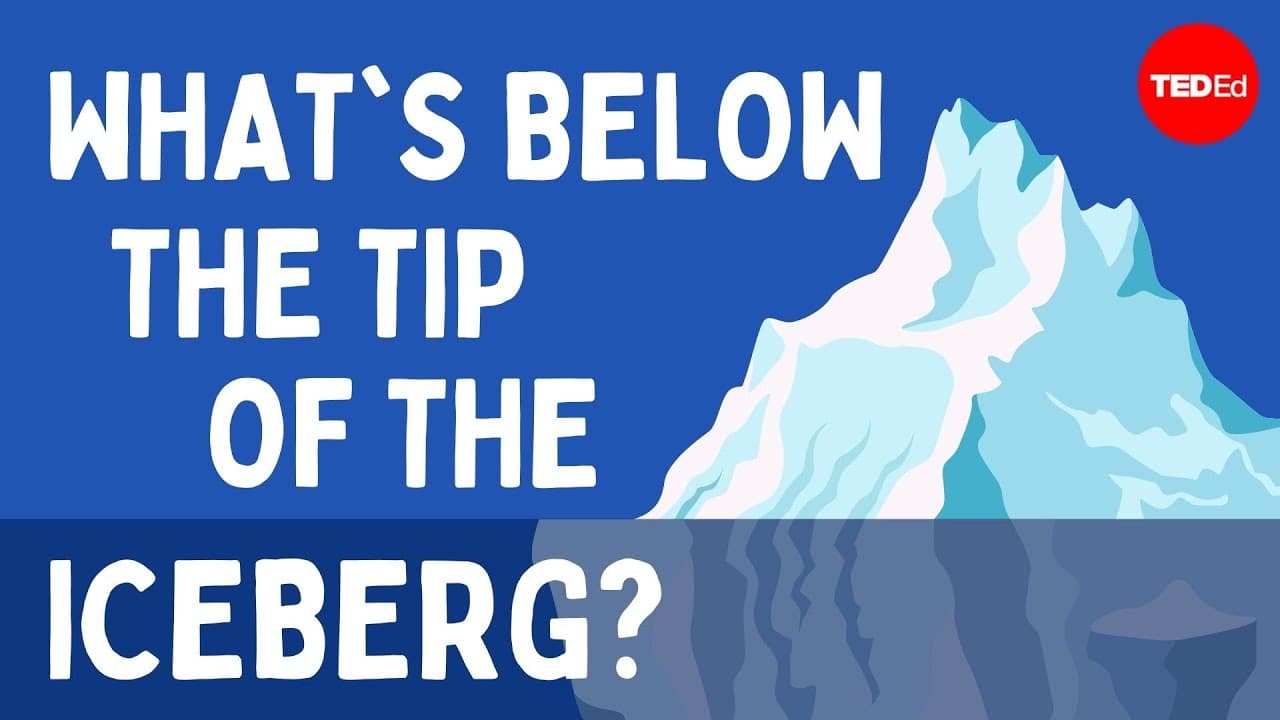
Have you ever heard the term, "tip of the iceberg"? You know that icebergs are mostly underwater, their immense bulk hidden beneath the water. But why is that so? Well, the density of pure ice is less than that of sea water. Usually only 1/9 of the volume of an iceberg is above the water. The shape of the underwater portion is difficult to discern ... Read More
Key Insights
- 💁 Icebergs are formed by glaciers and can live for three to six years, floating and being carried by ocean currents.
- 😀 They can travel thousands of miles, interrupting shipping lanes in certain areas.
- 🏂 Icebergs support diverse ecosystems, including species like icefish, jellyfish, siphonophores, snow petrels, whales, seals, and penguins.
- 🫠 Melting icebergs create thermal currents and a pool of cold, fresh water around them.
- 👨🦳 The color of an iceberg varies based on compression, with blue icebergs being more compressed and white icebergs having more air trapped inside.
- 🫠 Icebergs can impact ocean currents due to temperature variations caused by their melting.
- 🧑🌾 They are a common sight in far northern or southern areas, but can drift to unexpected locations, like Bermuda.
Install to Summarize YouTube Videos and Get Transcripts
Explore YouTube Video Summarizer or Get YouTube Transcript Extractor
Questions & Answers
Q: Why are icebergs mostly underwater?
Icebergs are mostly underwater due to the density of pure ice, which is less than that of seawater. This causes only a small portion of the iceberg to be visible above the surface.
Q: How do icebergs form?
Icebergs form from glaciers, which are made of fresh water and constantly compress and move. Over thousands of years, glaciers build layer upon layer of ice, eventually calving off to become icebergs.
Q: Do icebergs make sounds?
Yes, when icebergs melt, they make a fizzing sound called Bergie Seltzer. This occurs when the water-ice interface reaches compressed air bubbles trapped in the ice, causing them to burst and make a popping sound.
Q: How big can icebergs be?
Icebergs come in various sizes. The smallest are called growlers, about the size of a car, while the largest are classified as very large, towering over 270 feet above sea level and stretching over 670 feet in length.
Summary & Key Takeaways
-
Icebergs are mostly underwater, with only a small portion visible above the surface due to the density of pure ice.
-
They are created by glaciers, which constantly compress, move, and add layers of ice over thousands of years.
-
Icebergs have complex ecosystems, impact ocean currents, and support a variety of marine life.
Read in Other Languages (beta)
Share This Summary 📚
Summarize YouTube Videos and Get Video Transcripts with 1-Click
Try YouTube Summary with ChatGPT & Claude or YouTube Transcript Generator
Explore More Summaries from TED-Ed 📚






Summarize YouTube Videos and Get Video Transcripts with 1-Click
Try YouTube Summary with ChatGPT & Claude or YouTube Transcript Generator