Backspin Basketball Flies Off Dam
TL;DR
The Magnus effect, observed when a rotating object travels through the air, has applications in sports like tennis and golf, as well as non-sport areas such as sailboats and aircraft.
Transcript
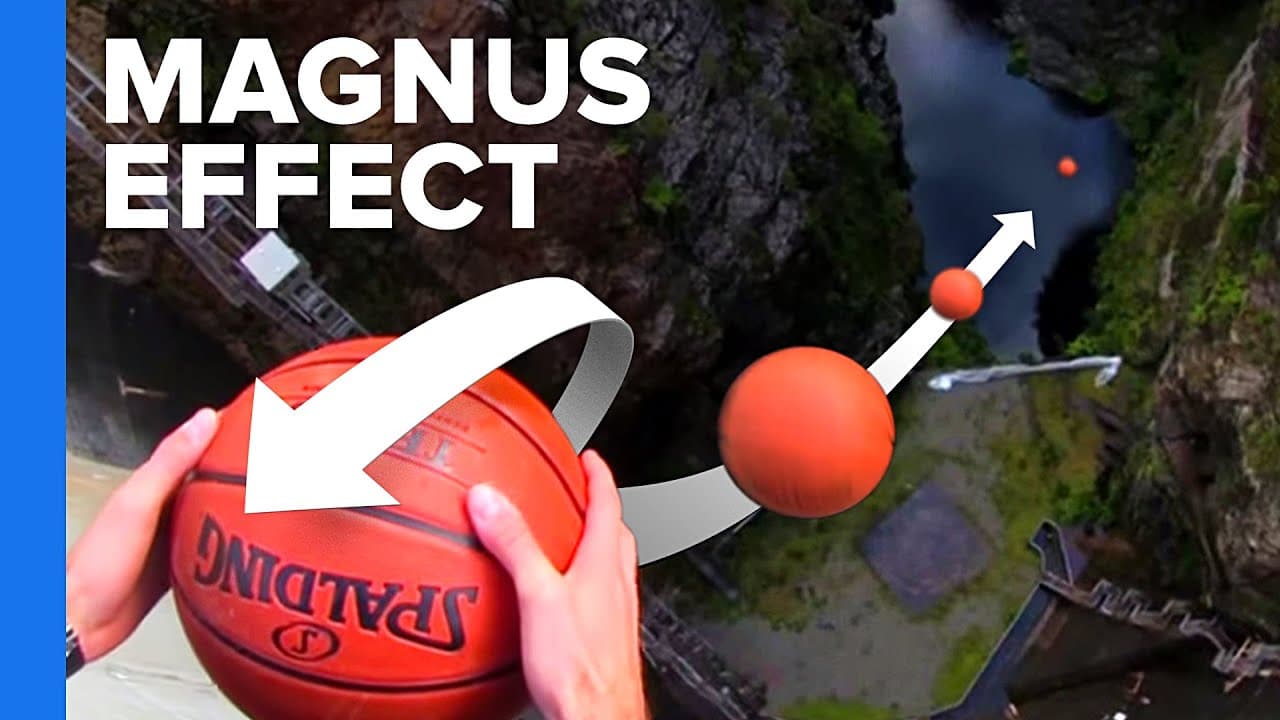
Recently some friends of mine went to the Gordon Dam in Tasmania, which is 126.5 meters (or 415 feet) high. Then they dropped a basketball over the edge. You can see that the basketball gets pushed around a bit by the breeze, but it lands basically right below where it was dropped. Now watch what happens when they drop another basketball, but this ... Read More
Key Insights
- 👱 The Magnus effect, observed when an object rotates while moving through the air, has various applications in sports and transportation.
- 📛 The effect is named after Heinrich Gustav Magnus, who described it in 1852, although Isaac Newton had previously observed similar phenomena.
- ⚽ The Magnus effect is harnessed in sports such as tennis, soccer, and golf to control the trajectory of balls.
- ⛵ In transportation, the effect is utilized in sailboats using Flettner rotors to propel the vessel forward by deflecting crosswinds.
- 😘 It is also explored in experimental aircraft designs, where spinning cylinders generate lift as an alternative to traditional wings.
- 🏑 The Magnus effect can significantly impact the distance and trajectory of objects in motion, making it a key consideration in various fields.
- 🧑💼 While the Magnus effect offers advantages, it also introduces trade-offs, such as increased drag in certain applications.
Install to Summarize YouTube Videos and Get Transcripts
Explore YouTube Video Summarizer or Get YouTube Transcript Extractor
Questions & Answers
Q: What is the Magnus effect?
The Magnus effect is a phenomenon observed when a rotating object, such as a basketball, moves through the air. It causes the object to experience a force perpendicular to its direction of motion.
Q: How does the Magnus effect affect the trajectory of a basketball?
When a basketball is thrown with backspin, the Magnus effect causes the air above the ball to move faster, creating low-pressure region, while the air below moves slower, creating a high-pressure region. This pressure difference results in an upward force, allowing the ball to stay airborne for longer.
Q: Is the Magnus effect only relevant in sports?
No, the Magnus effect has applications beyond sports. It is utilized in sailboats, where spinning cylinders called Flettner rotors are used to propel the ship forward by deflecting crosswinds. It is also explored in experimental rotor wing aircraft to generate lift.
Q: Are there any limitations or disadvantages to utilizing the Magnus effect?
While the Magnus effect can enhance performance in certain scenarios, it also introduces additional drag. For example, when using spinning cylinders instead of wings in aircraft, they generate more lift but also significantly more drag, making them less practical for widespread use.
Summary & Key Takeaways
-
Friends dropped a basketball off a high dam, noticing that backspin caused it to travel farther due to the Magnus effect.
-
The Magnus effect occurs because air on the front side of a rotating ball gets dragged along with it while air on the other side separates from the ball.
-
The Magnus effect is utilized in sports like tennis and golf, as well as in sailboats and experimental rotor wing aircraft.
Read in Other Languages (beta)
Share This Summary 📚
Summarize YouTube Videos and Get Video Transcripts with 1-Click
Try YouTube Summary with ChatGPT & Claude or YouTube Transcript Generator
Explore More Summaries from Veritasium 📚



Summarize YouTube Videos and Get Video Transcripts with 1-Click
Try YouTube Summary with ChatGPT & Claude or YouTube Transcript Generator