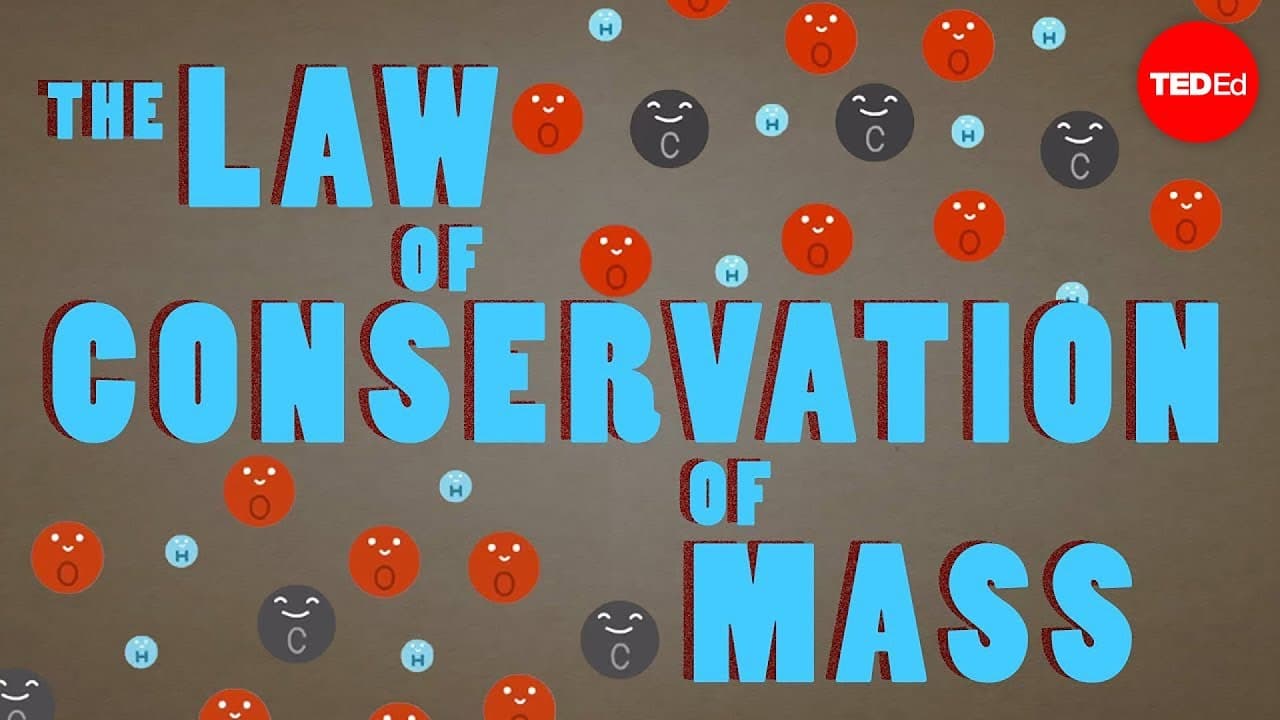
The law of conservation of mass - Todd Ramsey
TL;DR
Atoms, the fundamental building blocks of all matter, cannot be created or destroyed according to the law of conservation of mass. They originated from the Big Bang and were formed through nuclear reactions in stars.
Transcript
Where does all this stuff come from? This rock? That cow? Your heart? Not the things themselves, mind you, but what they're made of: the atoms that are the fabric of all things. To answer that question, we look to the law of conservation of mass. This law says take an isolated system defined by a boundary that matter and energy cannot cross. Insid... Read More
Key Insights
- 👮 The law of conservation of mass governs the behavior of matter and energy in isolated systems, such as the universe.
- 🫀 Atoms, which make up all matter, cannot be created or destroyed but can combine and rearrange during chemical reactions.
- 🤩 Atoms originated from the high-energy conditions of the early universe and were further formed through nuclear reactions in stars.
- 🤩 Stars play a crucial role in the formation of heavy elements, which are essential building blocks for planets and life.
- 🤩 The atoms that make up our bodies and everything around us are ultimately derived from the remnants of ancient stars.
- 👻 Chemical reactions allow the rearrangement of atoms and the release or absorption of energy stored in their bonds.
- 💆 The law of conservation of mass ensures that the total mass of a system remains constant during chemical reactions.
Install to Summarize YouTube Videos and Get Transcripts
Explore YouTube Video Summarizer or Get YouTube Transcript Extractor
Questions & Answers
Q: What does the law of conservation of mass state?
The law of conservation of mass states that in an isolated system, matter and energy cannot be created or destroyed but can only change form. This means that the total mass of the system remains constant before and after any chemical or physical changes.
Q: How do atoms form molecules?
Atoms can bond together to form molecules through chemical reactions. They share, donate, or receive electrons to achieve a stable configuration. These molecules can be as simple as water or carbon dioxide, or they can be complex compounds found in living organisms.
Q: Where did the atoms that make up our bodies come from?
The atoms that make up our bodies originated from the Big Bang. During the initial moments of the universe, hydrogen atoms formed from a high-energy soup of particles. Over time, these atoms and other elements formed stars, where heavier elements like carbon and oxygen were produced through nuclear reactions.
Q: How did the Earth and other celestial bodies form?
After stars went supernova, their elements were scattered across space. Clusters of these atoms and molecules came together to form celestial bodies like the Earth. Over billions of years, these atoms played their parts in various chemical reactions, leading to the diversity of matter we observe today.
Summary & Key Takeaways
-
The law of conservation of mass states that in an isolated system, matter and energy cannot be created or destroyed but can only change form.
-
Atoms, which make up all matter, can bond together to form molecules and undergo chemical reactions, but the total number of atoms remains constant.
-
Atoms originated from the high-energy soup of particles during the Big Bang and were further formed through nuclear reactions in stars, eventually leading to the formation of the Earth and all living things.
Read in Other Languages (beta)
Share This Summary 📚
Summarize YouTube Videos and Get Video Transcripts with 1-Click
Try YouTube Summary with ChatGPT & Claude or YouTube Transcript Generator
Explore More Summaries from TED-Ed 📚



Summarize YouTube Videos and Get Video Transcripts with 1-Click
Try YouTube Summary with ChatGPT & Claude or YouTube Transcript Generator