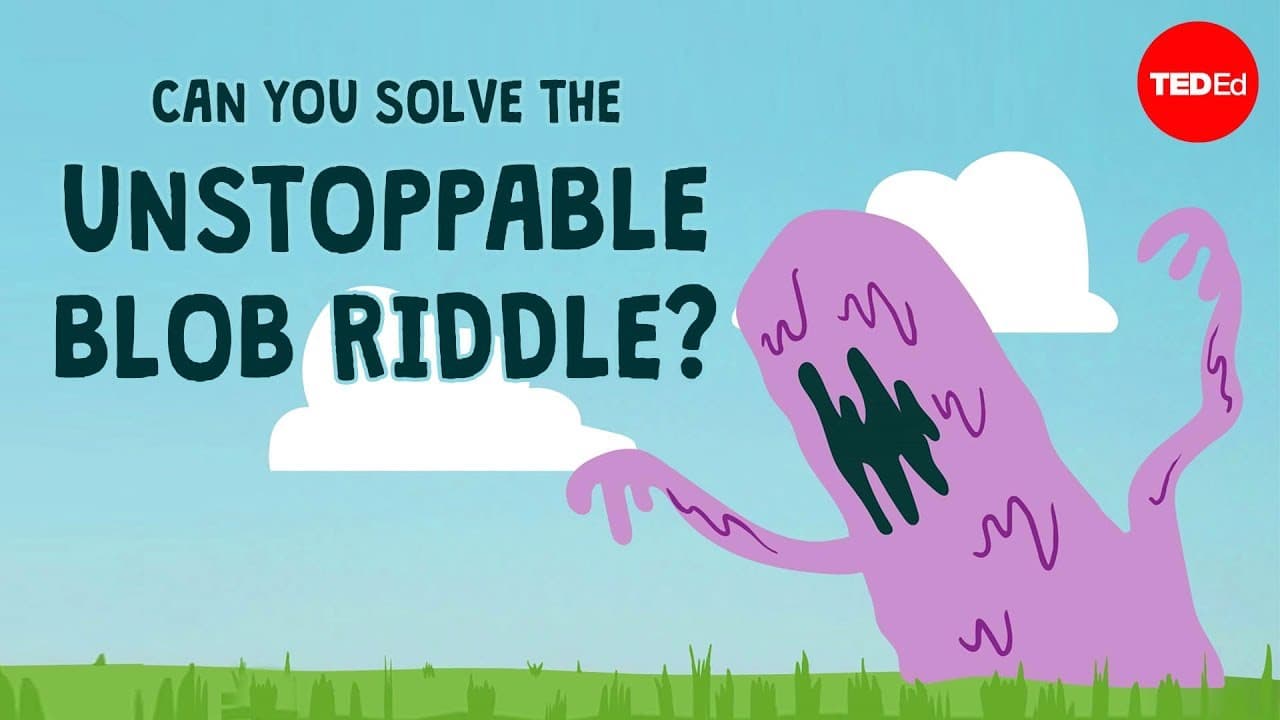
Can you solve the unstoppable blob riddle? - Dan Finkel
TL;DR
A blob doubles in size every hour and can only be stopped by cutting it into acute triangles with 7 cuts.
Transcript
A shooting star crashes on Earth, and a hideous blob emerges. It creeps and leaps, it glides and slides. It’s also unstoppable: weapons, fire, extreme temperatures… no matter what you throw at it, it just regrows and continues its rampage. Its expansion is breathtaking; it doubles in size every hour. But there’s one opportunity: after each hour, it... Read More
Key Insights
- 🌠 The blob created by a shooting star crash doubles in size every hour and regenerates quickly.
- 🔺 It can only be stopped by cutting it into acute triangles during its sleeping state as an obtuse triangle.
- 😌 The difficulty lies in avoiding obtuse and right angles while making cuts.
- 🍕 Inspiration can be drawn from slicing a pizza into acute triangles to solve the problem.
- 🔺 The strategy involves cutting off the sharp corners of the blob triangle to form a pentagon that can be divided into acute triangles.
- 💇 In total, 7 cuts are needed to render the blob inert and save the planet.
- 🙃 The technique of cutting polygons into acute triangles works for larger polygons and those with fewer sides.
Install to Summarize YouTube Videos and Get Transcripts
Explore YouTube Video Summarizer or Get YouTube Transcript Extractor
Questions & Answers
Q: How does the blob in the video grow and regenerate?
The blob, created by a shooting star crash, grows and regenerates by doubling in size every hour. It is immune to weapons, fire, and extreme temperatures.
Q: How can the blob be stopped from destroying the planet?
To stop the blob, it needs to be entirely cut into acute triangles. The blob goes into a sleeping state in the form of an obtuse triangle, allowing for cuts to be made. By cutting it into acute triangles, the blob becomes inert and harmless.
Q: Can any shape other than acute triangles be used to stop the blob?
No, experiments have shown that all shapes, except for acute triangles, wake the blob up and allow it to continue growing. Right triangles and other shapes are ineffective in stopping the blob.
Q: How many cuts can be made before the satellite returns?
Only 7 cuts can be made before the satellite completes its orbit and returns. It is crucial to strategize these cuts to ensure the blob is entirely divided into acute triangles.
Summary
A shooting star crashes on Earth, releasing a hideous blob that grows at an exponential rate and is unstoppable. However, it goes to sleep for a few minutes after each hour and forms itself into a flat triangle. The acute triangle portion of the blob is inert and never wakes up, while the obtuse triangle wakes up and continues to grow. The goal is to cut the blob into acute triangles using only 7 straight-line cuts while the satellite-mounted nano-fission ray is available to destroy the blob.
Questions & Answers
Q: What happens to the blob after each hour?
The blob goes to sleep and forms itself into a flat triangle for a few minutes before it wakes up and continues to grow.
Q: What is the difference between an acute triangle and an obtuse triangle?
An acute triangle has all angles less than 90 degrees, while an obtuse triangle has one angle greater than 90 degrees.
Q: What shapes of the blob wake up after the sleeping period?
All shapes of the blob, other than acute triangles, including right triangles, will wake up and continue to grow.
Q: How many cuts can be made while the satellite is above?
Only 7 straight-line cuts can be made while the satellite is overhead.
Q: What happens if there is even a single portion of the blob that will wake up after the satellite completes its orbit?
If even a single portion of the blob wakes up after the satellite completes its orbit, the blob will consume the entire world.
Q: What is the challenge in cutting the blob into acute triangles?
The challenge in cutting the blob into acute triangles stems from the fact that every time a cut reaches an edge, it either creates an acute and an obtuse angle or two right angles.
Q: How can pizza be used as inspiration for cutting the blob into acute triangles?
By squaring off the outside of a pizza, such as turning it into an octagon, each slice of the pizza becomes an acute triangle. This concept can be applied to larger polygons as well, including heptagons, hexagons, and pentagons.
Q: What shape can be obtained by cutting off the sharp corners of the blob triangle?
By cutting off the sharp corners of the blob triangle, a pentagon can be obtained.
Q: How many acute triangles can be cut from a blob pentagon?
A blob pentagon can be cut into five acute triangles.
Q: How many cuts are needed to render the blob completely inert?
By cutting the blob into five acute triangles from a blob pentagon, it only requires 7 cuts to render the blob completely inert.
Takeaways
In order to save the planet, the blob must be cut into acute triangles to prevent it from waking up and growing. Although there is a challenge in avoiding obtuse and right angles, inspiration can be drawn from shapes like pizzas and polygons. By transforming the blob triangle into a pentagon and cutting it into five acute triangles, the blob can be rendered completely inert with just 7 cuts. However, the task doesn't end there, as the question of what to do with these giant, practically indestructible triangles remains.
Summary & Key Takeaways
-
A shooting star crashes on Earth, creating a blob that grows and regenerates when attacked.
-
The blob goes into a sleeping state in the form of an obtuse triangle and can be cut during this time.
-
By cutting the blob into acute triangles, it can be rendered inert and the planet can be saved.
Read in Other Languages (beta)
Share This Summary 📚
Summarize YouTube Videos and Get Video Transcripts with 1-Click
Try YouTube Summary with ChatGPT & Claude or YouTube Transcript Generator
Explore More Summaries from TED-Ed 📚




Summarize YouTube Videos and Get Video Transcripts with 1-Click
Try YouTube Summary with ChatGPT & Claude or YouTube Transcript Generator