How to Build an AI-Driven Startup Efficiently
TL;DR
To build a successful AI-driven company, integrate AI as the core operating system rather than just a tool. Implement closed-loop systems to continuously improve processes and make your organization fully queryable. This approach allows for leaner teams with higher productivity and the ability to innovate rapidly, surpassing traditional company structures.
Transcript
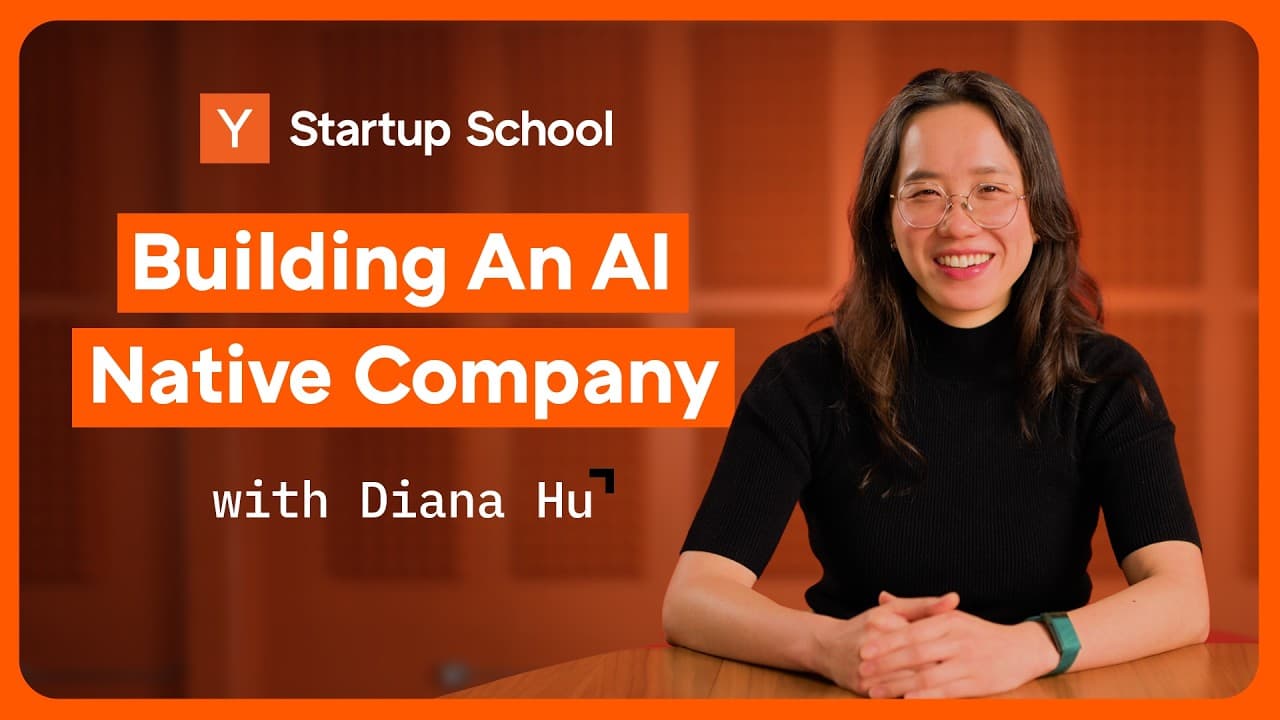
Hi, I'm Diana and I'm a partner at YC. Over the past few months, it's become clear to me that AI is not just going to change how quickly software gets built or what workflows get automated. It's going to fundamentally change the way startup should be run from what roles will exist to what products are possible to build. In this episode, I'm going t... Read More
Key Insights
- AI should be the operating system of your company, not just a tool.
- Closed-loop systems capture and improve processes continuously.
- A queryable organization allows AI to learn and self-improve.
- AI-driven companies can operate with smaller, more efficient teams.
- The classic management hierarchy becomes obsolete with AI.
- Three key roles in AI companies: Individual Contributor, Directly Responsible Individual, and AI Founder.
- Maximizing AI token usage, not headcount, is crucial for efficiency.
- Startups have an advantage in adopting AI due to fewer legacy constraints.
Install to Summarize YouTube Videos and Get Transcripts
Explore YouTube Video Summarizer or Get YouTube Transcript Extractor
Questions & Answers
Q: How can AI improve company operations?
AI can improve company operations by acting as the core operating system, enabling closed-loop processes that continuously capture and improve data. This leads to more efficient workflows, reduced need for middle management, and the ability to innovate rapidly with smaller teams. AI-driven companies can achieve higher productivity by making their organizations fully queryable and self-improving.
Q: What is a closed-loop system in AI-driven companies?
A closed-loop system in AI-driven companies is a self-regulating process that continuously monitors and adjusts its outputs to meet goals more effectively. Unlike open-loop systems, which lack feedback mechanisms, closed-loop systems capture data from every important process, feed it back into the AI, and improve over time, enhancing accuracy and stability in operations.
Q: Why are traditional management hierarchies becoming obsolete in AI companies?
Traditional management hierarchies are becoming obsolete in AI companies because AI can handle information routing and decision-making more efficiently than human middle managers. With AI as the intelligence layer, companies can streamline operations, reduce layers of human routing, and increase the speed of information flow, resulting in faster and more effective decision-making.
Q: What roles are essential in an AI-native company?
In an AI-native company, three essential roles are the Individual Contributor (IC), the Directly Responsible Individual (DRI), and the AI Founder. The IC focuses on building and operating, the DRI is responsible for strategy and outcomes, and the AI Founder leads by example, driving AI strategy and demonstrating capability gains to the team.
Q: How can startups benefit from AI adoption compared to larger companies?
Startups benefit from AI adoption by having the flexibility to design their systems, workflows, and culture around AI from the beginning, without the burden of legacy systems or processes. This allows them to innovate faster and operate more efficiently than larger companies, which face challenges in adapting existing structures to AI technologies.
Q: What is the significance of making a company fully queryable?
Making a company fully queryable is significant because it allows AI systems to access comprehensive data from all processes, enabling continuous learning and improvement. This transparency helps AI to provide real-time insights, optimize operations, and drive innovation, ultimately leading to more informed decision-making and increased efficiency.
Q: How do AI-driven companies achieve higher productivity with smaller teams?
AI-driven companies achieve higher productivity with smaller teams by leveraging AI tools to automate routine tasks and enhance decision-making processes. This allows individual contributors to accomplish tasks that previously required larger teams, reducing the need for extensive manpower while maintaining or even increasing output and innovation.
Q: What is the impact of AI on the future of engineering teams?
AI impacts the future of engineering teams by enabling them to work more efficiently and effectively. AI tools can automate code generation and testing, allowing engineers to focus on higher-level problem-solving and innovation. This reduces the need for large engineering teams, as a single engineer can achieve what previously required multiple team members, transforming productivity and output.
Summary & Key Takeaways
-
AI should be central to your company's operations, acting as the core system that drives all processes and decisions. By creating closed-loop systems, companies can continuously improve and adapt, leading to more efficient operations and innovation. This approach allows for smaller teams that can achieve more, disrupting traditional management structures.
-
In an AI-driven company, every process should be captured and analyzed by AI, making the organization fully queryable. This setup helps in creating a self-improving system where decisions and outcomes are constantly fed back into the intelligence layer, resulting in a dynamic and responsive company environment.
-
The shift to AI-native companies involves redefining roles and structures, focusing on maximizing AI capabilities rather than expanding headcount. Startups, without legacy systems, can fully embrace AI from the ground up, giving them a competitive edge over larger, established companies struggling with adaptation.
Read in Other Languages (beta)
Share This Summary 📚
Summarize YouTube Videos and Get Video Transcripts with 1-Click
Try YouTube Summary with ChatGPT & Claude or YouTube Transcript Generator
Explore More Summaries from Y Combinator 📚






Summarize YouTube Videos and Get Video Transcripts with 1-Click
Try YouTube Summary with ChatGPT & Claude or YouTube Transcript Generator