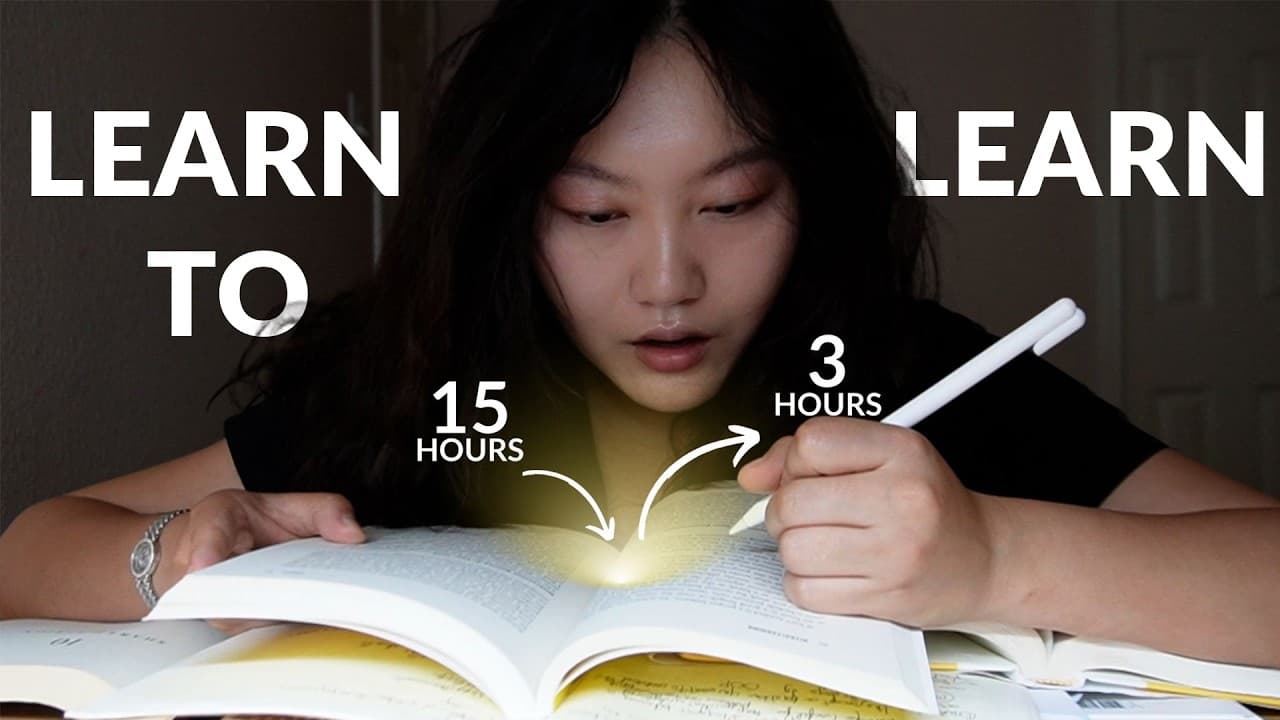
Learn To Learn In 25 Minutes
TL;DR
Learn effective learning techniques in a condensed 25-minute video.
Transcript
learning how to learn is one of those meta skills that give you a huge intelligence stat boost which makes anything else you're trying to learn so much easier whether that be coding driving piano literally anything because that's what really being smart is you're just able to learn things and then use the things that you lea... Read More
Key Insights
- Understanding the difference between focused and diffuse thinking can enhance problem-solving skills. Focused thinking is narrow and detail-oriented, while diffuse thinking allows for big-picture analysis.
- Memory is complex, involving short-term and long-term components. Short-term memory is limited but easily accessible, while long-term memory has vast capacity but requires effort to access.
- Chunking information helps in learning by associating different pieces together, making it easier to process and recall.
- Procrastination is a major obstacle in learning, but understanding and intervening in the habit loop can help overcome it.
- Effective learning involves both bottom-up (chunking and practicing) and top-down (understanding context) approaches.
- Spaced repetition and creating memorable analogies are powerful techniques for transferring information into long-term memory.
- Learning is more effective with the involvement of others, such as mentors or fellow learners, who can provide feedback and motivation.
- Utilizing tools like AI and online platforms can facilitate learning by offering personalized guidance and resources.
Install to Summarize YouTube Videos and Get Transcripts
Explore YouTube Video Summarizer or Get YouTube Transcript Extractor
Questions & Answers
Q: What are the two primary modes of thinking discussed in the video?
The video details two primary modes of thinking: focused and diffuse. Focused thinking is narrow and detail-oriented, used for tasks you are familiar with. Diffuse thinking, on the other hand, is open and allows for big-picture analysis, helping to solve problems by accessing different parts of the brain.
Q: How does memory function according to the video?
Memory is described as having two main components: short-term and long-term. Short-term memory, or working memory, is limited to about four slots and is easily accessible for immediate tasks. Long-term memory has a vast capacity but requires effort to store and retrieve information. The video emphasizes techniques like repetition and creating associations to move information from short-term to long-term memory.
Q: What is chunking and why is it important in learning?
Chunking is the process of grouping pieces of information together based on their use or meaning. This technique is essential in learning because it allows the brain to process complex information as single units, making it easier to understand and recall. By forming chunks, learners can efficiently manage and retrieve information, enhancing their overall learning ability.
Q: How can procrastination be addressed according to the video?
The video suggests addressing procrastination by understanding the habit loop, which includes a cue, routine, reward, and belief. By intervening at any point in this loop, such as changing the routine or focusing on the process rather than the outcome, individuals can break the cycle of procrastination. Planning tasks and rewarding oneself for progress can also help in overcoming procrastination.
Q: What role do mentors and social learning play in the learning process?
Mentors and social learning play a crucial role by providing guidance, feedback, and motivation. They can offer new perspectives and help learners overcome challenges by sharing their expertise. Social interactions make learning more engaging and can lead to better understanding through discussion and collaboration. Choosing the right group or mentor is important to ensure productivity and commitment to learning.
Q: What is spaced repetition and how does it aid memory retention?
Spaced repetition is a learning technique that involves reviewing information at increasing intervals over time. This method helps in transferring information into long-term memory by reinforcing the material just as it begins to fade from memory. By spacing out review sessions, learners can improve retention and recall, making it a highly effective strategy for memorizing complex information.
Q: How can AI tools assist in the learning process?
AI tools can assist in learning by providing personalized guidance and resources. They can offer tailored feedback, suggest learning paths, and help in organizing and reviewing material. AI can simulate the role of a mentor or coach, especially when access to human experts is limited. These tools can enhance learning efficiency and adapt to individual learning styles and needs.
Q: What practical tips does the video offer for effective learning?
The video offers several practical tips: plan your week with a to-do list, mix different types of tasks, focus on the process rather than the product, and ensure you have a finishing time for tasks. It also suggests using techniques like interleaving, practicing recall, and avoiding distractions to enhance learning efficiency. Additionally, creating memorable analogies and using spaced repetition are recommended for improving memory retention.
Summary & Key Takeaways
-
The video discusses the importance of learning how to learn, focusing on techniques such as switching between focused and diffuse thinking to solve problems effectively.
-
Memory is explored, highlighting the roles of short-term and long-term memory, and strategies like chunking and spaced repetition to improve retention.
-
Overcoming procrastination through understanding the habit loop and leveraging social learning and AI tools are emphasized for effective learning.
Read in Other Languages (beta)
Share This Summary 📚
Summarize YouTube Videos and Get Video Transcripts with 1-Click
Try YouTube Summary with ChatGPT & Claude or YouTube Transcript Generator
Explore More Summaries from Tina Huang 📚



Summarize YouTube Videos and Get Video Transcripts with 1-Click
Try YouTube Summary with ChatGPT & Claude or YouTube Transcript Generator