How Does a Transistor Work?
TL;DR
Transistors are tiny devices that control the flow of electric current and process information using zeros and ones.
Transcript
In this phone, there are nearly 100 million transistors, in this computer there's over a billion. The transistor is in virtually every electronic device we use: TV's, radios, Tamagotchis. But how does it work? Well the basic principle is actually incredibly simple. It works just like this switch, so it controls the flow of electric current. It can ... Read More
Key Insights
- 💁 Transistors are essential components in electronic devices due to their ability to control electric current and process information.
- 💁 Semiconductors, like silicon, form the basis of transistors, conducting electric current with their unique properties.
- ❓ Doping, the introduction of foreign substances, enhances the conductivity and performance of semiconductors.
- 💐 A transistor operates like a switch, using a gate to control the flow of current.
Install to Summarize YouTube Videos and Get Transcripts
Explore YouTube Video Summarizer or Get YouTube Transcript Extractor
Questions & Answers
Q: How does a transistor work?
A transistor functions as a switch, controlling electrical current flow. It can be turned on or off by applying a positive voltage to the gate, allowing or blocking the flow of electrons.
Q: What are the two types of doping for semiconductors?
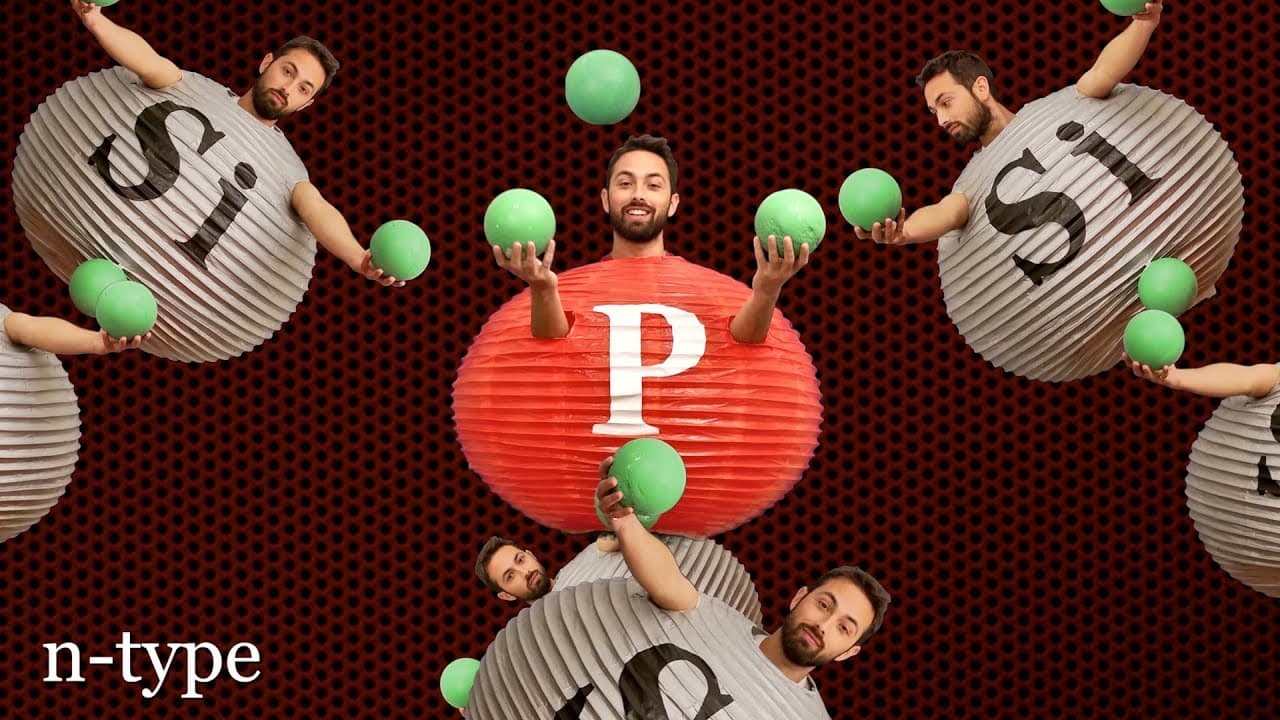
The two types are n-type and p-type doping. N-type doping involves injecting an element with five valence electrons, such as Phosphorus, to increase the semiconductor's conductivity. P-type doping introduces an element with three valence electrons, like Boron, creating holes that electrons can move into.
Q: Does n-type doping make semiconductors negatively charged?
No, n-type and p-type semiconductors are both neutral. The n and p refer to the sign of charge that can move within them (negative electrons for n-type and positive holes for p-type).
Q: How does a transistor get turned on?
To turn on a transistor, a small positive voltage needs to be applied to the gate. This voltage attracts electrons and reduces the depletion layer, allowing current to flow through the transistor.
Summary & Key Takeaways
-
Transistors are fundamental components of electronic devices, controlling the flow of electric current and storing/processing information using zeros and ones.
-
They are made of semiconductors, like silicon, which conduct electric current better than insulators but not as well as metals.
-
Doping, the process of injecting foreign substances into semiconductors, enhances their performance by increasing the number of mobile charges.
Read in Other Languages (beta)
Share This Summary 📚
Summarize YouTube Videos and Get Video Transcripts with 1-Click
Try YouTube Summary with ChatGPT & Claude or YouTube Transcript Generator
Explore More Summaries from Veritasium 📚




Summarize YouTube Videos and Get Video Transcripts with 1-Click
Try YouTube Summary with ChatGPT & Claude or YouTube Transcript Generator