What Are the Missing Baryons in the Universe?
TL;DR
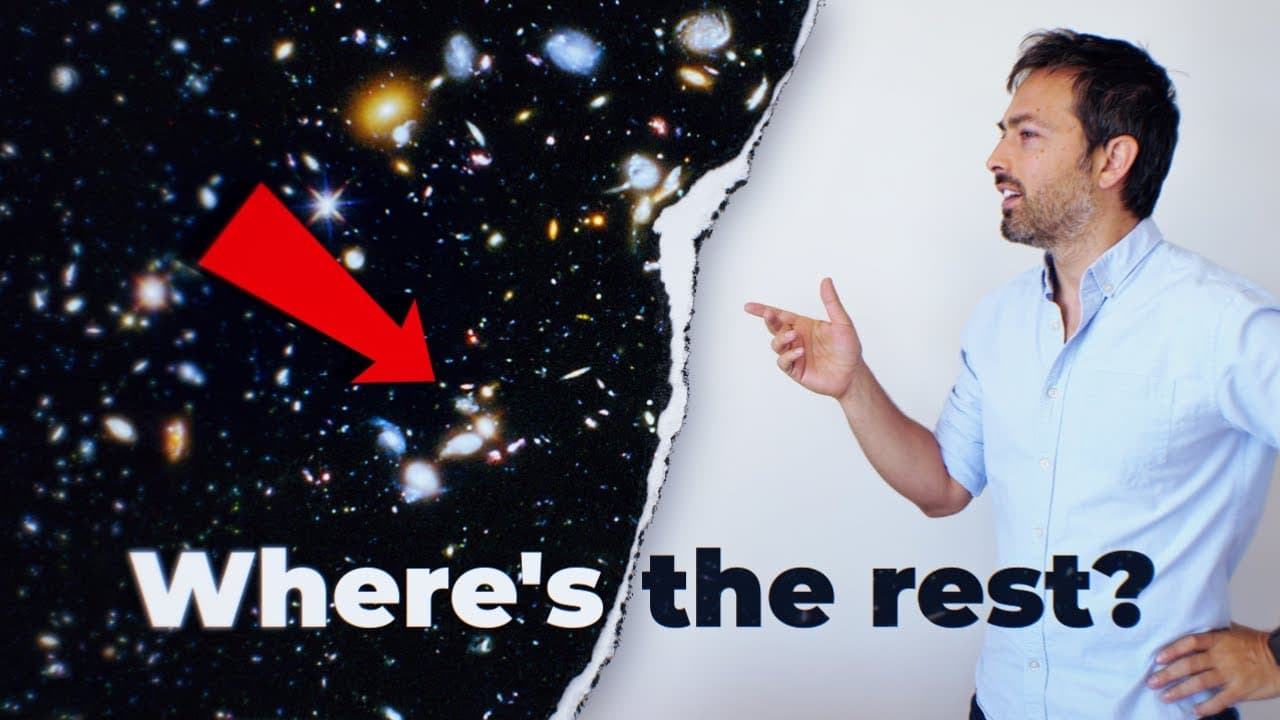
Scientists have discovered that approximately 50% of the universe's missing baryonic matter resides in the warm-hot intergalactic medium (WHIM), found using fast radio bursts and their dispersion measures. Initially, only 2.5% of the expected 5% of baryonic matter was detectable, but recent findings validate the predictions about the universe's composition.
Transcript
This episode was sponsored by KiwiCo More about them at the end of the show Until recently, half the universe was missing or hidden or just... undetected And no, I'm not talking about dark matter or dark energy, which make up 27 and 68 percent of our universe, respectively. No, I'm talking about normal ordinary matter Which makes up you and me and ... Read More
Key Insights
- ❓ The missing baryon problem refers to the discrepancy between the expected and observed amount of ordinary matter in the universe.
- 💁 Deuterium, a stable nucleus, was formed shortly after the Big Bang and is still present in the universe today.
- 🙂 Quasars, with their bright light and redshifted spectrum, provide a backlight to observe absorption lines created by neutral hydrogen atoms.
- 💨 By studying dispersion measures of fast radio bursts, astronomers were able to estimate the total amount of missing baryons, validating previous predictions.
Install to Summarize YouTube Videos and Get Transcripts
Explore YouTube Video Summarizer or Get YouTube Transcript Extractor
Questions & Answers
Q: Why is it expected that the universe should be 5% ordinary baryonic matter?
The universe is expected to have 5% baryonic matter to explain the observed relative abundances of different elements, particularly deuterium, hydrogen, and helium.
Q: How did deuterium, an unstable nucleus, form in the early universe?
Deuterium formed approximately 10 seconds after the Big Bang when the universe had cooled enough for it to become stable and rapidly fuse into helium.
Q: What are fast radio bursts, and how did scientists use them to find missing baryons?
Fast radio bursts are short-duration pulses of intense radio waves. By analyzing their dispersion measures and redshifts, scientists estimated the total amount of baryonic matter, including the ionized particles in the warm-hot intergalactic medium.
Q: Why did computer simulations suggest that the missing baryons are in the warm-hot intergalactic medium?
Computer simulations predicted that the rest of the baryonic matter lies in the intergalactic medium, specifically in the warm-hot regions between galaxies, as it is spread out and ionized.
Summary & Key Takeaways
-
Ordinary matter, known as baryonic matter, makes up only 2.5% of the expected 5% in the universe, leading to the missing baryon problem.
-
Scientists can estimate the density of radiation after the Big Bang by analyzing the ratio of deuterium to hydrogen, which indicates a 5% baryonic matter.
-
By using fast radio bursts and dispersion measures, astronomers have found that roughly 50% of the missing baryons are in the warm-hot intergalactic medium.
Read in Other Languages (beta)
Share This Summary 📚
Summarize YouTube Videos and Get Video Transcripts with 1-Click
Try YouTube Summary with ChatGPT & Claude or YouTube Transcript Generator
Explore More Summaries from Veritasium 📚



Summarize YouTube Videos and Get Video Transcripts with 1-Click
Try YouTube Summary with ChatGPT & Claude or YouTube Transcript Generator