How Does the Principle of Least Action Work?
TL;DR
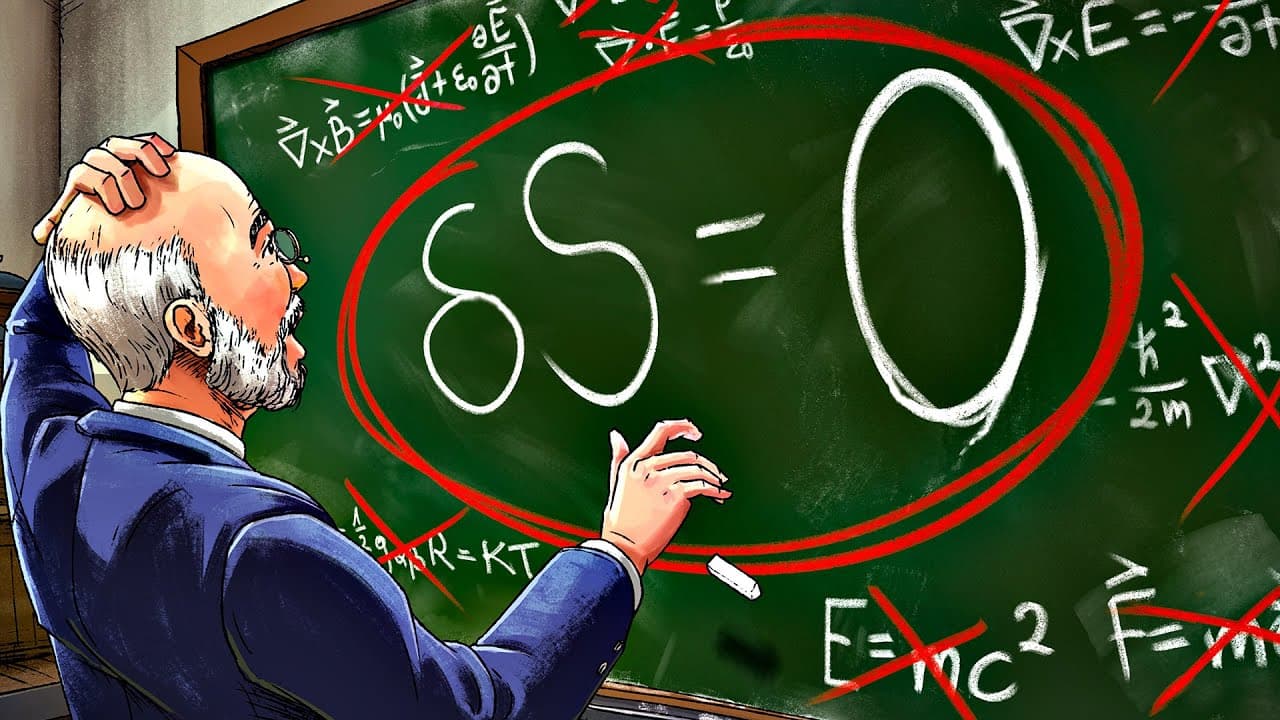
The principle of least action is a fundamental concept in physics that describes how nature optimizes processes. It states that the path taken by a system between two states is the one for which the action is minimized. This concept unifies various physical phenomena, from the motion of particles to the behavior of light, under a single theoretical framework.
Transcript
- This is a video about a single simple rule that underpins all of physics, every principle, from classical mechanics to electromagnetism, from quantum theory to general relativity, right down to the ultimate constituents of matter, the fundamental particles. All of it can be replaced by this single rule. It feels like we're approaching spo... Read More
Key Insights
- The principle of least action states that the path taken by a system is the one for which the action is minimized.
- Action is defined as the integral of the Lagrangian (kinetic energy minus potential energy) over time.
- The principle unifies different fields of physics, such as mechanics and optics, under a single rule.
- Johann Bernoulli used Fermat's principle of least time to solve the problem of fastest descent, leading to the discovery of the brachistochrone curve.
- Pierre Louis de Maupertuis proposed the principle of least action, suggesting nature minimizes action, not just time.
- Euler and Lagrange developed mathematical rigor for the principle, making it applicable to a wider range of problems.
- The principle of least action simplifies solving complex mechanics problems by using energies and scalars instead of forces and vectors.
- Hamilton's formulation of the principle provides a modern approach, allowing for the analysis of systems with varying energies.
Install to Summarize YouTube Videos and Get Transcripts
Explore YouTube Video Summarizer or Get YouTube Transcript Extractor
Questions & Answers
Q: How does the principle of least action unify physics?
The principle of least action unifies physics by providing a single framework that describes the evolution of systems across various fields. It states that the path taken by a system between two states is the one for which the action, defined as the integral of kinetic energy minus potential energy over time, is minimized. This principle applies to mechanics, optics, and other areas, demonstrating the interconnectedness of physical laws.
Q: What is the historical significance of the brachistochrone problem?
The brachistochrone problem, posed by Johann Bernoulli, challenged mathematicians to find the fastest descent path between two points. Its solution led to the discovery of the cycloid curve, known as the brachistochrone. This problem highlighted the principle of least time and inspired the development of the principle of least action, which became a cornerstone in physics for understanding the optimization of natural processes.
Q: Why is the principle of least action important in modern physics?
The principle of least action is important in modern physics because it provides a universal method for deriving equations of motion and understanding system dynamics. By minimizing action, defined as the integral of the Lagrangian over time, physicists can analyze complex systems more efficiently. This principle is foundational in fields such as quantum mechanics and general relativity, where traditional force-based approaches are less applicable.
Q: How did Euler and Lagrange contribute to the principle of least action?
Euler and Lagrange contributed to the principle of least action by developing its mathematical framework, allowing it to be applied rigorously to a wide range of problems. Euler introduced the integral form of action, while Lagrange provided a general proof and refined the method for solving mechanics problems using energies and scalars. Their work made the principle a powerful tool in theoretical physics.
Q: What is Hamilton's formulation of the principle of least action?
Hamilton's formulation of the principle of least action redefined the concept by expressing action as the integral of the Lagrangian, which is kinetic energy minus potential energy, over time. This modern approach emphasizes the use of energies and scalars, allowing for a more versatile analysis of physical systems. It provides a framework for understanding dynamics in systems with varying energies and is widely used in contemporary physics.
Q: How does the principle of least action simplify solving mechanics problems?
The principle of least action simplifies solving mechanics problems by allowing physicists to use energies and scalars instead of forces and vectors. By minimizing the action, defined as the integral of kinetic energy minus potential energy over time, complex systems can be analyzed more efficiently. This approach is particularly useful for problems involving multiple dimensions or non-Cartesian coordinate systems, like the double pendulum.
Q: What is the relationship between Fermat's principle of least time and the principle of least action?
Fermat's principle of least time is a special case of the principle of least action, where the path taken by light minimizes travel time. The principle of least action generalizes this concept to include other systems, stating that the path taken minimizes the action, defined as the integral of the Lagrangian over time. This broader principle applies to both light and particles, unifying different areas of physics under a common framework.
Q: Why is the principle of least action sometimes called the principle of stationary action?
The principle of least action is sometimes called the principle of stationary action because the action is not always minimized; it can also be stationary, meaning it is at a local minimum, maximum, or saddle point. This terminology reflects the mathematical condition that the variation of the action is zero, similar to finding stationary points in calculus. This broader concept accommodates cases where the action is not strictly minimized.
Summary & Key Takeaways
-
The principle of least action describes how systems evolve by minimizing action, a quantity defined as the integral of kinetic energy minus potential energy over time. This principle unifies various physical laws, providing a common framework for understanding mechanics and optics. Euler and Lagrange developed the mathematical foundation, making it a powerful tool for solving complex problems.
-
Johann Bernoulli's challenge to find the fastest descent path led to the discovery of the brachistochrone curve, solved using Fermat's principle of least time. Maupertuis later proposed that nature minimizes action, which was mathematically refined by Euler and Lagrange, establishing a fundamental principle in physics that applies to diverse phenomena.
-
Hamilton's reformulation of the principle of least action allows for a modern understanding of physical systems, emphasizing the use of energies and scalars over traditional forces. This approach simplifies the analysis of complex systems, such as the double pendulum, by focusing on the optimization of action rather than individual forces.
Read in Other Languages (beta)
Share This Summary 📚
Summarize YouTube Videos and Get Video Transcripts with 1-Click
Try YouTube Summary with ChatGPT & Claude or YouTube Transcript Generator
Explore More Summaries from Veritasium 📚


Summarize YouTube Videos and Get Video Transcripts with 1-Click
Try YouTube Summary with ChatGPT & Claude or YouTube Transcript Generator