How did they actually take this picture? (Very Long Baseline Interferometry)
TL;DR
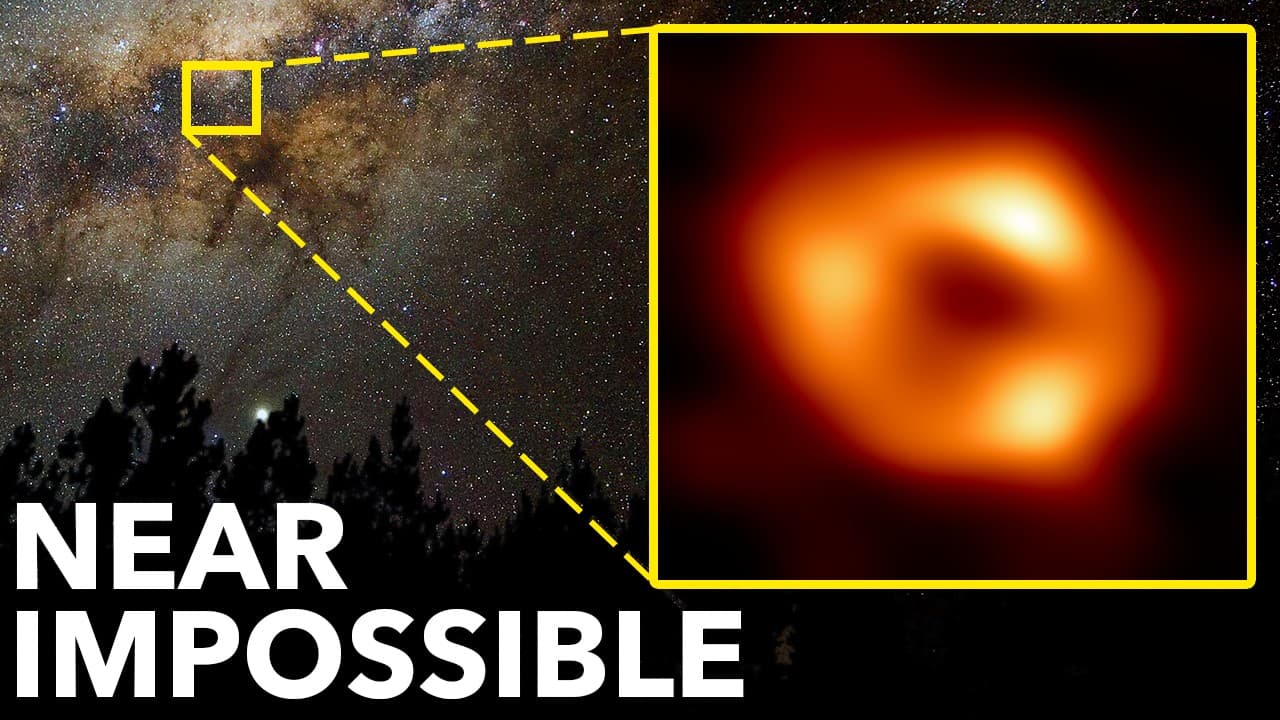
Scientists used a global network of radio telescopes to capture the first-ever image of a black hole by combining signals from multiple locations. The image shows the event horizon and the surrounding accretion disk, which emits superheated plasma as it falls into the black hole.
Transcript
This video is sponsored by KiwiCo, more about them at the end of the show. This is a picture of the supermassive black hole at the center of our Milky Way galaxy known as Sagittarius A*. The black hole itself doesn't emit light so what we're seeing is the hot plasma swirling around it. This is only the second picture of a black hole ever. It was ta... Read More
Key Insights
- 🖤 The image of the black hole was captured using a global network of radio telescopes.
- 🖤 The image shows the event horizon, the boundary beyond which nothing can escape the black hole's gravitational pull.
- 😋 The image also shows the accretion disk, a ring of superheated plasma swirling around the black hole.
- 🙂 Light rays are bent and absorbed by the black hole, creating dark regions in the image.
- ◾ The black hole at the center of the Milky Way galaxy appears smaller and quieter than the black hole at the center of galaxy M87.
- 🤙 The image was taken using a technique called very long baseline interferometry, which combines signals from multiple telescopes to improve angular resolution.
- 🖤 The size of the black holes on the sky is equivalent to taking a picture of a donut on the moon.
Install to Summarize YouTube Videos and Get Transcripts
Explore YouTube Video Summarizer or Get YouTube Transcript Extractor
Questions & Answers
Q: How was the image of the black hole taken?
The image was taken using a technique called very long baseline interferometry, which combines signals from multiple radio telescopes around the world. By combining the signals, scientists were able to achieve the level of angular resolution needed to capture the image.
Q: What is visible in the image of the black hole?
The image shows the event horizon, which is the boundary beyond which nothing can escape the black hole's gravitational pull. It also shows the accretion disk, a ring of superheated plasma swirling around the black hole.
Q: Why does the black hole appear darker in some areas?
The dark areas in the image correspond to regions where light rays are bent and absorbed by the black hole. Light that comes close to the event horizon gets trapped and can never be seen again.
Q: How does the black hole in the image compare to other black holes?
The black hole at the center of the Milky Way galaxy, Sagittarius A*, appears smaller and quieter than the black hole at the center of galaxy M87. It consumes less matter and emits less radiation, making it appear darker and less active.
Summary & Key Takeaways
-
Scientists captured the first-ever image of a black hole using a global network of radio telescopes.
-
The image shows the event horizon, the boundary beyond which nothing can escape the black hole's gravitational pull, and the accretion disk, a swirling ring of superheated plasma.
-
The black hole at the center of the Milky Way galaxy, known as Sagittarius A*, appears much smaller and quieter than the black hole at the center of galaxy M87.
Read in Other Languages (beta)
Share This Summary 📚
Summarize YouTube Videos and Get Video Transcripts with 1-Click
Try YouTube Summary with ChatGPT & Claude or YouTube Transcript Generator
Explore More Summaries from Veritasium 📚






Summarize YouTube Videos and Get Video Transcripts with 1-Click
Try YouTube Summary with ChatGPT & Claude or YouTube Transcript Generator