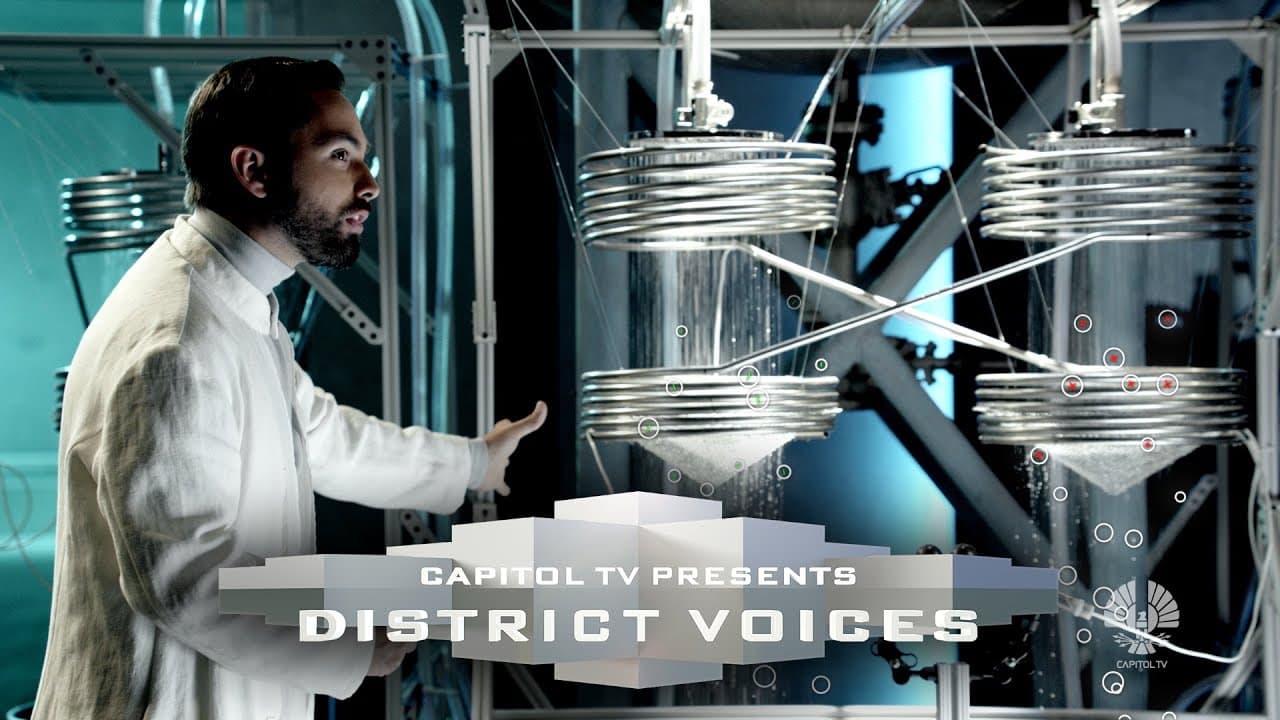
CapitolTV's DISTRICT VOICES - District 5: Electric Sparks From Falling Water
TL;DR
Learn how falling water can generate electricity without any traditional power source or moving parts.
Transcript
this is capital T greetings citizens welcome to the Coriolanus nine solar thermal power plant in the heart of district 5 this facility generates over seven percent of our proud capital's energy needs but did you know that you can generate electricity from mere drops of water I'm going to show you an experiment that does just that as we turn on the ... Read More
Key Insights
- ✊ The Coriolanus nine solar thermal power plant in district 5 generates a significant portion of the capital's energy needs.
- 💦 Electricity can be generated from falling water using the charged particles (ions) present in water.
- 🥳 The experiment's simplicity and lack of moving parts make it an accessible method for electricity generation.
- 🏗️ A clear separation of charge and the build-up of positive and negative ions result in the generation of electricity.
- 😋 The voltage can be controlled by adjusting the charge build-up on the rings and mesh.
- 🌱 This approach eliminates the need for large-scale infrastructure like mirrors or coal-burning plants.
- 🗯️ With the right materials, this experiment can be replicated at home.
Install to Summarize YouTube Videos and Get Transcripts
Explore YouTube Video Summarizer or Get YouTube Transcript Extractor
Questions & Answers
Q: How does the experiment generate electricity without any power source or moving parts?
The experiment utilizes the charged particles (ions) present in water. As the water falls, an imbalance of negative and positive charges occurs, creating a separation of charge. The positively charged ions are attracted to the negatively charged mesh, while the negative ions are attracted to the positively charged ring. This separation of charge generates electricity without the need for traditional methods.
Q: Can this experiment be replicated at home?
Yes, with access to the right materials, it is possible to build a similar apparatus at home. The experiment requires rings, mesh, and a spark gap to create the electric generator. However, it is crucial to ensure safety precautions while working with electricity.
Q: How is this method different from traditional hydroelectric generation?
Traditional hydroelectric generation typically involves turbines and moving parts. In this experiment, no turbines or moving parts are required. The electricity is generated solely based on the charged particles in the falling water, making it a simpler and potentially more accessible method.
Q: How does the experiment reach the designed voltage of 20,000 volts?
As the charge builds up on the mesh and rings, the separation of positive and negative charge increases. Eventually, when the designed voltage of 20,000 volts is reached, electrons jump from the negative rings to the positive ones through the spark gap, ionizing the air and creating the spark.
Summary & Key Takeaways
-
The Coriolanus nine solar thermal power plant generates over 7% of the capital's energy needs, but there's a way to generate electricity from just drops of water.
-
By using the intrinsic properties of falling water, a simple experiment with rings and mesh can generate a spark of around 20,000 volts of electricity.
-
The separation of charge and the build-up of positive and negative ions in the water stream create a clear separation of charge, resulting in an electric generator.
Read in Other Languages (beta)
Share This Summary 📚
Summarize YouTube Videos and Get Video Transcripts with 1-Click
Try YouTube Summary with ChatGPT & Claude or YouTube Transcript Generator
Explore More Summaries from Veritasium 📚




Summarize YouTube Videos and Get Video Transcripts with 1-Click
Try YouTube Summary with ChatGPT & Claude or YouTube Transcript Generator