Is This What Quantum Mechanics Looks Like?
TL;DR
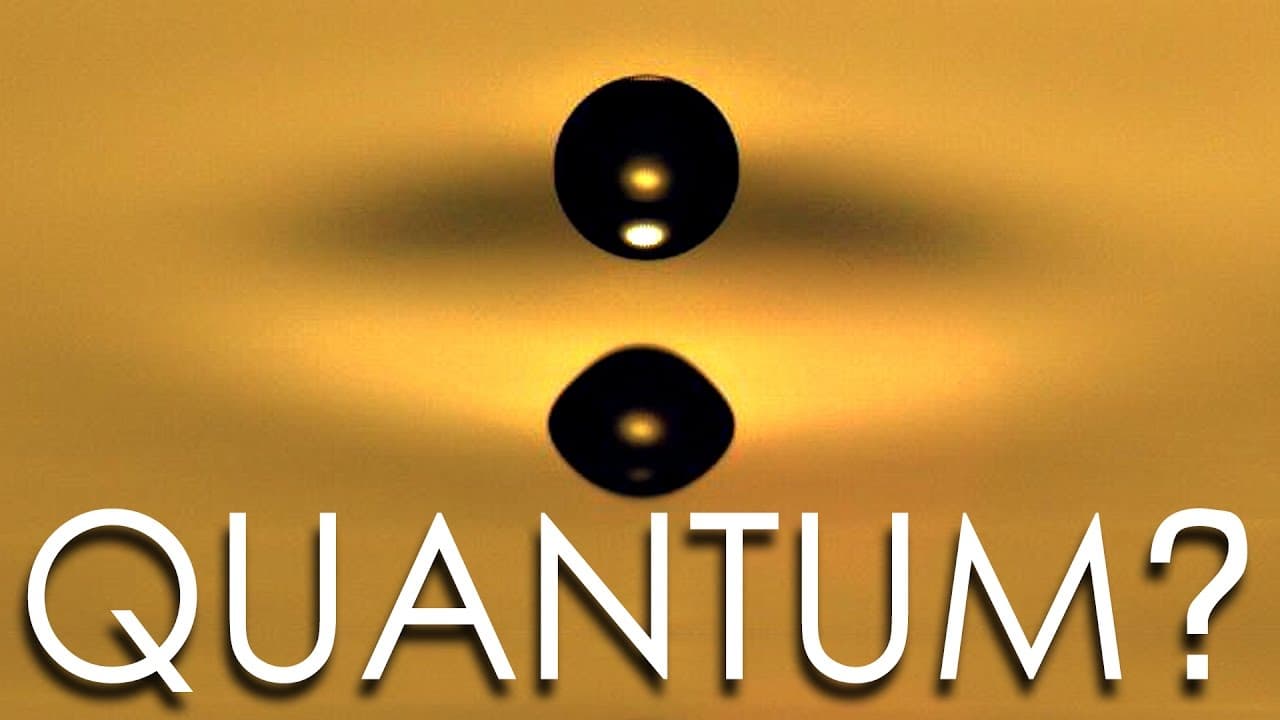
Bouncing droplets on a vibrating surface exhibit behavior similar to quantum mechanics, suggesting the possibility of a pilot wave theory.
Transcript
Check this out I'm using this speaker to vibrate a petri dish containing silicon oil Now if I take this toothpick and make a little droplet on the surface the droplet will stay there, hovering above the surface The droplet is actually bouncing and it will keep bouncing for a very long time Now the reason for this is a little layer of air between th... Read More
Key Insights
- 💦 Bouncing droplets on a vibrating surface can replicate many of the strange phenomena of quantum mechanics.
- 💦 The behavior of bouncing droplets suggests the possibility of a pilot wave theory, which was marginalized in favor of the Copenhagen interpretation of quantum mechanics.
- 💦 Bouncing droplets exhibit interference patterns and tunneling-like behavior, similar to quantum particles.
- 💦 The similarity between bouncing droplets and quantum mechanics suggests that there are competing theories for the same experimental results.
- 👋 The pilot wave theory offers a more deterministic view of the universe, where particles have definite positions and momenta.
- 💦 Bouncing droplets create a wavefield on the surface that stores information about their previous locations.
- 💦 The patterns created by bouncing droplets resemble electron probability densities in quantum corral experiments.
Install to Summarize YouTube Videos and Get Transcripts
Explore YouTube Video Summarizer or Get YouTube Transcript Extractor
Questions & Answers
Q: How do bouncing droplets on a vibrating surface stay suspended in air?
Bouncing droplets on a vibrating surface create a layer of air between the droplet and the surface, preventing them from recombining with the oil and allowing them to hover and bounce for a long time.
Q: How can bouncing droplets replicate phenomena found in quantum mechanics?
Bouncing droplets can replicate phenomena such as the double-slit experiment and tunneling by exhibiting interference patterns and crossing barriers that they wouldn't classically have enough energy to overcome.
Q: Do bouncing droplets exhibit quantization?
Yes, bouncing droplets, when confined to a circular corral, exhibit quantization similar to electrons bound to atoms. The droplets move chaotically but over time, patterns similar to electron probability densities build up.
Q: How does the pilot wave theory explain the behavior of bouncing droplets?
The pilot wave theory postulates that particles have accompanying waves that guide their motion. Bouncing droplets exhibit behavior that aligns with the pilot wave theory, suggesting that it might be a possible explanation for quantum phenomena.
Summary & Key Takeaways
-
Bouncing droplets on a vibrating surface create a layer of air between the droplet and the surface, allowing it to hover and bounce for a long time.
-
These droplets can replicate phenomena found in quantum mechanics, such as the double-slit experiment and tunneling.
-
The droplets exhibit quantization, similar to electrons bound to atoms, and create patterns similar to electron probability densities.
Read in Other Languages (beta)
Share This Summary 📚
Summarize YouTube Videos and Get Video Transcripts with 1-Click
Try YouTube Summary with ChatGPT & Claude or YouTube Transcript Generator
Explore More Summaries from Veritasium 📚



Summarize YouTube Videos and Get Video Transcripts with 1-Click
Try YouTube Summary with ChatGPT & Claude or YouTube Transcript Generator