How Does a Quantum Computer Work?
TL;DR
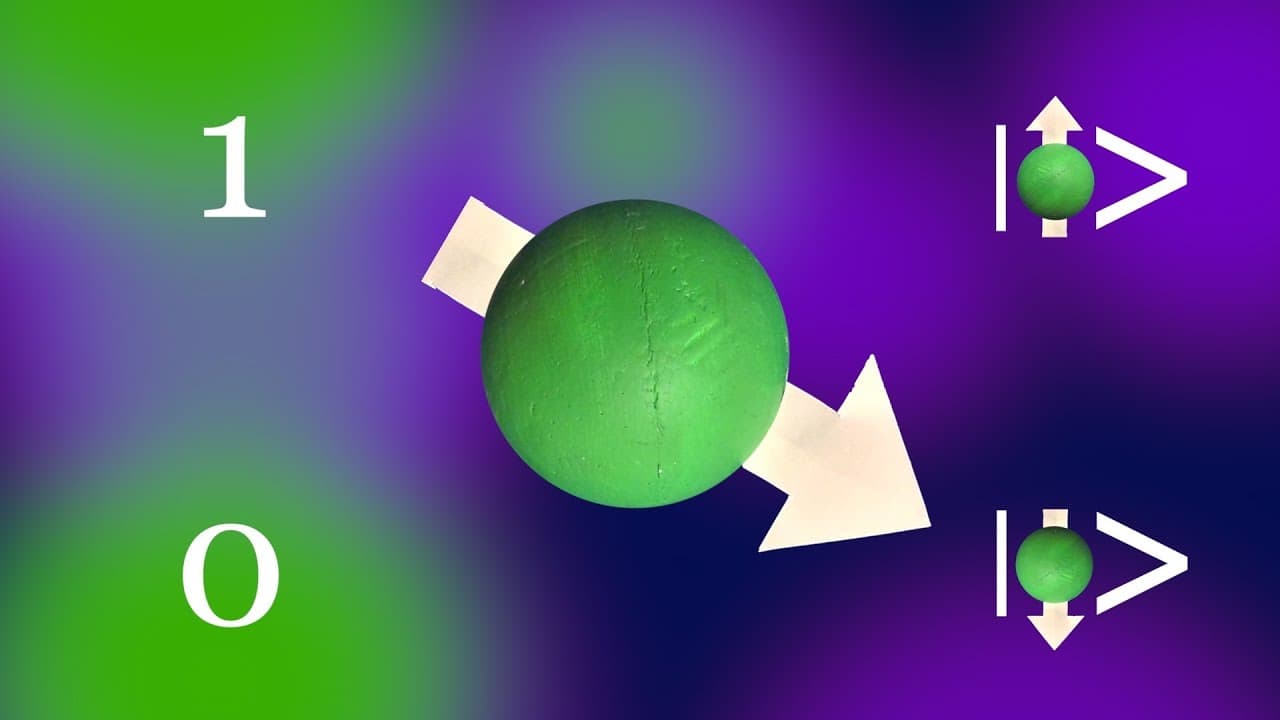
Quantum computers use qubits, which can be both zero and one at the same time, giving them superior computing power.
Transcript
A classical computer performs operations using classical bits, which can be either zero or one. Now in contrast, a quantum computer users quantum bits or qubits. And they can be both zero and one at the same time. And it is this that gives a quantum computer its superior computing power. There are a number of physical objects that can be used as a ... Read More
Key Insights
- 🖱️ Quantum computers use qubits, which can be both zero and one simultaneously, thanks to quantum superposition.
- 👨🔬 Qubits can be physical objects like photons, nuclei, or electrons, with different research groups using different qubit implementations.
- 👻 Quantum superposition allows for exponentially more computational power, with N qubits containing 2^N classical bits of equivalent information.
- 😌 The challenge lies in designing logical operations that result in measurable and unique states for final computation results.
Install to Summarize YouTube Videos and Get Transcripts
Explore YouTube Video Summarizer or Get YouTube Transcript Extractor
Questions & Answers
Q: What is the difference between classical bits and qubits?
Classical bits can only be zero or one, while qubits can be both zero and one simultaneously, thanks to quantum superposition.
Q: How do researchers use the outermost electron in phosphorous as a qubit?
The electron's magnetic field, called spin, can be aligned with a magnetic field to represent the zero state (spin down) or the one state (spin up).
Q: How does quantum superposition enable the incredible computing power of quantum computers?
Quantum objects, like qubits, can exist in a superposition of states, represented by coefficients, before measurement, allowing for multiple calculations to occur simultaneously.
Q: Why are quantum computers not a replacement for classical computers?
Quantum computers are only faster for specific calculations that benefit from the parallelism offered by quantum superposition. They are not universally faster for all tasks.
Summary & Key Takeaways
-
Classical computers use classical bits, which can be either zero or one, while quantum computers use qubits, which can be in both states simultaneously.
-
Qubits can be physical objects like photons, nuclei, or electrons, with researchers using the outermost electron in phosphorous as a qubit.
-
Quantum superposition allows qubits to exist in multiple states at once, leading to exponential computational power.
Read in Other Languages (beta)
Share This Summary 📚
Summarize YouTube Videos and Get Video Transcripts with 1-Click
Try YouTube Summary with ChatGPT & Claude or YouTube Transcript Generator
Explore More Summaries from Veritasium 📚


Summarize YouTube Videos and Get Video Transcripts with 1-Click
Try YouTube Summary with ChatGPT & Claude or YouTube Transcript Generator