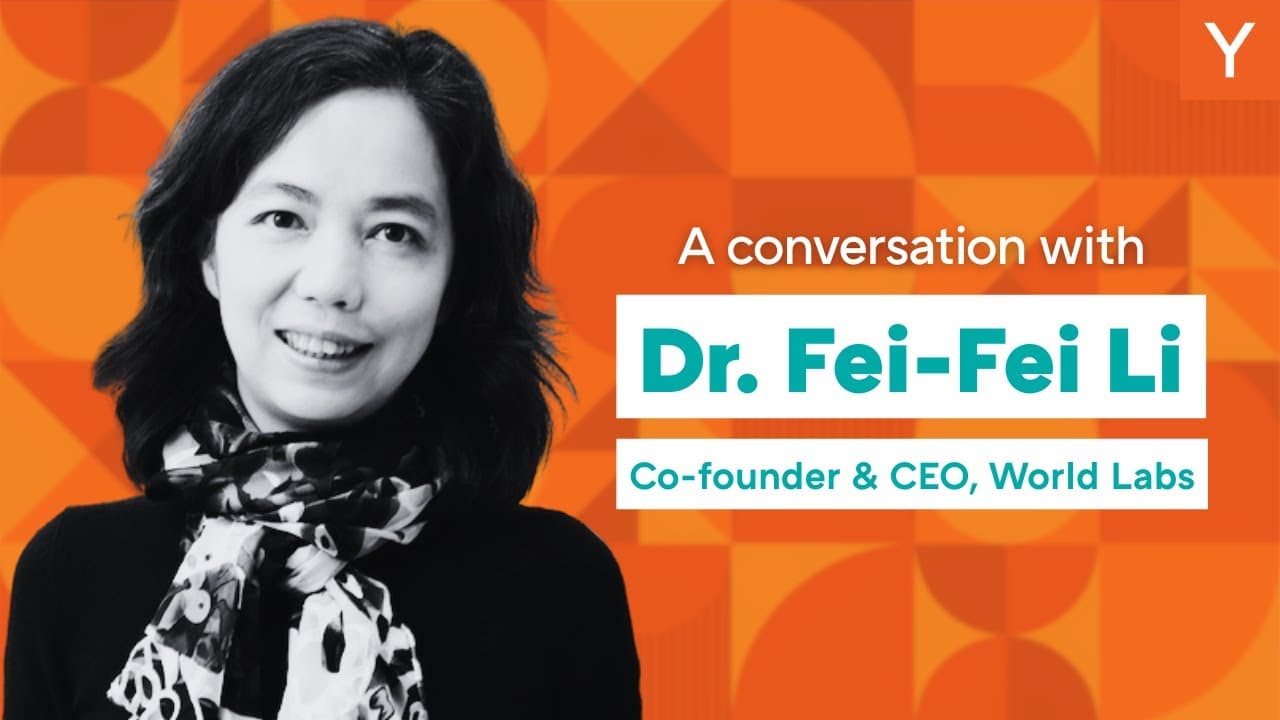
Fei-Fei Li: Spatial Intelligence is the Next Frontier in AI
TL;DR
Fei-Fei Li discusses AI's evolution and future in spatial intelligence.
Transcript
my entire career is going after problems that are just so hard bordering delusional to me AGI will not be complete without spatial intelligence and I want to solve that problem i just love being an entrepreneur forget about what you have done in the past forget about what others think of you just hunker down and build that is my comfort zone so I'm... Read More
Key Insights
- Fei-Fei Li's career has focused on solving complex AI problems, including spatial intelligence, which she believes is crucial for achieving AGI.
- ImageNet, created by Fei-Fei Li, was a pioneering project that provided the necessary data for modern computer vision and sparked the deep learning revolution.
- The breakthrough in AI came in 2012 with the success of convolutional neural networks, which exceeded expectations in computer vision tasks.
- The transition from object recognition to scene understanding in AI was marked by the development of image captioning, a significant milestone in visual intelligence.
- Fei-Fei Li emphasizes the importance of spatial intelligence in AI, which involves understanding and interacting with the 3D world, a task she considers harder than language processing.
- World Labs, founded by Fei-Fei Li, aims to tackle the challenge of spatial intelligence by creating world models that capture 3D structures and spatial intelligence.
- Fei-Fei Li's entrepreneurial journey includes founding a dry cleaning business at 19, which taught her valuable skills for her later ventures in AI.
- Mentoring has been a significant part of Fei-Fei Li's career, and she values intellectual fearlessness as a key trait for success in AI research and development.
Install to Summarize YouTube Videos and Get Transcripts
Explore YouTube Video Summarizer or Get YouTube Transcript Extractor
Questions & Answers
Q: What was the significance of ImageNet in AI development?
ImageNet, created by Fei-Fei Li, was a groundbreaking project that provided the necessary data for modern computer vision, sparking the deep learning revolution. It addressed the data scarcity problem in AI by compiling a vast dataset of images, allowing researchers to train and benchmark machine learning algorithms effectively.
Q: How did the success of convolutional neural networks impact AI?
The success of convolutional neural networks in 2012 marked a significant breakthrough in AI, particularly in computer vision. These networks exceeded expectations in image recognition tasks, demonstrating the power of deep learning and leading to advancements in image captioning and storytelling, thereby expanding the capabilities of AI.
Q: What is spatial intelligence, and why is it important for AI?
Spatial intelligence involves understanding and interacting with the 3D world, a crucial component for achieving AGI. Fei-Fei Li emphasizes its importance as it allows AI to comprehend and navigate the physical environment, a task she considers more challenging than language processing due to its complexity and the need for multi-sensory integration.
Q: What is World Labs' mission in the AI landscape?
World Labs, founded by Fei-Fei Li, aims to tackle the challenge of spatial intelligence by creating world models that capture 3D structures and spatial intelligence. The company focuses on developing foundational models where the output is 3D worlds, addressing both generative and discriminative aspects of AI to advance real-world applications.
Q: How did Fei-Fei Li's early entrepreneurial experience shape her career?
Fei-Fei Li's early entrepreneurial experience, running a dry cleaning business at 19, taught her valuable skills such as fundraising, management, and resilience. These skills have been instrumental in her later ventures, including her work in AI research and her role as a founder and CEO, where she continues to embrace challenges and innovate.
Q: What qualities does Fei-Fei Li value in her students and team members?
Fei-Fei Li values intellectual fearlessness in her students and team members. She looks for individuals who are unafraid to tackle hard problems, embrace challenges, and are driven by curiosity and a commitment to solving complex issues. This trait is crucial for success in the rapidly evolving field of AI.
Q: What challenges does Fei-Fei Li identify in developing spatial intelligence in AI?
Fei-Fei Li identifies several challenges in developing spatial intelligence in AI, including the complexity of understanding 3D structures, the need for multi-sensory integration, and the lack of readily available spatial data. These challenges make spatial intelligence a harder problem than language processing, requiring innovative approaches and high-quality data.
Q: How does Fei-Fei Li view the role of open source in AI development?
Fei-Fei Li views open source as a vital component of the AI ecosystem, fostering innovation and collaboration. She believes that open source efforts should be protected and encouraged, as they contribute to the entrepreneurial ecosystem and public sector, enabling broader access to AI technologies and accelerating advancements in the field.
Summary & Key Takeaways
-
Fei-Fei Li's career in AI has been marked by her focus on solving complex problems, including spatial intelligence, which she believes is essential for achieving AGI. Her pioneering work on ImageNet provided the data foundation for modern computer vision, sparking the deep learning revolution.
-
The breakthrough in AI came in 2012 with the success of convolutional neural networks, which exceeded expectations in computer vision tasks. This led to advancements in image captioning and storytelling, marking a significant transition from object recognition to scene understanding in AI.
-
Fei-Fei Li's current focus is on spatial intelligence, which involves understanding and interacting with the 3D world. She founded World Labs to tackle this challenge, aiming to create world models that capture 3D structures and spatial intelligence, a task she considers harder than language processing.
Read in Other Languages (beta)
Share This Summary 📚
Summarize YouTube Videos and Get Video Transcripts with 1-Click
Try YouTube Summary with ChatGPT & Claude or YouTube Transcript Generator
Explore More Summaries from Y Combinator 📚




Summarize YouTube Videos and Get Video Transcripts with 1-Click
Try YouTube Summary with ChatGPT & Claude or YouTube Transcript Generator