Why Does Time Seem to Speed Up as We Age?
TL;DR
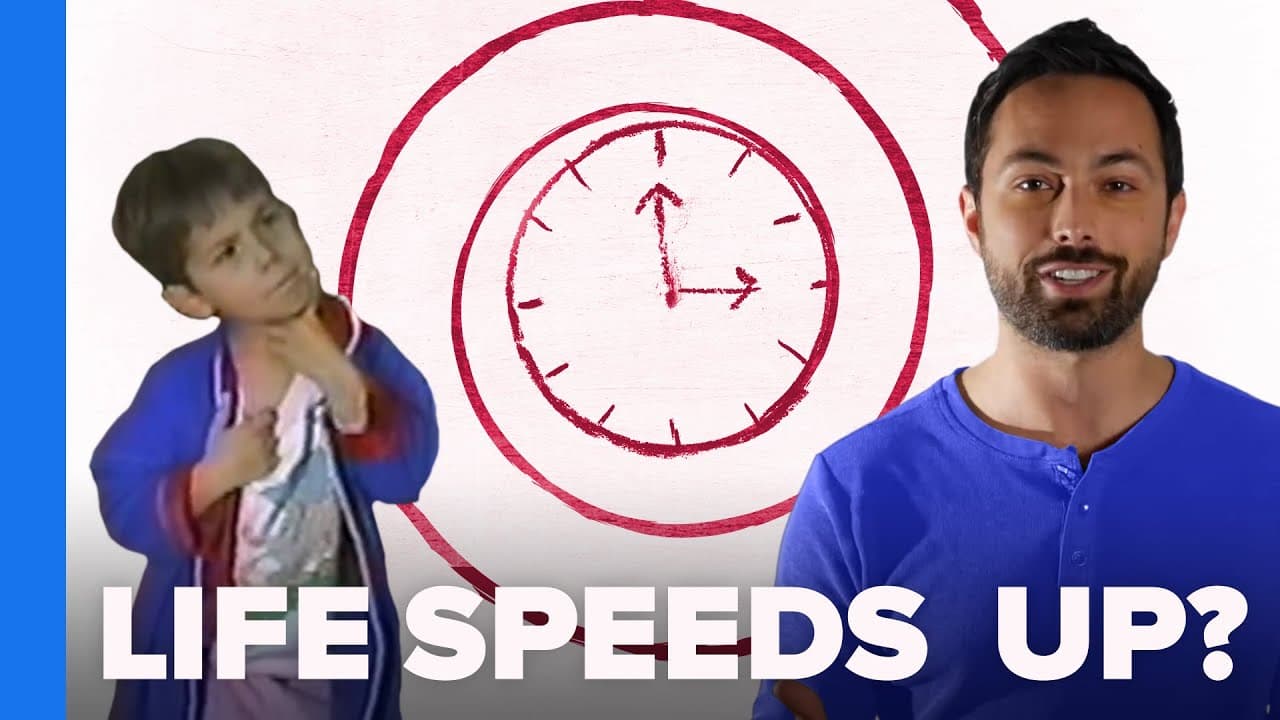
Time appears to speed up as we age because each year makes up a smaller fraction of our lives, and our internal clock slows due to decreased neuron firing rates. Engaging in novel experiences or feeling fear can make time feel longer, whereas repetitive activities and boredom can make it seem to drag on, highlighting the complex nature of our perception of time.
Transcript
I remember when I was a kid waiting an hour for my favorite TV show to come on, which was Sharon, Lois & Bram. That felt like eternity, but as I've gotten older, everything seems to have sped up. Time is going much faster. That's something virtually everyone agrees upon. "Yeah, I feel like- I feel like it does." "Oh man, so much." "Each year sort o... Read More
Key Insights
- 🤪 Each year represents a smaller fraction of our lives as we age, contributing to our perception of time going faster.
- ⏲️ Our brain's firing rate and energy usage decrease as we age, affecting our internal clock and making external time seem to speed up.
- 🐢 Focusing on activities and experiencing novelty can make time feel slower, while boredom can make it feel longer.
- 😨 Fear and intense experiences can distort our perception of time, making it feel longer than it actually is.
- 🧠 Our sense of time is not localized in one part of the brain, suggesting that it is a fundamental function of the brain.
- 👋 Good movies and engaging activities can make time seem to fly by because we are fully engrossed in the moment.
- 💄 Holidays and memorable experiences can feel like they go by quickly in the moment but create more memories, making them feel longer when remembered.
Install to Summarize YouTube Videos and Get Transcripts
Explore YouTube Video Summarizer or Get YouTube Transcript Extractor
Questions & Answers
Q: Why does time seem to go faster as we get older?
One reason is that each year represents a smaller fraction of our overall lives, but changes in our brain's firing rate and energy usage also play a role.
Q: How does our perception of time differ as we age?
Older individuals tend to overestimate the passage of time, while younger individuals are more accurate in estimating time intervals.
Q: Can the sense of time be localized to a specific part of the brain?
No, our sense of time, or chronoception, does not seem to be localized in one specific part of the brain and is not like the standard five senses.
Q: Can repetition affect our perception of time?
Yes, novel experiences require more brain energy to process, so they feel longer. Repetition can make time seem faster because our brains do not invest as much energy in processing familiar stimuli.
Summary & Key Takeaways
-
Time seems to go faster as we get older because each year represents a smaller fraction of our entire lives.
-
Our neurons fire at a slower rate as we age, which affects our internal clock and makes external time appear to speed up.
-
Focusing on activities, experiencing novelty, and being scared can make time feel slower, while boredom can make it feel longer.
Read in Other Languages (beta)
Share This Summary 📚
Summarize YouTube Videos and Get Video Transcripts with 1-Click
Try YouTube Summary with ChatGPT & Claude or YouTube Transcript Generator
Explore More Summaries from Veritasium 📚


Summarize YouTube Videos and Get Video Transcripts with 1-Click
Try YouTube Summary with ChatGPT & Claude or YouTube Transcript Generator