The Absurdity of Detecting Gravitational Waves
TL;DR
Gravitational waves, detected for the first time in human history, required extraordinary engineering to measure tiny wiggles in space-time caused by black hole collisions.
Transcript
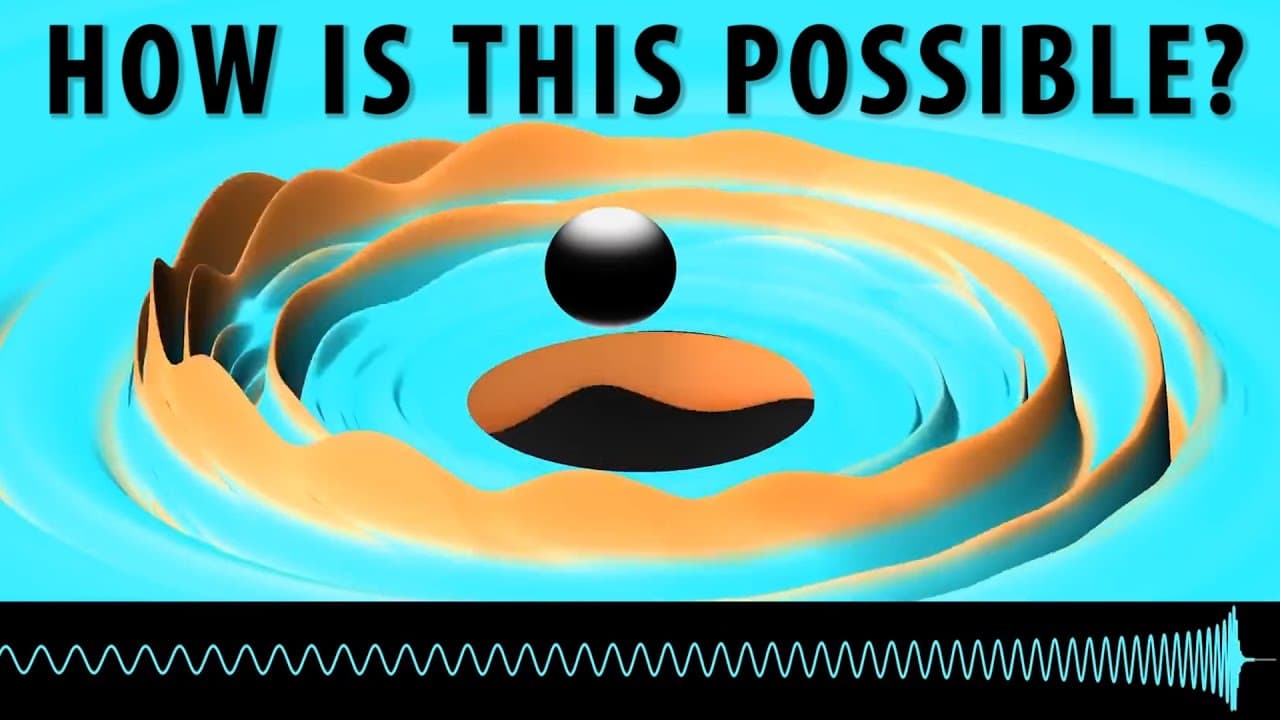
1.3 billion years ago in a galaxy far, far away two black holes merged As they violently spiraled into each other They created traveling distortions in the fabric of space-time gravitational waves in the last tenth of a second the energy released in these waves was 50 times greater then the energy being released by everything else in the observable... Read More
Key Insights
- 🫤 Gravitational waves were detected by measuring tiny distortions in space-time caused by a black hole collision 1.3 billion years ago.
- 👋 The detection of gravitational waves required unprecedented engineering precision to detect minute changes in the interferometer arms.
- 🪩 Stable lasers with a constant wavelength and ultra-smooth mirrors were essential for reliable measurements.
- 💯 The detection process involves creating a vacuum chamber, eliminating noise sources, and pumping out enough air to create an almost perfect vacuum.
- 🙂 Gravitational waves stretch light as well, adding another complexity to the detection process.
- 🦾 Quantum mechanics imposes limits on the sensitivity of detectors, requiring engineers to minimize uncertainty by focusing on measuring only one aspect.
Install to Summarize YouTube Videos and Get Transcripts
Explore YouTube Video Summarizer or Get YouTube Transcript Extractor
Questions & Answers
Q: How do gravitational waves stretch and squeeze space-time?
Gravitational waves are created by the violent merging of massive objects, causing distortions in space-time that propagate as waves with energy greater than anything else in the observable universe.
Q: Why is it difficult to detect gravitational waves?
Gravitational waves are extremely tiny, stretching and squeezing space by just one part in 10 to the 21, requiring measurements on a very large scale. Additionally, environmental noise and vibrations pose challenges to detecting these subtle signals.
Q: How is the interference of light waves used in detecting gravitational waves?
Interferometers use the interference of light waves to measure tiny changes in the length of the arms caused by gravitational waves. These changes can be observed by analyzing the interference pattern of the light beams.
Q: What role does quantum mechanics play in limiting the sensitivity of gravitational wave detectors?
Quantum mechanics introduces uncertainty, and the Heisenberg uncertainty principle affects the precision of measurement. However, engineers have designed systems that minimize uncertainty by focusing on measuring only one aspect, the stretching of the interferometer arms.
Summary & Key Takeaways
-
1.3 billion years ago, two black holes merged, generating gravitational waves that travelled through space and were detected on Earth.
-
Detecting gravitational waves is challenging due to their tiny magnitude, requiring measurements on a scale equivalent to the width of a human hair.
-
The detection process involves using long interferometer arms, ultra-smooth mirrors, stable lasers, vacuum chambers, and minimizing noise from the environment.
Read in Other Languages (beta)
Share This Summary 📚
Summarize YouTube Videos and Get Video Transcripts with 1-Click
Try YouTube Summary with ChatGPT & Claude or YouTube Transcript Generator
Explore More Summaries from Veritasium 📚




Summarize YouTube Videos and Get Video Transcripts with 1-Click
Try YouTube Summary with ChatGPT & Claude or YouTube Transcript Generator