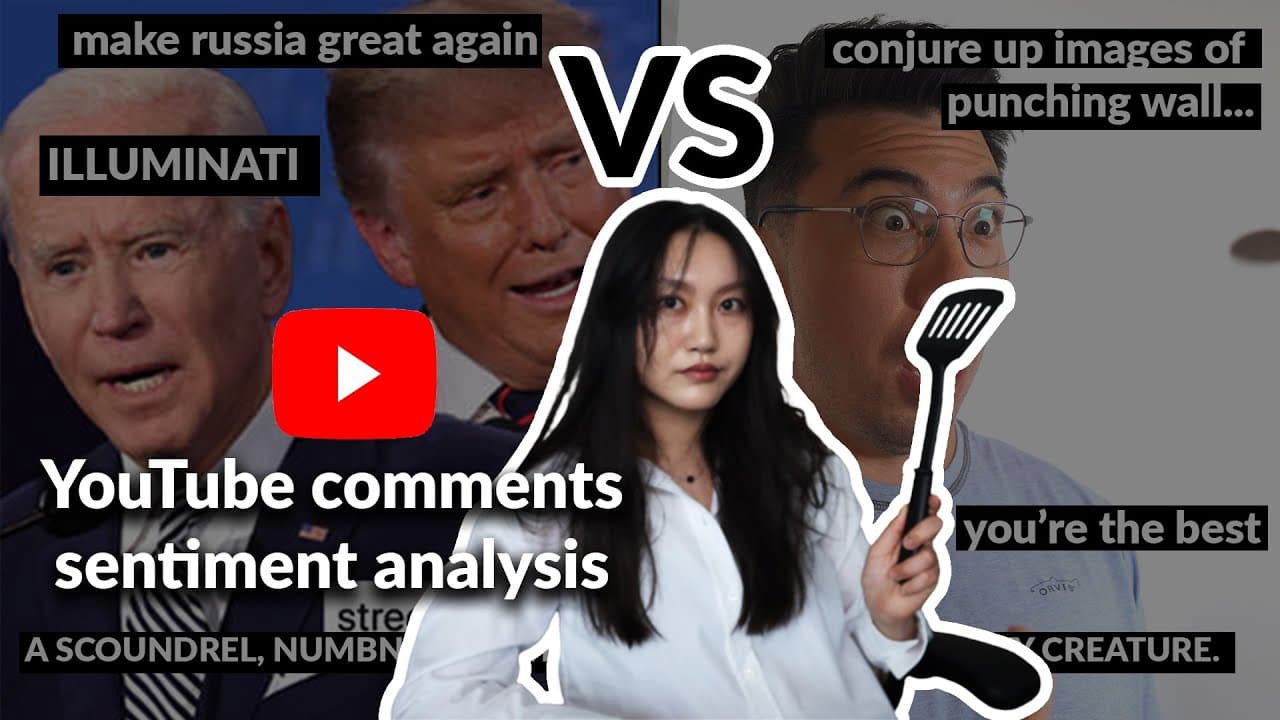
The comments sections are WILD | YouTube sentiment analysis - Data science project for beginners
TL;DR
Analyzing YouTube comments using sentiment analysis tools.
Transcript
the coursera course spend 15 bloody minutes trying to find the cost of certification he sits he sits in his golf course and i mean literally think about it you probably play more than i do jim america sent a fool on an errand and he has cut her legs off and displayed the stops so this is how it all started for those of you that reach out to me aski... Read More
Key Insights
- The video demonstrates how to perform sentiment analysis on YouTube comments using tools like TextBlob and Vader, highlighting their strengths and weaknesses.
- Sentiment analysis can be challenging due to its inability to accurately determine the context and direction of sentiments in individual comments.
- The creator emphasizes the importance of cleaning data, especially with unstructured and error-prone YouTube comments, to improve analysis results.
- The project explores both positive and negative comments, revealing that content creators often receive more positive feedback, which can skew sentiment analysis results.
- Using scatter text and NLP models, the project identifies key words associated with a YouTube channel, though results can vary based on the model and data used.
- The analysis extends to polarizing topics like the US presidential debates, demonstrating how sentiment analysis can be applied to broader, more contentious issues.
- K-means clustering was attempted to categorize comments, but challenges in data preprocessing affected the clarity and usefulness of the clusters.
- The project is designed to be beginner-friendly, with code and instructions provided for others to replicate and expand upon the analysis.
Install to Summarize YouTube Videos and Get Transcripts
Explore YouTube Video Summarizer or Get YouTube Transcript Extractor
Questions & Answers
Q: What tools were used for sentiment analysis in the video?
The video utilized TextBlob and Vader for sentiment analysis. TextBlob is known for its simplicity and ease of use, while Vader is optimized for social media text. Both tools were compared to highlight their strengths and weaknesses in analyzing YouTube comments.
Q: What challenges are associated with sentiment analysis according to the video?
One major challenge is the difficulty in accurately determining the context and direction of sentiments in individual comments. Sentiment analysis tools often misclassify comments due to negative words, even if the overall sentiment is not negative. Data cleaning is also crucial due to unstructured and error-prone comments.
Q: How does the video suggest improving sentiment analysis?
The video suggests improving sentiment analysis by enhancing data cleaning processes to handle unstructured comments better. It also recommends exploring thematic analysis rather than focusing solely on individual words, which might provide more contextually accurate sentiment insights.
Q: What were the results of the k-means clustering attempt?
The k-means clustering attempt aimed to categorize comments into clusters. However, due to data preprocessing challenges, the clusters were not clearly defined. The analysis revealed mixed results, with one cluster showing more negativity and the other having a mix of sentiments.
Q: How does the video apply sentiment analysis to broader topics?
The video extends sentiment analysis to broader topics by examining comments related to the US presidential debates. This application demonstrates how sentiment analysis can be used to assess polarizing issues, although it also highlights the limitations in accurately capturing the nuances of such discussions.
Q: What is the video creator's perspective on viewer feedback?
The creator encourages viewer feedback and suggestions for improving the analysis. They express interest in seeing how others might expand upon the project and implement suggested improvements, indicating a collaborative approach to learning and refining data science techniques.
Q: What is the purpose of the project shared in the video?
The project's purpose is to introduce beginners to data science by providing a practical example of sentiment analysis using YouTube comments. It aims to be accessible, offering code and guidance for viewers to replicate and build upon the analysis, fostering learning and experimentation.
Q: What future improvements does the video suggest for sentiment analysis?
Future improvements suggested include using thematic analysis to capture sentiment more accurately and refining data cleaning processes to handle unstructured comments better. The creator also mentions exploring additional NLP techniques to enhance the robustness and accuracy of sentiment analysis.
Summary & Key Takeaways
-
The video explores how to perform sentiment analysis on YouTube comments using TextBlob and Vader, highlighting the strengths and weaknesses of these tools. It discusses the challenges of accurately determining sentiment direction and context in individual comments.
-
The analysis includes both positive and negative comments, revealing that creators often receive more positive feedback, which can skew sentiment analysis results. The project also examines polarizing topics like the US presidential debates to demonstrate broader applications.
-
K-means clustering was attempted to categorize comments, but data preprocessing challenges affected the clarity of the clusters. The project is beginner-friendly, with code and instructions provided for replication and expansion. Viewer feedback and suggestions for improvement are encouraged.
Read in Other Languages (beta)
Share This Summary 📚
Summarize YouTube Videos and Get Video Transcripts with 1-Click
Try YouTube Summary with ChatGPT & Claude or YouTube Transcript Generator
Explore More Summaries from Tina Huang 📚





Summarize YouTube Videos and Get Video Transcripts with 1-Click
Try YouTube Summary with ChatGPT & Claude or YouTube Transcript Generator