What Did Euclid's Fifth Postulate Reveal About Geometry?
TL;DR
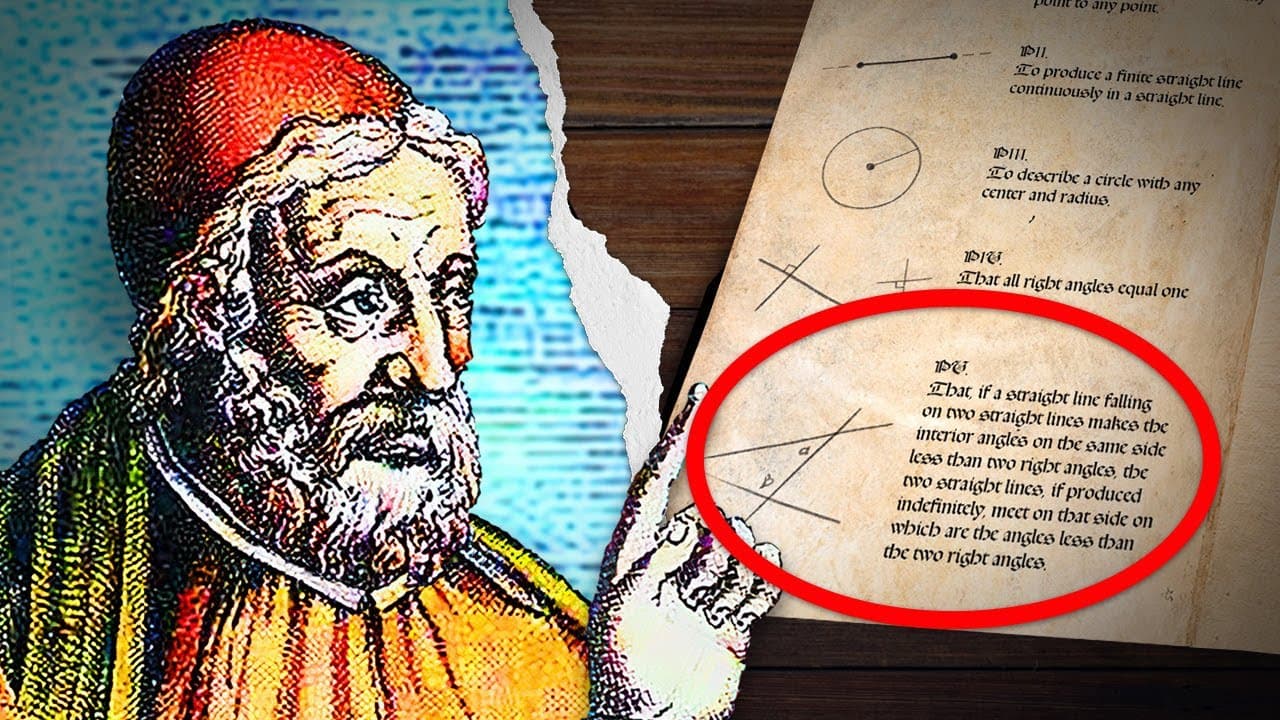
Euclid's fifth postulate, known as the Parallel postulate, challenged mathematicians for over 2,000 years and ultimately led to the development of non-Euclidean geometries like spherical and hyperbolic geometries. This discovery changed our understanding of space and laid the groundwork for Einstein's general theory of relativity, demonstrating the importance of geometry in explaining the universe.
Transcript
(dramatic music) - [Derek] A single sentence in one of the oldest math books held the key to understanding our universe. Euclid's "Elements" has been published in more editions than any other book except the Bible. It was the go to math text for over 2,000 years. But for all that time, mathematicians were skeptical of a single line which seemed lik... Read More
Key Insights
- 🫤 Euclid's Elements, published over 2,000 years ago, provided a rigorous foundation for mathematical proof and was a comprehensive summary of known mathematics at the time.
- 🥺 Euclid's fifth postulate, the Parallel postulate, sparked skepticism among mathematicians and led to the discovery of non-Euclidean geometries such as spherical and hyperbolic geometries.
- 🫥 János Bolyai played a crucial role in the development of hyperbolic geometry, imagining a world where multiple parallel lines could pass through a point on a curved surface.
Install to Summarize YouTube Videos and Get Transcripts
Explore YouTube Video Summarizer or Get YouTube Transcript Extractor
Questions & Answers
Q: What was Euclid's approach to summarizing all known mathematics at the time?
Euclid accepted a few simple, basic statements as postulates, from which he built logical proofs to derive all other theorems. This approach, using definitions, common notions, and postulates, became the foundation of modern mathematics.
Q: Why were mathematicians skeptical about Euclid's fifth postulate?
The fifth postulate seemed more complex and wordy compared to the previous four postulates. It dealt with the concept of parallel lines, which mathematicians struggled to prove or disprove based on the other postulates.
Q: How did János Bolyai contribute to the understanding of non-Euclidean geometries?
Bolyai, inspired by Euclid's fifth postulate, imagined a world where multiple parallel lines could pass through a point. His work led to the discovery of hyperbolic geometry, where straight lines on a curved surface appear bent.
Q: How did non-Euclidean geometries affect Einstein's general theory of relativity?
Non-Euclidean geometries, specifically the concept of curved spacetime, became essential to Einstein's theory. The behavior of straight lines in curved geometries helped explain gravity as the curvature of spacetime caused by massive objects.
Key Insights:
- Euclid's Elements, published over 2,000 years ago, provided a rigorous foundation for mathematical proof and was a comprehensive summary of known mathematics at the time.
- Euclid's fifth postulate, the Parallel postulate, sparked skepticism among mathematicians and led to the discovery of non-Euclidean geometries such as spherical and hyperbolic geometries.
- János Bolyai played a crucial role in the development of hyperbolic geometry, imagining a world where multiple parallel lines could pass through a point on a curved surface.
- Non-Euclidean geometries, particularly curved spacetime, became fundamental to Einstein's general theory of relativity, explaining gravity as the curvature of spacetime by massive objects.
Summary & Key Takeaways
-
Euclid's Elements, published around 300 BC, summarized all known mathematics at the time and provided a rigorous mathematical proof that was the gold standard for centuries.
-
Euclid's fifth postulate, known as the Parallel postulate, seemed strange and sparked skepticism among mathematicians.
-
Mathematicians, including János Bolyai, tried to prove or disprove the fifth postulate and discovered spherical and hyperbolic geometries.
-
The discovery of curved geometries played a crucial role in the development of Einstein's general theory of relativity.
Read in Other Languages (beta)
Share This Summary 📚
Summarize YouTube Videos and Get Video Transcripts with 1-Click
Try YouTube Summary with ChatGPT & Claude or YouTube Transcript Generator
Explore More Summaries from Veritasium 📚




Summarize YouTube Videos and Get Video Transcripts with 1-Click
Try YouTube Summary with ChatGPT & Claude or YouTube Transcript Generator