Inside The Navy's Indoor Ocean
TL;DR
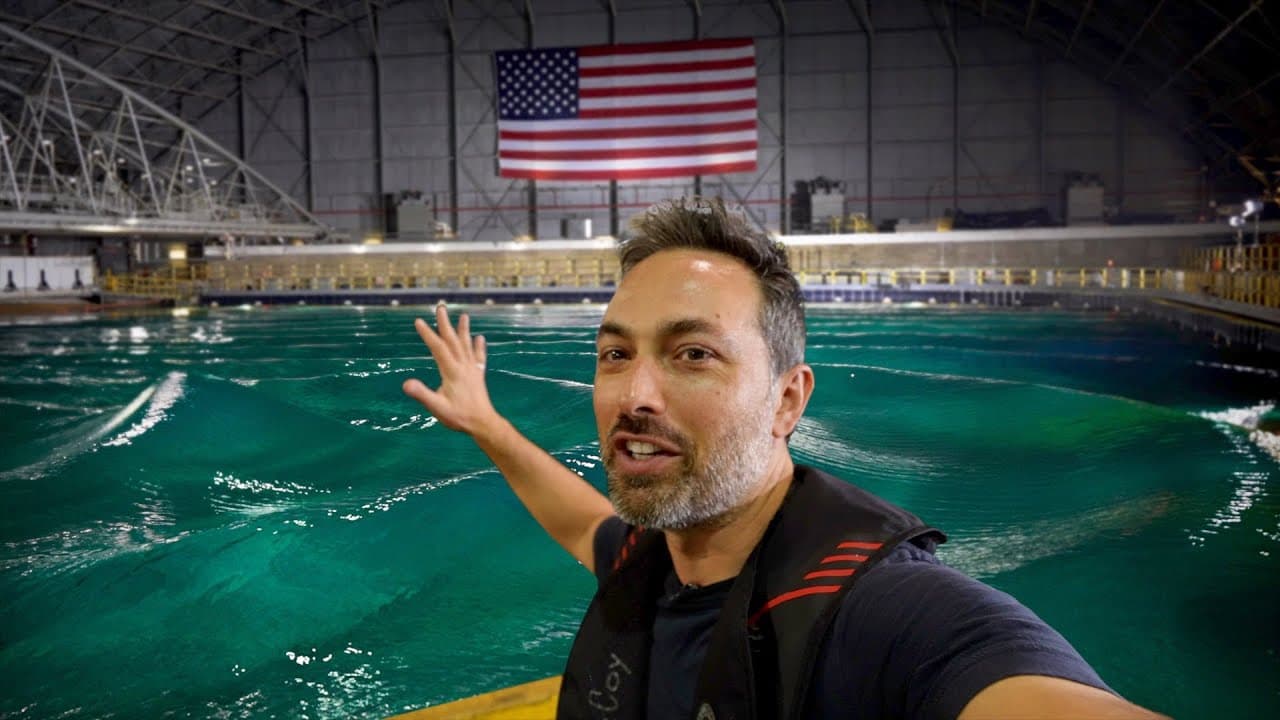
The Navy's Indoor Ocean at Carderock is a massive wave pool used for testing scale ships in various wave conditions, replicating real-world ocean conditions.
Transcript
I'm here at the Navy's Indoor Ocean at Carderock. This is the biggest wave pool in the world and they can make all kinds of different waves so they can test scale ships and make them better before they actually go out on the open ocean. I came in and I'd seen some pictures, but I just walked in here and it's just, it's insane. 'Cause they say indoo... Read More
Key Insights
- 👋 The Navy's Indoor Ocean at Carderock allows precise control over wave characteristics, enabling the testing of ships under various wave conditions.
- 🌊 Different oceans have different wave spectra, which engineers can replicate in the wave pool to simulate specific locations around the world.
- 🚤 Scale models of Navy ships are tested in the pool, considering factors such as above-water signatures, speed, and buoyancy to improve ship designs.
- 👋 The pool is also used to measure wave height, period, and direction using ultrasonic sensors for accurate testing results.
- 🌊 Wind speed, duration, fetch, fetch width, and water depth are crucial factors that affect wave size and shape in the real world.
- 👋 The pool's wave demonstrations illustrate phenomena such as the principle of superposition and standing waves.
- 🤗 The pool is not open for swimming due to safety reasons and the focus on scientific testing.
Install to Summarize YouTube Videos and Get Transcripts
Explore YouTube Video Summarizer or Get YouTube Transcript Extractor
Questions & Answers
Q: How do the wave makers in the Indoor Ocean at Carderock create waves?
The pool has 216 wave makers that use air bellows and force transducers to create waves of various shapes and sizes. They are programmed to move in choreographed ways to produce perfect-sized waves.
Q: What is the purpose of testing ships in the wave pool?
The wave pool allows engineers to test different ship designs and observe how they behave in real-world wave conditions before they are deployed on the open ocean.
Q: How do different wave frequencies affect wave amplitude and speed?
Waves with higher frequencies appear to have greater amplitude due to steeper slopes. Additionally, high-frequency waves travel slower than low-frequency waves, and wave speed is inversely proportional to frequency.
Q: What is the significance of the principle of superposition in wave testing?
The principle of superposition states that when waves meet, they add together. This allows engineers to create larger waves by adding multiple smaller waves together. It is essential for understanding wave behavior and designing ships that can withstand wave forces.
Summary & Key Takeaways
-
The Navy's Indoor Ocean at Carderock is a 360 feet long, 240 feet wide, and 20 feet deep wave pool used to test scale ships before deployment.
-
The pool has 216 wave makers that can create waves of different shapes and sizes, with precise control over amplitude and frequency.
-
Different wave characteristics, such as wavelength, frequency, and speed, are observed and tested using ultrasonic sensors and wave demonstrations.
Read in Other Languages (beta)
Share This Summary 📚
Summarize YouTube Videos and Get Video Transcripts with 1-Click
Try YouTube Summary with ChatGPT & Claude or YouTube Transcript Generator
Explore More Summaries from Veritasium 📚


Summarize YouTube Videos and Get Video Transcripts with 1-Click
Try YouTube Summary with ChatGPT & Claude or YouTube Transcript Generator