What Are AI Agents and How Do They Work?
TL;DR
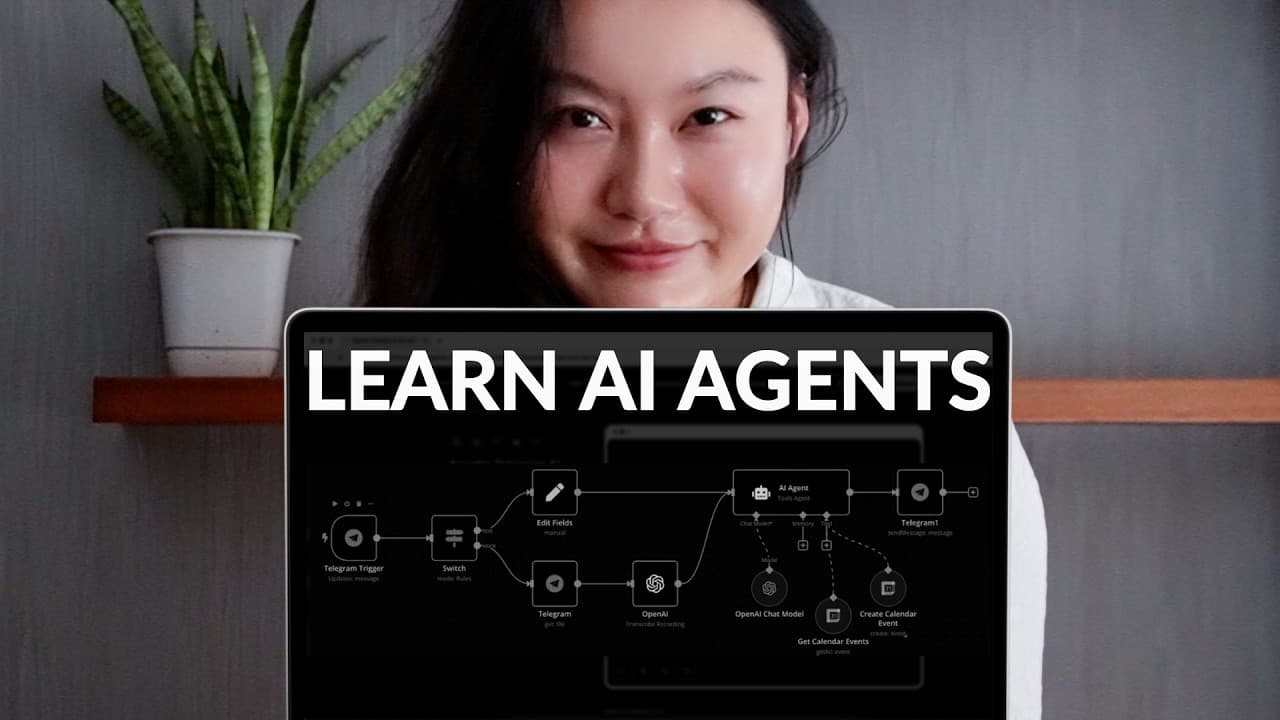
AI agents are autonomous entities that perform tasks using agentic workflows. These workflows involve iterative processes, tool usage, planning, and reasoning to achieve goals. Multi-agent systems enhance functionality by dividing tasks among specialized agents. Understanding these systems can revolutionize fields like data analysis, cybersecurity, and personal assistance.
Transcript
I learned about AI agents for you so here's the cliffnotes version to save you weeks of me learning about this there's not actually one course that just fully nicely covers everything so I did three courses wrote a bunch of papers and watch a lot of YouTube videos as well and of course actually made my own agents too my notes themse... Read More
Key Insights
- AI agents are autonomous entities designed to perform tasks using iterative agentic workflows.
- Non-agentic workflows are linear, while agentic workflows involve iterative processes including planning and revising.
- Autonomous AI agents can independently determine steps and tools needed to complete tasks, though full autonomy is still developing.
- Agentic design patterns include reflection, tool use, planning, and multi-agent systems.
- Multi-agent systems involve multiple AI agents working together, each with specialized roles, similar to human teams.
- Hierarchical, sequential, hybrid, parallel, and asynchronous are common multi-agent system design patterns.
- AI agents can be built using no-code tools like n8n, enabling non-coders to create complex workflows.
- The future of AI agents includes transforming software services into AI-driven solutions, offering significant business opportunities.
Install to Summarize YouTube Videos and Get Transcripts
Explore YouTube Video Summarizer or Get YouTube Transcript Extractor
Questions & Answers
Q: What is an AI agent?
An AI agent is an autonomous entity that performs tasks using an agentic workflow. These workflows are iterative, involving planning, reasoning, and tool usage to achieve specific goals. AI agents can range from simple task automators to complex multi-agent systems that collaborate to solve intricate problems.
Q: How do agentic workflows differ from non-agentic workflows?
Agentic workflows involve iterative processes where tasks are broken down into smaller steps, allowing for planning, tool usage, and continuous revision. This contrasts with non-agentic workflows, which are linear and execute tasks from start to finish without iteration or refinement, often resulting in less optimal outcomes.
Q: What are the key components of a single AI agent?
A single AI agent comprises four components: a specific task it is designed to accomplish, the answer or output it must provide, the AI model it uses to process information, and the tools it has access to for executing tasks. These components work together to enable the agent to function autonomously.
Q: What are multi-agent systems?
Multi-agent systems involve multiple AI agents working together, each with specialized roles, to complete a task. These systems mimic human teamwork, where different agents handle specific parts of a task, improving efficiency and effectiveness. They can be configured in various patterns, such as hierarchical or parallel, to suit different applications.
Q: How can AI agents be created without coding?
AI agents can be created using no-code tools like n8n, which allow users to design workflows and integrate various AI functionalities without programming knowledge. These tools enable the creation of complex multi-agent systems by providing a user-friendly interface to configure tasks, tools, and interactions between agents.
Q: What opportunities exist for AI agents in business?
AI agents offer significant opportunities to transform existing software services into AI-driven solutions. For every software-as-a-service (SaaS) company, there is potential for a corresponding AI agent company. This transformation can lead to innovative business models and services, leveraging AI agents' capabilities to automate and enhance processes.
Q: What are some examples of agentic design patterns?
Agentic design patterns include reflection, where an AI reviews and improves its output; tool use, where AI utilizes external tools to perform tasks; planning and reasoning, where AI determines steps and tools needed for tasks; and multi-agent systems, where multiple AI agents collaborate to achieve complex objectives.
Q: Why are multi-agent systems advantageous?
Multi-agent systems are advantageous because they allow for task specialization, where different agents handle specific parts of a task, leading to more efficient and effective outcomes. This division of labor mirrors human teamwork, enabling AI systems to tackle complex problems by leveraging the strengths of specialized agents.
Summary & Key Takeaways
-
AI agents operate using agentic workflows that involve iterative processes, planning, and tool usage to achieve specific tasks. These workflows enhance the efficiency and effectiveness of AI systems. Multi-agent systems, where specialized agents collaborate, are key to advancing AI capabilities.
-
The video explores various agentic design patterns such as reflection, tool use, and multi-agent systems, emphasizing their role in improving AI outcomes. Multi-agent systems allow for task specialization, mirroring human teamwork for better results.
-
Opportunities in AI agent development are vast, with potential to transform existing software services into AI-driven solutions. No-code tools like n8n facilitate the creation of AI agents, enabling broader participation in AI innovation and business development.
Read in Other Languages (beta)
Share This Summary 📚
Summarize YouTube Videos and Get Video Transcripts with 1-Click
Try YouTube Summary with ChatGPT & Claude or YouTube Transcript Generator
Explore More Summaries from Tina Huang 📚





Summarize YouTube Videos and Get Video Transcripts with 1-Click
Try YouTube Summary with ChatGPT & Claude or YouTube Transcript Generator