Does a Falling Slinky Defy Gravity?
TL;DR
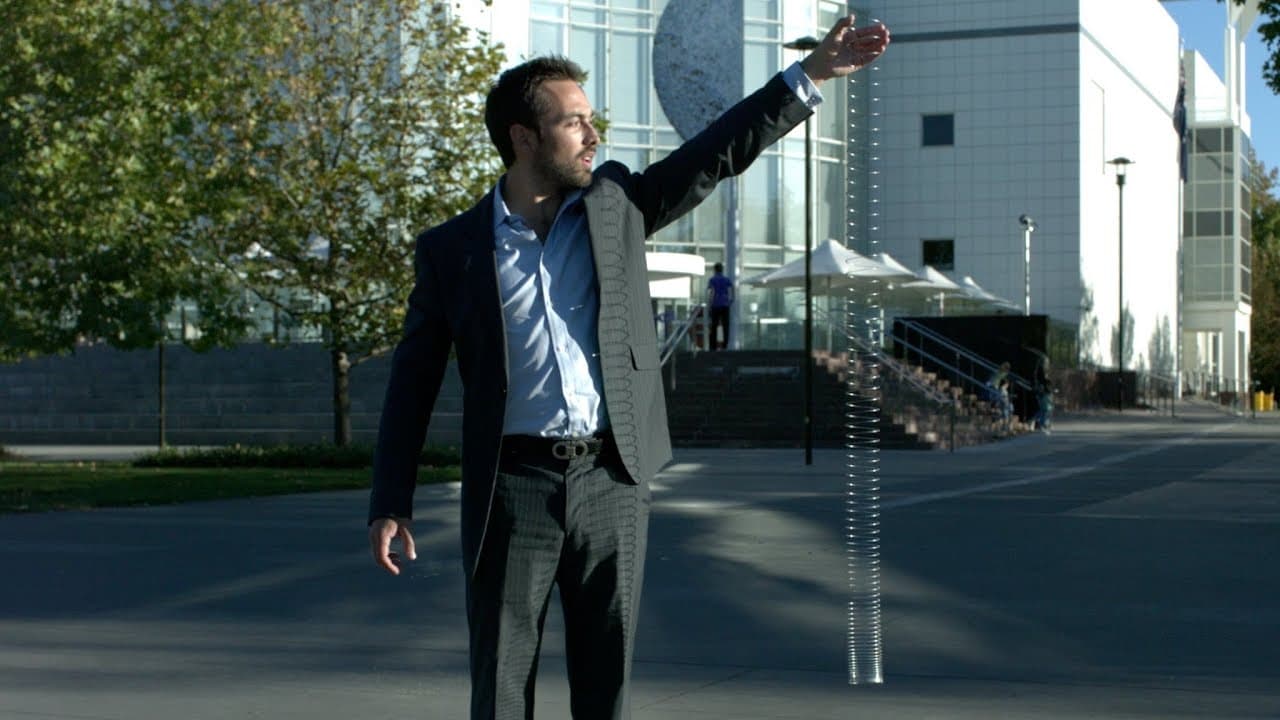
The video shows a modeling of the collapse of a slinky, with a gradual collapse of the turns rather than instant collapse, providing a more realistic representation.
Transcript
the so this is the modeling that I've been doing and and so this this was done with the purpose of trying to explain the the the data that was extracted from one of the movies of real falling linky what you see in this one is that the turns at the top are are snapping together um behind a front that propagates down so the blue section at the top is... Read More
Key Insights
- ↩️ The collapse of a slinky occurs gradually, with the turns snapping together behind a propagating front.
- 💁 The time for information about a change to reach the bottom of the slinky is finite.
- 💆 Changing the spring constant or increasing the slinky's mass can alter the collapse time.
- 🍂 The bottom of the slinky does not fall immediately due to tension release when all turns come down.
- 📳 Holding the slinky collapsed at the top and releasing the bottom causes oscillations in a basic mode, known as the breathing mode.
- 🏆 The period of oscillation in the breathing mode can be used as a test for the slinky's parameters.
- ❓ The collapse model provides a more realistic representation of the slinky's behavior compared to instant collapse.
Install to Summarize YouTube Videos and Get Transcripts
Explore YouTube Video Summarizer or Get YouTube Transcript Extractor
Questions & Answers
Q: How does the slinky collapse model improve upon real-life observations?
The model improves by assuming a fixed number of turns over which the collapse occurs gradually, rather than instantly collapsing. This gradual collapse is more true to the behavior observed in movies of real falling slinkies.
Q: What is meant by "information" in the context of the slinky collapse?
In physics, "information" refers to the signal or cause-effect relationship between physical actions. When something changes at the top of the slinky, there is a finite time for that information to propagate to the bottom.
Q: How long does it take for the compression wave to propagate from the top to the bottom of the slinky?
The collapse time, or the time for the compression wave to reach the bottom, is approximately a third of a second.
Q: Is there a way to extend the collapse time of the slinky?
Yes, the collapse time can be extended by decreasing the spring constant, making the slinky softer. This slows down the wave propagation. Additionally, increasing the mass of the slinky adds more inertia to the collapse process.
Summary & Key Takeaways
-
The slinky collapse model demonstrates the turns at the top snapping together behind a front that propagates down.
-
The collapse occurs gradually, with the colored blue section representing the collapsed part of the slinky.
-
The bottom of the slinky does not fall immediately due to the finite time required for information about the change to propagate from the top to the bottom.
Read in Other Languages (beta)
Share This Summary 📚
Summarize YouTube Videos and Get Video Transcripts with 1-Click
Try YouTube Summary with ChatGPT & Claude or YouTube Transcript Generator
Explore More Summaries from Veritasium 📚






Summarize YouTube Videos and Get Video Transcripts with 1-Click
Try YouTube Summary with ChatGPT & Claude or YouTube Transcript Generator