Mars Helicopter (before it went to Mars)
TL;DR
The Mars helicopter is set to make the first powered flight on another planet, overcoming the challenges of Mars' thin atmosphere and low gravity.
Transcript
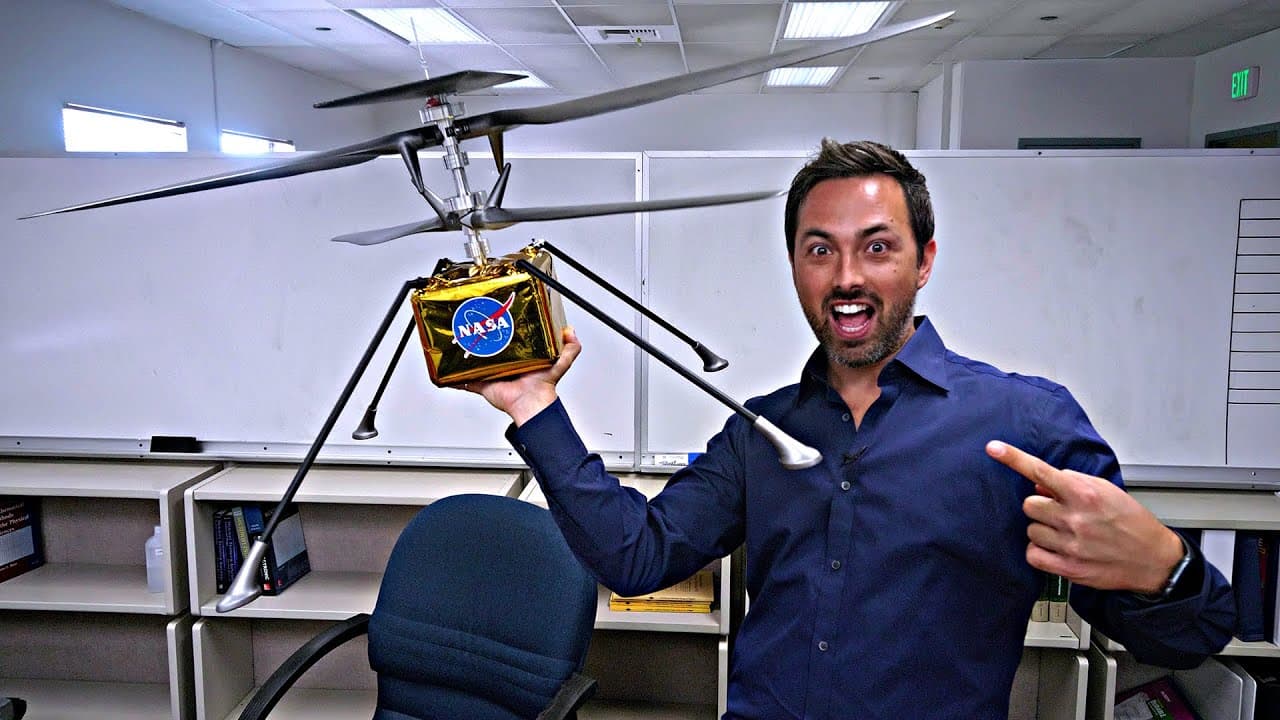
I'm at the Jet Propulsion Laboratory in Pasadena, and I'm here to see the first drone that's gonna fly on another planet. It's the Mars helicopter. Come on! - So this is our baby. - No way! - Yeah. - That thing right there is the actual machine that is going to take off and land on Mars. It's going with the Mars 2020 mission. That is the Mars helic... Read More
Key Insights
- 💨 The Mars helicopter will attempt the first powered flight on another planet, showcasing human engineering capabilities and paving the way for future exploration.
- 😘 Overcoming the challenges of Mars' thin atmosphere and low gravity requires innovative design solutions, such as lightweight materials and high RPM blade rotation.
- 👻 The helicopter's compact size and efficient propeller design allow it to fit on the rover and generate enough lift to fly.
- ⌛ Autonomous flight is essential due to the time delay between Mars and Earth, requiring onboard sensors and control algorithms for real-time adjustments.
Install to Summarize YouTube Videos and Get Transcripts
Explore YouTube Video Summarizer or Get YouTube Transcript Extractor
Questions & Answers
Q: How is flying the Mars helicopter different from flying a helicopter on Earth?
Flying the Mars helicopter requires spinning the blades at a much higher RPM due to Mars' thin atmosphere. The helicopter also needs to be lightweight and compact to fit on the rover and generate efficient lift.
Q: How is the Mars helicopter controlled and maneuvered?
The helicopter uses a collective and cyclic control system. Collective control changes the pitch of the blades uniformly, providing height control, while cyclic control modulates the pitch as it goes around, generating an asymmetric torque that allows for stability and direction changes.
Q: How does the Mars helicopter handle the challenges of Mars' environment, such as dust storms and low temperatures?
While dust storms are less aggressive on Mars due to the low density of the atmosphere, the helicopter needs to spin its blades at a high RPM to lift itself. To handle low temperatures, the helicopter has insulation using CO2 gas as an insulator, which keeps the batteries and electronic boards warm.
Q: What is the purpose of the Mars helicopter mission?
The primary purpose of the Mars helicopter is a technology demonstration to prove that flying on another planet is possible. The data and engineering lessons from this mission will inform the design of future aircraft for exploration and scientific purposes.
Summary & Key Takeaways
-
The Mars helicopter is a groundbreaking project that will attempt the first powered flight on another planet as part of the Mars 2020 mission.
-
The helicopter faces unique challenges on Mars, such as the extremely thin atmosphere, which requires spinning the blades at a much higher RPM than helicopters on Earth.
-
The lightweight design, weighing less than 1.8 kilograms, and the use of counter-rotating propellers make it possible for the helicopter to fit on the rover and generate efficient lift.
Read in Other Languages (beta)
Share This Summary 📚
Summarize YouTube Videos and Get Video Transcripts with 1-Click
Try YouTube Summary with ChatGPT & Claude or YouTube Transcript Generator
Explore More Summaries from Veritasium 📚




Summarize YouTube Videos and Get Video Transcripts with 1-Click
Try YouTube Summary with ChatGPT & Claude or YouTube Transcript Generator