Misconceptions About the Universe
TL;DR
The universe has always been expanding faster than the speed of light, and we can see objects beyond our Hubble sphere due to the accelerating expansion of space.
Transcript
there was a time when the universe was expanding so rapidly the parts of it were moving apart from each other faster than the speed of light that time is right now a lot of people make a big deal out of the fact that during inflation right after our universe burst into existence the whole universe was expanding faster than light now while that is t... Read More
Key Insights
- 🙂 The universe has always been expanding faster than the speed of light due to the expanding space between objects.
- 💨 Hubble's observations led to the understanding that the further out in space we look, the faster objects are moving away from us.
- 🙂 Objects beyond our Hubble sphere, which are moving away from us faster than light, can still be seen due to the expanding Hubble sphere and the time it takes for light to reach us.
- 🚥 The observable universe is much larger than our Hubble sphere, limited only by the particle horizon and the time light has had to travel towards us.
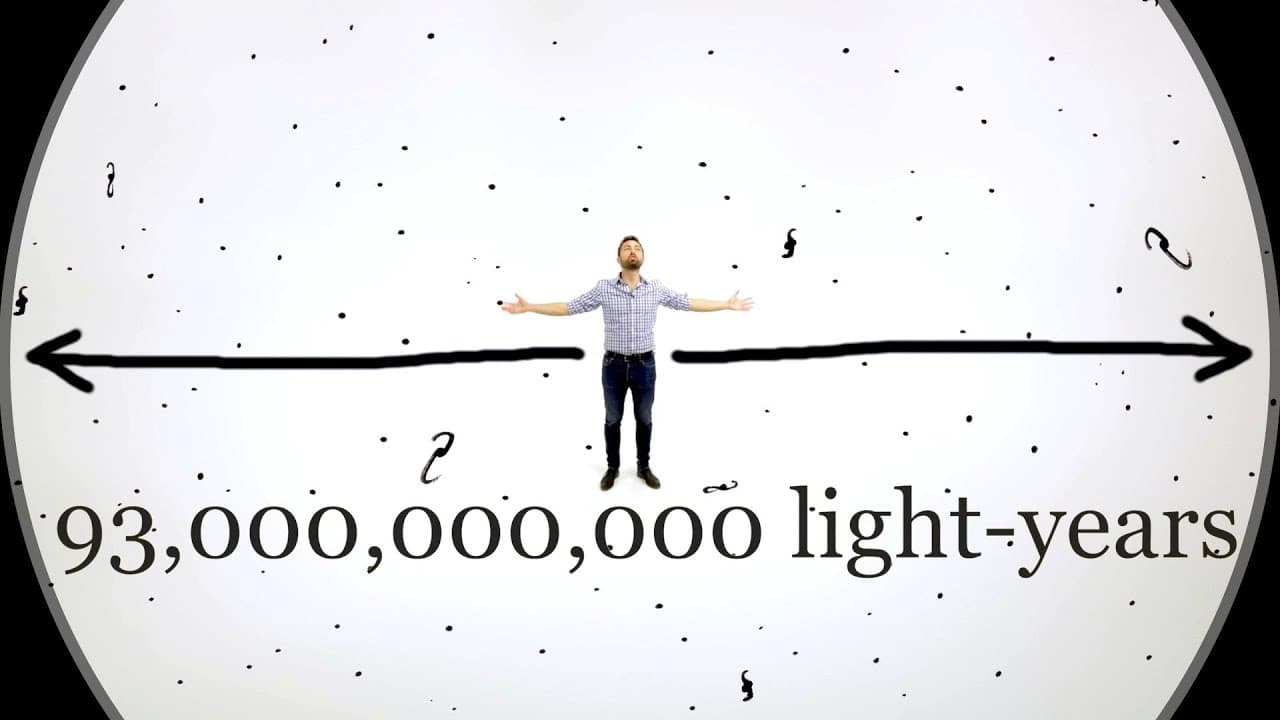
- 🙂 The diameter of the observable universe is about 93 billion light-years, containing a vast volume of objects we can see.
- 🇧🇩 The singularity, representing the beginning of the universe, would only be true if the universe is finite, but if it is infinite, the Big Bang would have occurred everywhere.
Install to Summarize YouTube Videos and Get Transcripts
Explore YouTube Video Summarizer or Get YouTube Transcript Extractor
Questions & Answers
Q: Does the fact that the universe is expanding faster than light violate Einstein's theory of relativity?
No, because relativity states that nothing can move through space faster than light, but space itself can expand at any rate it likes.
Q: How can we see objects that are moving away from us faster than light?
The expanding Hubble sphere allows light from objects in superluminal regions of space to eventually enter a subluminal region and reach us.
Q: How far can we see in the universe?
The observable universe has a radius of over 46 billion light-years and a diameter of about 93 billion light-years, thanks to the expanding space and the time it takes for light to travel.
Q: If the universe is infinite, what is it expanding into?
The universe doesn't have to expand into anything, as it can expand into itself. Infinity allows for endless expansion.
Summary & Key Takeaways
-
The universe has always been expanding faster than the speed of light due to the expanding space between objects.
-
Hubble observations in the 1920s showed that the further out in space he looked, the faster objects were moving away from us.
-
Objects beyond our Hubble sphere, which are moving away from us faster than light, can still be seen as the expanding Hubble sphere allows their light to reach us.
Read in Other Languages (beta)
Share This Summary 📚
Summarize YouTube Videos and Get Video Transcripts with 1-Click
Try YouTube Summary with ChatGPT & Claude or YouTube Transcript Generator
Explore More Summaries from Veritasium 📚



Summarize YouTube Videos and Get Video Transcripts with 1-Click
Try YouTube Summary with ChatGPT & Claude or YouTube Transcript Generator